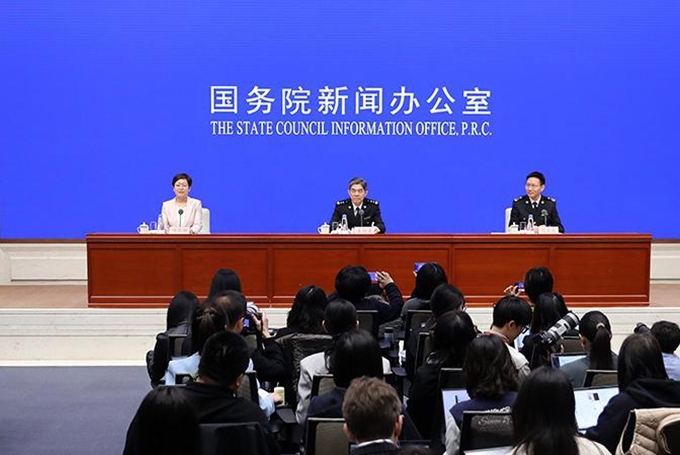
SCIO briefing on China's imports, exports in Q1 2025
China.org.cn | May 8, 2025

National Business Daily:
We have noticed that this year's government work report emphasizes that "we will promote Smart Customs development and cooperation to further simplify customs clearance procedures." Could you introduce the latest progress and the next key plans concerning the development of smart customs? Thank you.
Wang Lingjun:
The government work report has indeed put forward requirements for the development of smart customs for two consecutive years. I would like to invite Mr. Lyu to answer this question.
Lyu Daliang:
Thank you for your question. As Mr. Wang just mentioned, the government work report has made arrangements for the development of smart customs for two consecutive years. Over the past year, taking digital transformation and intelligent upgrade as the main paths, the GACC has on the one hand advanced the reform and innovation of supervision systems and the optimization of procedures and on the other hand has actively introduced cutting-edge technologies such as big data and AI, to promote the comprehensive transformation and upgrading of customs supervision services to ensure safety, facilitation and efficiency at the same time and to fully serve the high-quality development of foreign trade and support high-standard opening up.
At present, we have gradually established a smart customs framework system represented by nine major landmark projects, accelerated the construction, application and replication of various business scenario promotions, and made significant progress in safeguarding national security at the borders, facilitating smooth and convenient customs clearance, and promoting convenience for the people and enterprises.
For example, we have developed and applied intelligent gates for health and quarantine monitoring, integrating multiple functions such as temperature monitoring and infectious disease risk monitoring, providing a new seamless customs clearance experience for inbound and outbound travelers. We have increased the application of intelligent image review technology. By using intelligent models, we have achieved intelligent early warning, automatic targeting and precise interception of risks related to the safe entry and trade control of goods and items. This has reinforced China's border security and become a calling card of Chinese customs in the international customs community. We have implemented the model of remote video inspection for imported copper concentrate transported by rail. This approach ensures quality and safety control while enabling precision cargo sorting, effectively alleviating port congestion, improving customs clearance efficiency, and saving logistics costs for enterprises.
This year, in accordance with the arrangements of the government work report, we will further focus on smart customs development and cooperation.
In terms of development, our goal is to achieve overall integration and basic functionality. We will accelerate the development, implementation and application of various operation scenarios, focusing on integration, promote the transformation and upgrading of customs operations and optimization and the redesigning of procedures. This aims to create a new smart customs clearance experience characterized by "seamless clearance, intelligent supervision, minimal interruption and ubiquitous regulatory services."
In terms of cooperation, we will continue to deepen communication and cooperation with the WTO and WCO. We will continuously promote the development of a global online cooperation platform for smart customs, accelerate the creation of the BRICS Customs Demonstration Center, and facilitate more practical cooperation, contributing ideas and solutions to the modernization of global customs. Thank you.
Xing Huina:
Today's press conference is hereby concluded. Thank you to the speakers and journalists. Goodbye.
Translated and edited by Liao Jiaxin, Mi Xingang, Liu Caiyi, Liu Jianing, Xiang Bin, Yan Xiaoqing, Zhang Rui, Xu Kailin, Wang Qian, Fan Junmei, Huang Shan, Li Huiru, David Ball, and Jay Birbeck. In case of any discrepancy between the English and Chinese texts, the Chinese version is deemed to prevail.