Third group interview on the events commemorating the 80th anniversary of the victory in the Chinese People's War of Resistance Against Japanese Aggression and the World Anti-Fascist War
China.org.cn | October 10, 2025
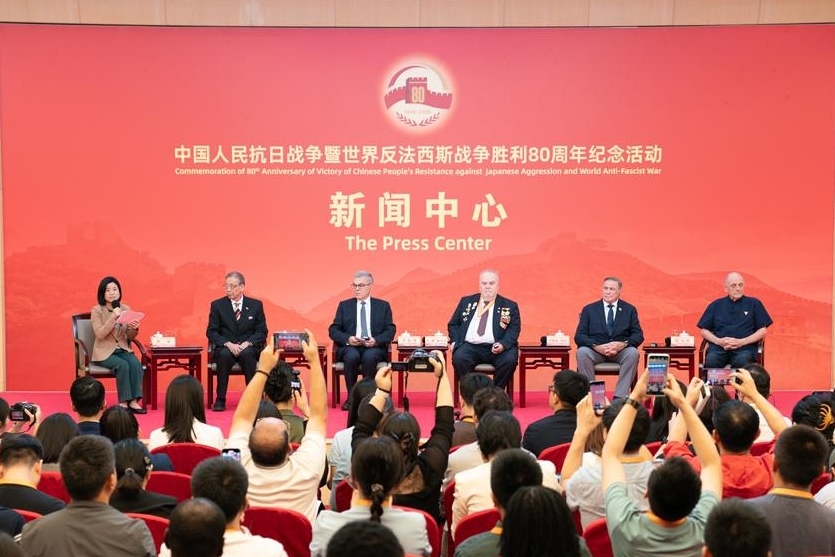

Public Establishment of Television (EPTV):
Before asking my question, I would like to take this opportunity to pay tribute to the Chinese people and to all the people around the world who devoted themselves to the Anti-Fascist War. My question is for Mr. Jean-Louis Bussière. Your father, Dr. Jean Jérome Augustin Bussière, took great risks during the war to deliver medicine and provide aid to the Chinese military and civilians during the War of Resistance. In your opinion, what belief supported him in making such heroic actions? On the occasion of the 80th anniversary of the victory in the War of Resistance Against Japanese Aggression, what do you think is the practical significance of your father's spirit? Thank you.
Jean-Louis Bussiere:
Thank you for your questions. My father came to China in 1913, and at that time he had no idea that he would spend the latter half of his life, more than 40 years, in China. His primary duty in coming to China was to devote himself to the modernization of the Chinese medical system. He held many important positions, such as professor at the famous Beiyang Medical School in Tianjin and a medical officer at the French Legation. He provided medical assistance to many high-ranking officials of the Chinese government. In 1918, he also supported the Chinese people in fighting an outbreak of the plague. In addition, my father served as the director of the St. Michel Hospital established by France in Beijing. During this period, he requested the expansion of the hospital to treat more Chinese patients. At that time, many foreign hospitals in Beijing refused to admit Chinese patients. My father thought it was very unfair, so he requested the expansion. He also provided medical services to many famous Chinese artists, such as Mei Lanfang and Qi Baishi, and treated many poor people.
As you may know, my father built a private mansion in the Western Hills of Beijing, known as Bussiere Garden. Later, he converted the Bussiere Garden into a clinic, providing free medical services to the local people. It can be said that my father wholeheartedly devoted himself to the Chinese people in the latter half of his life. He also actively trained doctors for China. He once served as a school doctor at Peking University, and was friends with Mr. Cai Yuanpei and Mr. Li Shizeng. Together, they initiated the work-study program in France, enabling outstanding Chinese students in various disciplines such as medicine, science and economics to pursue further studies in countries like France and Belgium. My father also participated in the founding of the Sino-French University. He participated in the establishment of the Aurora University School of Medicine in Shanghai, and served as its first dean, and long adhered to bilingual teaching in Chinese and French.
In addition to training doctors, my father made many efforts in the field of cultural exchange. My father could speak Chinese, and he, along with Mr. André d'Hormon, the translator-reviser of the French version of "Dream of the Red Chamber," organized cultural salons where many French and Chinese intellectuals exchanged ideas. They built a bridge of communication, understanding, and friendship between these two great civilizations.
Next, I will talk about my father's views on the Japanese invasion. As early as 1931, when the Japanese army invaded Manchuria (northeast China), my father witnessed the atrocities committed by the Japanese army. After the full outbreak of the war, he was deeply shocked. After the Lugouqiao Incident, he rushed to the front lines to treat the wounded. In letters to his French friends living in Beijing, he mentioned that he had treated some survivors of the Nanjing Massacre who had fled to Beijing. He was deeply angered by the atrocities committed by the Japanese and believed it was unacceptable. He felt it was only right to help the Chinese people resist the Japanese invasion.
You may still remember the Bussiere Garden I just mentioned. My father converted it into a temporary relief center, where he participated in organizing the treatment and transportation of critically injured patients. Later, some anti-Japanese resistance figures found him, hoping he could help with the transportation of medicine to resistance bases. My father agreed without hesitation. At first, my father was able to drive a car with diplomatic license plates through the Japanese blockades, using his identity as a medical officer in the French Legation as cover. But later, as the war situation became increasingly tense, gasoline became a controlled material, and my father resolutely switched to using a bicycle to transport medicine. He was already 71 years old at the time, traveling back and forth between his residence in the city and the Western Hills, secretly transporting a large amount of medicine to the resistance bases, including even radio batteries. It can be said that during the Chinese People's War of Resistance Against Japanese Aggression, my father always firmly stood on the side of the Chinese people, helping them repel the Japanese invaders.
My father's spirit embodies practical significance on two levels. First, his heroic deeds further enriched the special relationship between China and France. I still remember back in 2014, when China and France commemorated the 50th anniversary of the establishment of diplomatic relations and President Xi Jinping visited France. At the commemorative meeting, President Xi Jinping delivered an important speech in which he mentioned my father, Jean Augustin Bussiere. He recalled how my father risked his life to blaze a “hump route” on his bicycle, carrying precious medicine to the base of anti-Japanese aggression in China. During the visit, President Xi Jinping also toured the Charles de Gaulle Foundation, where I had the honor of receiving him in a cordial meeting.
In fact, in Beijing, there are many Chinese citizens who received medical treatment from my father, and their descendants have also shared with me stories of his deeds. Today, the Jardin Bussiere has become a hub for people-to-people exchanges between France and China. This highlights the special ties between the two countries.
The second level is to bravely demonstrate the spirit of resistance — never giving up and standing firm in defending our homeland against the ravages of war. Moreover, we should respect cultural differences, value cultural diversity, and uphold solidarity among the peoples of different countries. I think this is the significance of reflecting on this period of history, especially as we commemorate the 80th anniversary of the victory in the Chinese People's War of Resistance against Japanese Aggression. Thank you.