Third group interview on the events commemorating the 80th anniversary of the victory in the Chinese People's War of Resistance Against Japanese Aggression and the World Anti-Fascist War
China.org.cn | October 10, 2025
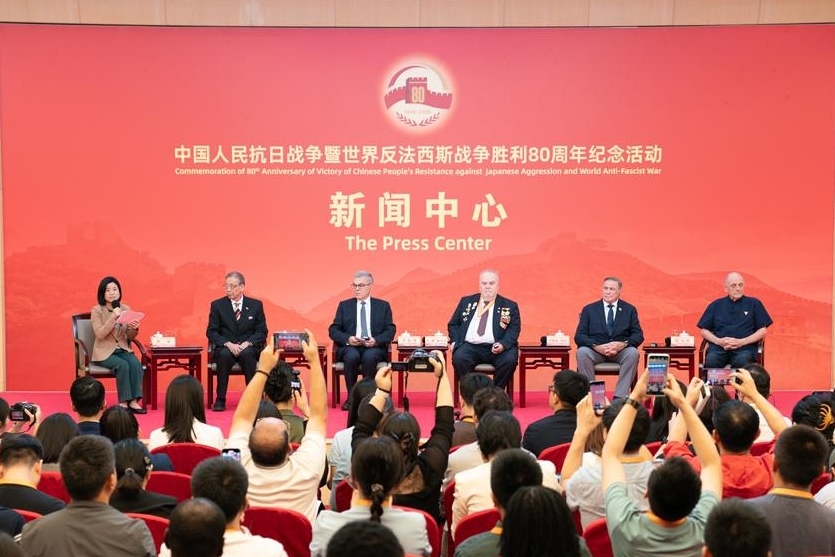

Tatoli, the National News Agency of East Timor:
My question is for Mr.Yokichi Kobayashi and Mr. Chuikov. We know both of you are descendants of soldiers, and through the stories of your relatives, you have a deeper understanding of the brutality of war. What is the importance and meaning of this hard-won peace, and how do this year's commemorative activities inspire both the people of your country and those of other nations? Thank you.
Yokichi Kobayashi:
Thank you for your question. My father, Kiyoshi Kobayashi, was originally a soldier in the Independent Mixed Fifth Brigade of the Japanese Expeditionary Forces in China. In 1939, he came to China, landed in Qingdao, and then was stationed on the Jiaodong Peninsula in eastern Shandong province. In 1940, he was wounded and captured while fighting with the Eighth Route Army. After being captured, he fell into despair and was very distressed. He once tried to escape, but there was no road in the mountainous area, he was caught once again. At that time, the Eighth Route Army also captured another Japanese soldier, who happened to be my father's superior, named Seko. Seko was shocked when he saw my father and asked, "Kiyoshi Kobayashi, how are you still alive?" We already sent your ashes back to Japan, and sent a notice of death in battle to your family, stating that you died in battle in Wendeng County, Shandong province, China. When my father heard that he had no chance of returning to the army or even home, he gave up the idea of fleeing.
At that time, Zhong Xidong, director of the General Political Department of the Eighth Route Army, spoke to him through a translator: Comrade Kobayashi, if you wish to return to the Japanese army, we can arrange it. However, having been held as a prisoner of war by the Eighth Route Army for so long, you will undoubtedly face trial by the Japanese military court upon your return, which would be an irresponsible decision on your part. After hearing his words, my father realized that the Eighth Route Army did not see him as an enemy. Instead, they gave him freedom and equal treatment, respected his personal dignity, and considered him a friend, a brother and a comrade. He was later sent to the Yan'an Japanese Worker and Peasant School, where he was re-educated and changed his perspectives. He quickly understood that Japan's war was an unjust act of aggression, and realized that to permanently end such wars and free the people of both Japan and China from Japanese imperialist oppression, it was necessary to follow the path of the Communist Party of China and the Eighth Route Army. He seriously reflected on himself and wrote an article titled "My Reflections," which was published in the Dazhong Newspaper on July 23, 1944, in the Shandong Anti-Japanese Base Area. This is a copy of that newspaper from that year.
My father gradually became famous in the Jiaodong Anti-Japanese Base Area, and the local military and civilians affectionately called him "Japanese Eighth Route". After that, he joined the Chinese people in the War of Resistance, fighting against the Japanese invaders. He also wrote articles in newspapers many times. My father deeply loved China and cared greatly for the Chinese people. He fought alongside the Eighth Route Army against the Japanese invaders. This part of his life was not only a proud and honorable chapter for him but also a great source of pride for me and my family. Thank you.
Zhou Li:
Thank you, Mr. Kobayashi. Please let Mr. Chuikov answer this question.
Nikolai Vladimirovich Chuikov:
Talking about atrocities is impossible to be pleasant. My grandfather participated in six wars in his lifetime. He always said that the duty of a soldier is not to fight, but to defend peace, In the postwar period, he was very concerned about the issue of peaceful development. After 1945, he worked in Berlin for another eight years. Do you know what the first military order was after the Soviet army captured Berlin? It was General Marshal Vasily Chuikov's order to distribute food to ordinary civilians. This was an order for peace. My grandfather was stationed in Berlin at that time and was the first to execute it.
I once thought that nothing could be more heinous than what the Nazis did. They killed hundreds of thousands of people in concentration camps. Later, I came to understand the Nanjing Massacre, realizing that the atrocities committed by the Japanese army were as horrific as those crimes committed by the Nazis. Two Japanese officers engaged in a killing contest, initially aiming to kill 100 people, but later increasing the target to 150 because they felt the original number was too low. Such cruelty is beyond the limits of human decency. During the Nanjing Massacre, tens of thousands of Chinese women were raped, while those who tried to protect their families were killed by Japanese soldiers with bayonets and bullets, which is outrageous. The world must know and remember this chapter of history. War has rules. Soldiers wearing epaulettes on their shoulders must not turn their guns or bayonets against civilians, but are instead obliged to protect them.
The veterans committee has subcommittees in different countries, including a Chinese subcommittee and a German subcommittee. The German subcommittee is composed of German anti-fascist individuals, and there are still more than 600 members, which is a considerable number.
After all that has been said, I still want to say that we must remember history and never let such brutal acts happen again. Thank you.