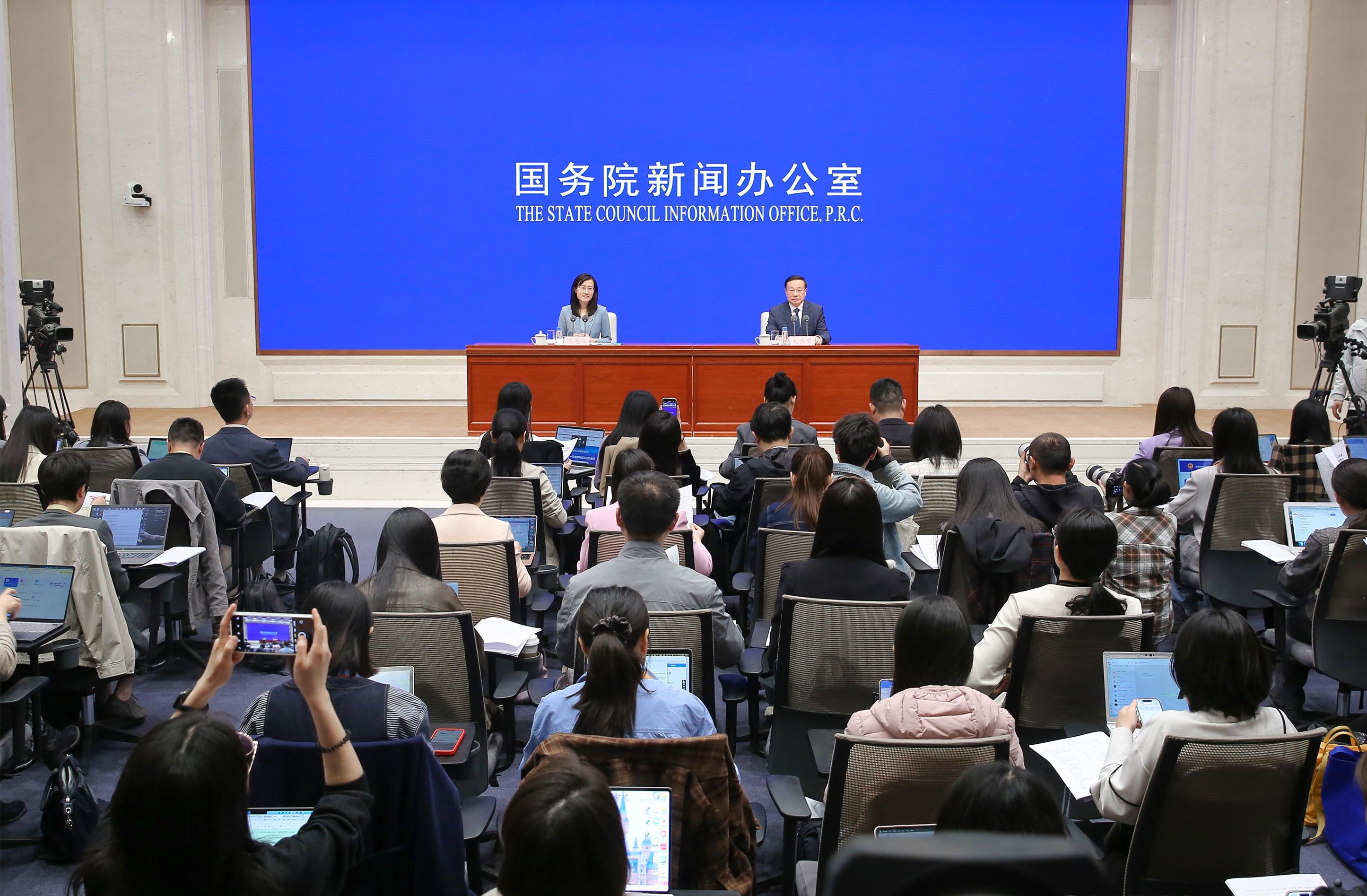
China.org.cn | July 28, 2026


Speaker:
Mr. Mao Shengyong, deputy commissioner of the National Bureau of Statistics (NBS)
Chairperson:
Ms. Jia Huili, deputy director general of the Press Bureau of the State Council Information Office (SCIO)
Date:
April 16, 2026
Jia Huili:
Ladies and gentlemen, good morning. Welcome to this press conference held by the State Council Information Office (SCIO). This is a regular briefing on China's economic data. Today, we are pleased to have with us Mr. Mao Shengyong, deputy commissioner of the National Bureau of Statistics (NBS), who will brief you on China's economic performance in the first quarter of 2026 and take your questions.
Now, I'll give the floor to Mr. Mao.
Mao Shengyong:
Thank you, Ms. Jia. Friends from the media, good morning. I will begin by briefing you on China's economic performance in the first quarter, and then take your questions.
The national economy got off to a good start in the first quarter.
In the first quarter, under the strong leadership of the Communist Party of China (CPC) Central Committee with Comrade Xi Jinping at its core, all regions and departments fully implemented the decisions and arrangements made by the CPC Central Committee and the State Council, accelerated carrying out more proactive and effective macro policies, focused on keeping employment, enterprises operations, markets and expectations stable, and expedited the cultivation of new quality productive forces. As a result, the growth of production and supply accelerated, market demand continued to improve, employment was generally stable, market prices picked up moderately, and high-quality development advanced with new and positive momentum. The national economy got off to a good start with development showing greater resilience and vitality.
According to preliminary estimates, gross domestic product (GDP) in the first quarter reached 33,419.3 billion yuan (about $4.87 trillion), up by 5.0% year on year at constant prices, 0.5 percentage point faster than that of the fourth quarter of 2025. By industry, the value added of the primary industry was 1,194.1 billion yuan, up by 3.8% year on year; that of the secondary industry was 11,613.5 billion yuan, up by 4.9%; and that of the tertiary industry was 20,611.7 billion yuan, up by 5.2%. GDP in the first quarter grew by 1.3% quarter on quarter.
First, agricultural production showed good momentum and animal husbandry was generally stable.
In the first quarter, the value added of agriculture (crop farming) increased by 3.7% year on year. The winter wheat maintained a stable sown area with seedlings continuing to grow in good conditions, and the spring farming and preparation work progressed smoothly. According to the national planting intention survey, the intended sown area for grains was generally stable. Specifically, the area for rice was basically the same and the area for corn remained stable with a slight increase. In the first quarter, the output of pork, beef, mutton and poultry was 26.62 million metric tons, up by 4.8% year on year. Of this total, the output of pork and poultry grew by 4.2% and 9.3%, respectively, while that of beef and mutton dropped by 1.4% and 2.0%, respectively. The output of milk grew by 3.4%, and that of eggs dropped by 3.1%. In the first quarter, the number of pigs slaughtered was 200.26 million, up by 2.8% year on year. By the end of the first quarter, the number of pigs registered in stock was 423.58 million, up by 1.5%.
Second, industrial production accelerated, and equipment manufacturing and high-tech manufacturing grew quickly.
The total value added of industrial enterprises above designated size grew by 6.1% year on year in the first quarter, 1.1 percentage points faster than that of the fourth quarter of 2025. In terms of sectors, the value added of mining increased by 6.0% year on year, that of manufacturing increased by 6.4%, and that of production and supply of electricity, heat power, gas and water increased by 4.3%. The value added of equipment manufacturing and high-tech manufacturing went up by 8.9% and 12.5% year on year, respectively, 2.8 percentage points and 6.4 percentage points faster than that of industrial enterprises above designated size, respectively. In terms of ownership, the value added of state holding enterprises went up by 4.8% year on year; that of share-holding enterprises went up by 6.6%; that of enterprises funded by foreign investors or investors from Hong Kong, Macao and Taiwan went up by 3.9%; and that of private enterprises went up by 6.1%. In terms of products, the production of 3D printing devices, lithium-ion batteries and industrial robots grew by 54.0%, 40.8% and 33.2% year on year, respectively. In March, the value added of industrial enterprises above designated size went up by 5.7% year on year, or up by 0.28% month on month. In March, the Manufacturing Purchasing Managers' Index (PMI) stood at 50.4%, 1.4 percentage points higher than that of the previous month. The Production and Operation Expectation Index was 53.4%. In the first two months, the total profits made by industrial enterprises above designated size were 1,024.6 billion yuan, up by 15.2% year on year.
Third, the service sector grew quickly and modern services maintained good growth momentum.
In the first quarter, the value added of services went up by 5.2% year on year. Specifically, the value added of leasing and business services, information transmission, software and information technology services, finance, transport, storage and postal services, and accommodation and catering grew by 12.2%, 10.6%, 6.5%, 4.3% and 4.3%, respectively. In March, the Index of Services Production increased by 5.0% year on year. Specifically, the Index of Services Production of information transmission, software and information technology services, leasing and business services and finance went up by 11.8%, 10.1% and 6.7% respectively. In the first two months, the business revenue of service enterprises above designated size grew by 7.4% year on year. In March, the Business Activity Index for Services stood at 50.2%, 0.5 percentage point higher than that of the previous month; and the Business Activity Expectation Index for Services was 54.8%. Specifically, the Business Activity Index for industries including railway transportation, telecommunication, broadcast, television and satellite transmission services, monetary and financial services, and insurance stayed within the high expansion range of 55.0% and above.
Fourth, market sales accelerated and retail sales of services grew quickly.
In the first quarter, total retail sales of consumer goods reached 12.7695 trillion yuan, up 2.4% year on year, 0.7 percentage point faster than in the fourth quarter of the previous year. By location, retail sales of consumer goods in urban areas reached 11.0574 trillion yuan, up 2.3% year on year, while those in rural areas reached 1.7121 trillion yuan, up 3.1%. Grouped by consumption patterns, retail sales of goods hit 11.3072 trillion yuan, up 2.2%, while catering income reached 1.4623 trillion yuan, up 4.2%. Sales of basic living goods and certain upgraded goods grew quickly. Among enterprises above designated size, retail sales rose 10% year on year for grain, oil and food, 9.3% for clothes, shoes, hats and textiles, 20.8% for communication equipment, and 12.6% for gold, silver and jewelry. In March, total retail sales of consumer goods rose 1.7% year on year and 0.14% month on month. In the first quarter, retail sales of services increased 5.5% year on year, unchanged from last year's full-year growth rate. Specifically, retail sales of communication information services, tourism consultation and rental services, and cultural, sports and leisure services all grew quickly. In the first quarter, online retail sales of goods and services reached 4.9774 trillion yuan, up by 8% year on year. Specifically, online retail sales of goods reached 3.1614 trillion yuan, up 7.5%, accounting for 24.8% of total retail sales of consumer goods, while online retail sales of services totaled 1.8160 trillion yuan, up 8.8%.
Fifth, fixed-asset investment maintained steady growth and infrastructure investment grew quickly.
In the first quarter, national fixed-asset investment (excluding rural households) reached 10.2708 trillion yuan, up 1.7% year on year, while for the full year of last year, it had declined by 3.8%. Excluding investment in real estate development, national fixed-asset investment rose 4.8%. By sector, infrastructure investment grew 8.9% year on year, investment in manufacturing rose 4.1%, and investment in real estate development fell 11.2%. The floor space of new commercial buildings sold totaled 195.25 million square meters, down 10.4% year on year, while sales of new commercial buildings totaled 1.7262 trillion yuan, down 16.7%. By industry, investment in the primary industry climbed 15.9% year on year, investment in the secondary industry was up 5.8%, and investment in the tertiary industry fell 1%. Private investment fell 2.2% year on year, with the decline narrowing 4.2 percentage points from a year earlier. Excluding real estate development, private investment rose 1.3%. Investment in high-tech industries rose 7.4% year on year. Within that, investment in computer and office equipment manufacturing rose 28.3%, investment in aircraft, spacecraft and equipment manufacturing climbed 19%, and investment in information services grew 20.9%. In March, fixed-asset investment (excluding rural households) rose 0.52% month on month.
Sixth, imports and exports of goods grew quickly and the trade structure continued to improve.
In the first quarter, the total value of goods imports and exports reached 11.8380 trillion yuan, up 15% year on year. The total value of exports reached 6.8467 trillion yuan, up 11.9%, while the total value of imports hit 4.9913 trillion yuan, up 19.6%. General trade imports and exports increased 9% year on year. Imports and exports with Belt and Road partner countries rose 14.2%. Imports and exports by private enterprises rose 16.2%, accounting for 57.3% of the total value of imports and exports. Exports of mechanical and electrical products increased 18.3%. In March, the total value of imports and exports reached 4.1046 trillion yuan, up 9.2% year on year.
Seventh, consumer prices rose faster while producer prices for industrial products continued to recover.
In the first quarter, the consumer price index (CPI) rose 0.9% year on year, 0.4 percentage point higher than in the fourth quarter of 2025. By category, prices for food, tobacco, alcohol and dining out rose 0.5% year on year; clothing climbed 1.8%; housing declined 0.2%; articles and services for daily use increased 2.3%; transportation and communication fell 1.1%; education, culture and recreation grew 1%; medical services and health care rose 1.8%; and other articles and services jumped 14.1%. Within the category of food, tobacco, alcohol and dining out, pork prices fell 11.3%, grain prices declined 0.3%, fresh fruit prices climbed 4.3% and fresh vegetable prices jumped 7.6%. Core CPI, excluding food and energy prices, grew 1.2% year on year. In March, the CPI rose 1% year on year and fell 0.7% month on month.
In the first quarter, producer prices for industrial products fell 0.6% year on year, with the decline narrowing by 1.5 percentage points from the fourth quarter of last year. Within that, the PPI rose 0.5% year on year in March, compared with a decline of 0.9% in the previous month, and rose 1% month on month. In the first quarter, purchasing prices for industrial products nationwide fell 0.5% year on year. In March, prices rose 0.8% year on year, compared with a decline of 0.7% the previous month, and rose 1.2% month on month.
Eighth, employment remained generally stable and the surveyed urban unemployment rate was unchanged year on year.
In the first quarter, the average surveyed urban unemployment rate nationwide was 5.3%, unchanged from the same period last year. In March, the surveyed urban unemployment rate was 5.4%. The surveyed unemployment rate of the population with local household registration was 5.4%, while that for the population with non-local household registration was 5.3%. Among non-local workers, those with agricultural household registration had a surveyed unemployment rate of 5.7%. The surveyed urban unemployment rate in 31 major cities was 5.3%. Employees of enterprises worked an average of 48.1 hours per week. By the end of the first quarter, the number of rural migrant workers totaled 188.38 million, up 0.2% year on year.
Ninth, resident income continued to grow, with rural residents' income growing faster than that of urban residents.
In the first quarter, nationwide per capita disposable income was 12,782 yuan, up 4.9% in nominal terms year on year, or 4% in real terms after adjusting for price factors. By place of residence, per capita disposable income of urban residents was 16,549 yuan, posting nominal growth of 4.2% year on year and real growth of 3.2%. Per capita disposable income of rural residents was 7,433 yuan, registering nominal growth of 6.1% year on year and real growth of 5.4%. By income source, nationwide per capita salary income rose 4.9%, net business income increased 6.6%, net property income climbed 1.6% and net income from transfers jumped 5.1% in nominal terms. Median nationwide per capita disposable income was 10,433 yuan with nominal growth of 5% year on year.
Overall, China's national economy got off to a solid start in the first quarter, with major macroeconomic indicators rebounding and new growth drivers emerging rapidly. However, the external environment is becoming more complex and volatile, the imbalance between strong supply and weak demand remains prominent, and the foundation for economic improvement still needs strengthening. Going forward, we must follow the guidance of Xi Jinping Thought on Socialism with Chinese Characteristics for a New Era, fully implement the decisions and plans of the CPC Central Committee and the State Council, and fully and faithfully apply the new development philosophy on all fronts. We will move faster to foster a new development pattern, work to promote high-quality development, and adhere to the general principle of pursuing progress while ensuring stability. We will implement more proactive and effective macroeconomic policies, continuously expand domestic demand, improve supply and optimize the allocation of new resources while making the best use of existing ones. We will also focus on keeping employment, enterprise operations, markets and expectations stable, and continuously consolidate and expand the momentum of steady economic growth.
That's all from me. Thank you.
Jia Huili:
Thank you for your introduction, Mr. Mao. The floor is now open for questions. Please identify the media outlet you represent before asking questions.