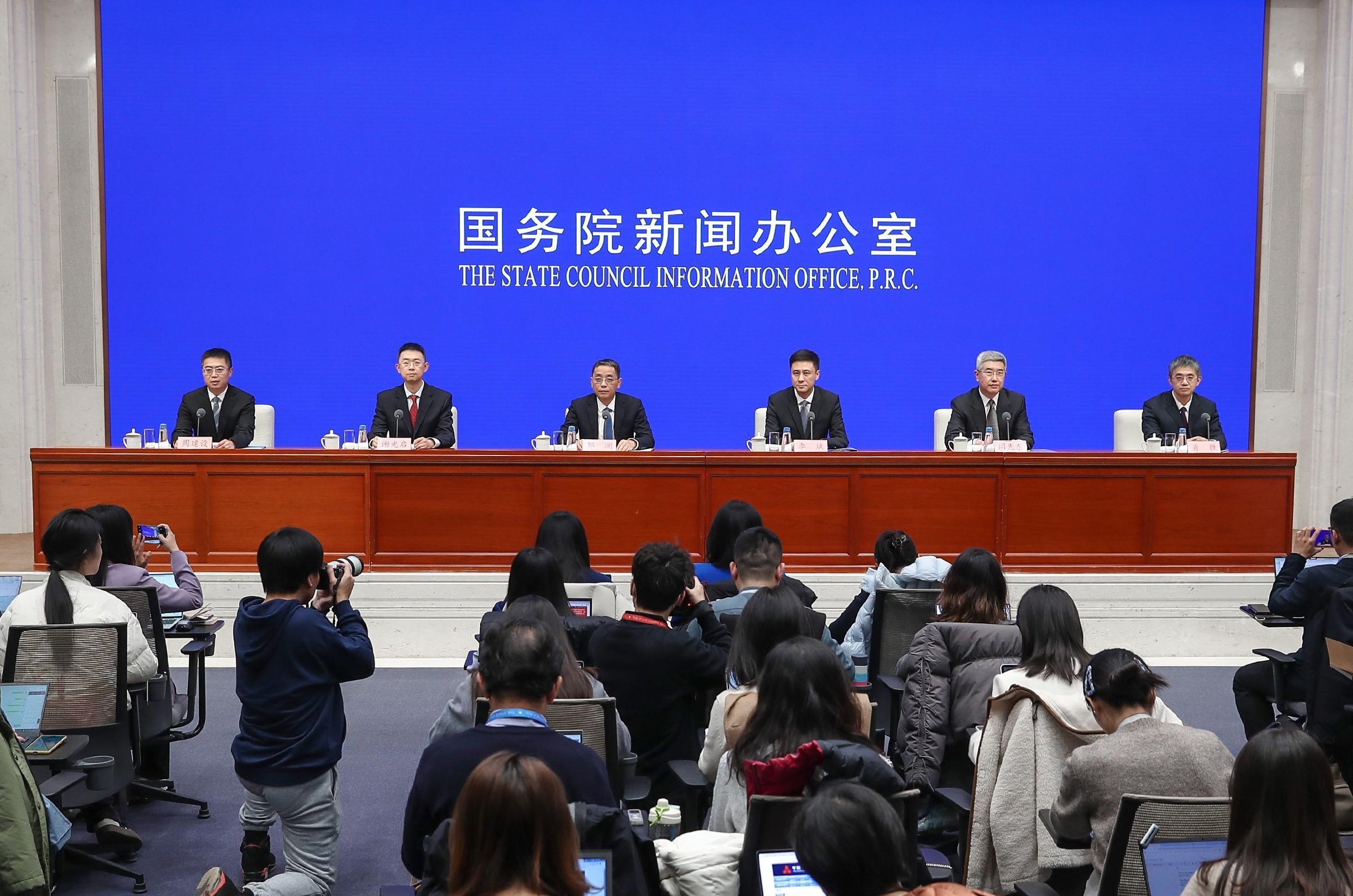
China.org.cn | February 5, 2026


Dingduan News:
According to recent data, M2 and total social financing have maintained steady growth. What were the key characteristics of social financing scale and M2 growth in 2025? Thank you.
Zou Lan:
Thank you. For this final question, I would like to invite Mr. Yan to respond.
Yan Xiandong:
Thank you for your question. Since the start of 2025, the PBC has implemented a moderately loose monetary policy, maintaining ample liquidity. Growth in aggregate financing to the real economy (AFRE) and in M2 have both remained relatively high. By the end of 2025, China's AFRE and M2 increased 8.3% and 8.5% year on year, respectively, with growth rates approximately 1.3 and 1.5 percentage points higher than the projected targets for economic growth and the CPI.
AFRE maintained reasonable growth, adequately meeting the funding needs of the real economy. In 2025, AFRE increased by 35.6 trillion yuan. First, in terms of composition, direct financing within the AFRE increment reached 16.7 trillion yuan, accounting for 46.9%. This was 7.8 percentage points higher than in 2020, the final year of the 13th Five-Year Plan period. Specifically, net government bond financing totaled 13.84 trillion yuan, up 2.54 trillion yuan from the previous year. Net non-financial corporate bond financing reached 2.39 trillion yuan, up 482.5 billion yuan from the previous year. This was achieved by leveraging financing support tools for private enterprise bonds and launching the "sci-tech board" in the bond market, an innovative initiative to enhance support for technological innovation and private enterprises. Additionally, through policies and measures to support the capital market and stabilize market expectations, non-financial corporate equity financing reached 476.3 billion yuan, up 186.3 billion yuan from the previous year. Second, yuan loans issued by financial institutions to the real economy maintained reasonable growth, increasing by 15.91 trillion yuan for the year. In addition, off-balance-sheet financing improved, with trust loans, entrusted loans, and undiscounted bankers' acceptance bills increasing by a total of 499.7 billion yuan for the year, up 489.1 billion yuan year on year.
M2 growth accelerated, continuing to create a favorable monetary and financial environment for economic recovery and improvement. At the end of 2025, M2 stood at 340.29 trillion yuan, up 8.5% year on year, 0.5 percentage point higher than the previous month and 1.2 percentage points higher than the same period last year.
Deposits are a major component of M2. Therefore, let me provide an overview of deposit growth at financial institutions. In 2025, yuan deposits increased by 26.4 trillion yuan. Structurally, deposits exhibited the following characteristics: First, household deposits maintained steady growth, increasing 14.6 trillion yuan throughout the year, up 381.2 billion yuan year on year. Second, non-financial corporate deposits grew rapidly, increasing 2.3 trillion yuan for the year, 2.6 trillion yuan more than the previous year. Of this, demand deposits rose 5.3 trillion yuan year on year. Third, non-bank financial institution deposits increased significantly, rising 6.4 trillion yuan for the year, 3.8 trillion yuan more than the previous year.
Additionally, asset management products also had a certain impact on deposit composition. By the end of 2025, total assets of asset management products reached 119.9 trillion yuan, up 13.1% year on year. This included 34.5 trillion yuan in bank wealth management products, 40.8 trillion yuan in public funds, 22.8 trillion yuan in asset management trusts, and 21.6 trillion yuan in asset management products from insurance companies, securities firms, funds, futures companies, and financial asset investment companies combined. On the one hand, in 2025, funds raised by asset management products from households and non-financial enterprises increased by 4 trillion yuan and 1 trillion yuan, respectively, up 337.9 billion yuan and 200 billion yuan from 2024. On the other hand, among the underlying assets of asset management products in 2025, deposits and certificates of deposit increased by 4.6 trillion yuan, accounting for 50% of total new underlying assets. This also contributed to the increase in deposits of non-bank financial institutions.
Next, in accordance with the arrangements of the Central Economic Work Conference, the PBC will continue to implement a moderately loose monetary policy, keeping growth in AFRE and M2 in line with projected economic growth and CPI levels, providing strong financial support for a solid start to the 15th Five-Year Plan period.
That's all I have to say. Thank you!
Zhou Jianshe:
That concludes today's press conference. Thank you to all our speakers and to all our journalist friends. Goodbye!
Translated and edited by Zhang Rui, Liu Jianing, Wang Yanfang, Liu Caiyi, Li Xiao, Li Congrong, Xu Kailin, Yan Bin, Zhang Yuxin, Liao Jiaxin, Wang Wei, Fan Junmei, Liu Sitong, Huang Shan, Zhang Junmian, Ma Yujia, Li Huiru, David Ball, Jay Birbeck, and Tudor Finneran. In case of any discrepancy between the English and Chinese texts, the Chinese version is deemed to prevail.