China.org.cn | August 15, 2025


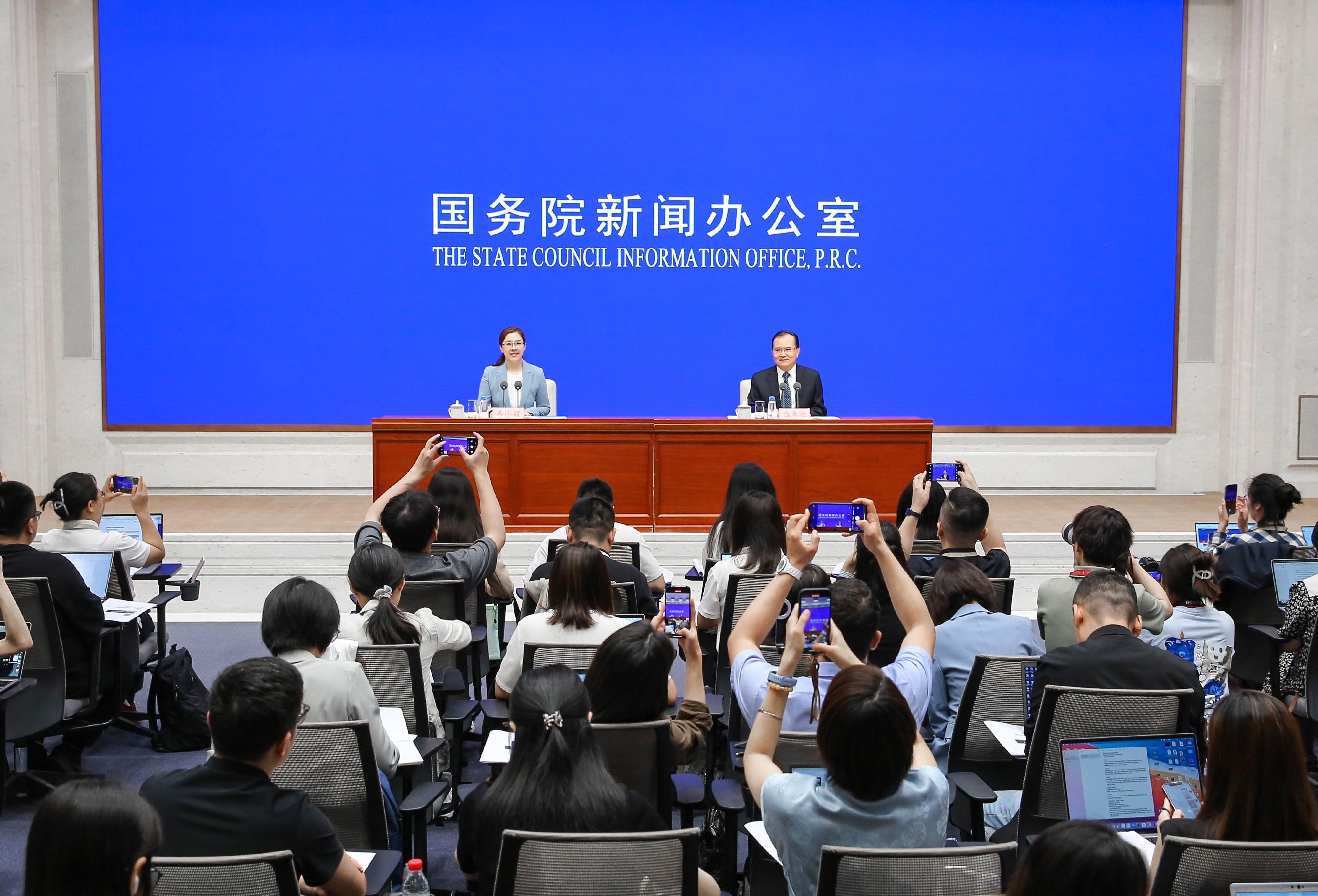

Speaker:
Mr. Sheng Laiyun, deputy commissioner of the National Bureau of Statistics (NBS)
Chairperson:
Ms. Shou Xiaoli, director general of the Press Bureau of the State Council Information Office (SCIO) and spokesperson of the SCIO
Date:
July 15, 2025
Shou Xiaoli:
Ladies and gentlemen, good morning. Welcome to this press conference held by the State Council Information Office (SCIO). Today, we are holding another regular briefing on economic data. We have invited Mr. Sheng Laiyun, deputy commissioner of the National Bureau of Statistics (NBS), to brief you on China's national economic performance in the first half of 2025 and to answer your questions.
Now, I'll give the floor to Mr. Sheng for his introduction.
Sheng Laiyun:
Thank you, Ms. Shou. Good morning, friends from the media. I am pleased to share with you the key data on China's national economic performance. As usual, I will first brief you on the economic performance in the first half of the year, and then take your questions.
In the first half of the year, China's national economy forged ahead despite challenges and maintained steady and positive momentum.
In the first half year, under the strong leadership of the Central Committee of the Communist Party of China (CPC) with Comrade Xi Jinping at its core, all regions and departments strictly implemented the decisions and arrangements made by the CPC Central Committee and the State Council, adhered to the general principle of pursuing progress while ensuring stability, fully and faithfully applied the new development philosophy on all fronts, accelerated efforts to create a new pattern of development, coordinated domestic economic work and endeavors in the international economic and trade field, and implemented more proactive and effective macro policies. As a result, the national economy withstood pressure and improved steadily despite challenges. Production and demand grew steadily, employment was generally stable, household incomes continued to increase, new growth drivers witnessed robust development and high-quality development made new strides, helping ensure overall social stability.
According to preliminary estimates, China's gross domestic product (GDP) in the first half of 2025 reached 66,053.6 billion yuan, up by 5.3% year on year at constant prices. By industry, the value added of the primary industry was 3,117.2 billion yuan, up by 3.7% year on year; that of the secondary industry was 23,905.0 billion yuan, up by 5.3%; and that of the tertiary industry was 39,031.4 billion yuan, up by 5.5%. By quarter, GDP increased by 5.4% year on year in the first quarter, and 5.2% in the second quarter. The GDP for the second quarter increased by 1.1% quarter on quarter.
First, summer grain witnessed stable production and a good harvest, and animal husbandry grew steadily.
In the first half of the year, the value added of agriculture (crop farming) registered a year-on-year increase of 3.7%. The overall output of summer grain was 149.74 million metric tons, 150,000 metric tons less than that of the previous year, or a decrease of 0.1%. In the first half of the year, the output of pork, beef, mutton and poultry was 48.43 million metric tons, up by 2.8% year on year. Of this total, the output of pork, beef and poultry grew by 1.3%, 4.5% and 7.4%, respectively, while that of mutton fell by 4.6%. The output of milk was up by 0.5% and that of eggs up by 1.5%. At the end of the second quarter, the number of pigs registered in stock was 424.47 million, up by 2.2% year on year; and 366.19 million pigs were slaughtered in the first half of the year, up by 0.6%.
Second, industrial production grew rapidly, and equipment manufacturing and high-tech manufacturing showed good growth.
In the first half of the year, the total value added of industrial enterprises above designated size grew by 6.4% year on year. In terms of sectors, the value added of mining increased by 6.0% year on year, that of manufacturing increased by 7.0%, and that of the production and supply of electricity, thermal power, gas and water increased by 1.9%. The value added of equipment manufacturing increased by 10.2% year on year, and that of high-tech manufacturing increased by 9.5%, which were 3.8 percentage points and 3.1 percentage points faster than that of industrial enterprises above designated size, respectively. In terms of ownership, the value added of state holding enterprises was up by 4.2% year on year; that of share-holding enterprises was up by 6.9%; that of enterprises funded by foreign investors or investors from Hong Kong, Macao and Taiwan was up by 4.3%; and that of private enterprises was up by 6.7%. In terms of products, the production of 3D printing devices, new energy vehicles and industrial robots grew by 43.1%, 36.2% and 35.6% year on year, respectively. In June, the value added of industrial enterprises above designated size went up by 6.8% year on year, or up by 0.50% month on month. In June, the Manufacturing Purchasing Managers' Index stood at 49.7%, which was 0.2 percentage point higher than that of the previous month; and the Production and Operation Expectation Index was 52.0%. In the first five months, the total profits made by industrial enterprises above designated size were 2,720.4 billion yuan, down by 1.1% year on year.
Third, the service sector grew faster, and modern services enjoyed sound development.
In the first half of the year, the value added of the service sector went up by 5.5% year on year, which was 0.2 percentage point faster than that in the first quarter. Specifically, the value added of information transmission, software and information technology services, leasing and business services, transport, storage and postal services, and wholesale and retail trade grew by 11.1%, 9.6%, 6.4% and 5.9%, respectively. In June, the Index of Services Production increased by 6.0% year on year. Specifically, the Index of Services Production of information transmission, software and information technology services, leasing and business services, finance, and wholesale and retail trade went up by 11.6%, 8.4%, 7.3% and 6.9%, respectively. In the first five months, the business revenue of service enterprises above designated size went up by 8.1% year on year. In June, the Business Activity Index for Services stood at 50.1%; and the Business Activity Expectation Index for Services was 56.0%. Specifically, the Business Activity Index for industries like postal services, telecommunication, broadcast, television and satellite transmission services, internet software and IT services, monetary and financial services, capital market services, and insurance stayed within the high expansion range of 55.0% and above.
Fourth, market sales growth picked up, with sales of higher-end consumer goods performing strongly.
In the first half of the year, total retail sales of consumer goods reached 24.5458 trillion yuan, up 5% year on year, accelerating 0.4 percentage point from the first quarter. By region, urban retail sales of consumer goods totaled 21.305 trillion yuan, up 5% year on year, while rural retail sales of consumer goods reached 3.2409 trillion yuan, up 4.9%. By consumption type, retail sales of goods totaled 21.7978 trillion yuan, up 5.1% year on year, while catering revenue reached 2.748 trillion yuan, up 4.3%. Sales of basic living goods and certain higher-end consumer products posted solid growth. Retail sales by enterprises above designated size rose 12.3% for grain, oil and food; 22.2% for sports and recreational articles; and 11.3% for gold, silver and jewelry. The consumer goods trade-in policy continued to show results, with retail sales by enterprises above designated size rising 30.7% for household appliances and audiovisual equipment, 25.4% for cultural and office supplies, 24.1% for furniture, and 22.9% for communication equipment. Online retail sales reached 7.4295 trillion yuan, rising 8.5% year on year. Specifically, online retail sales of physical goods totaled 6.1191 trillion yuan, increasing 6% and accounting for 24.9% of total retail sales of consumer goods. In June, total retail sales of consumer goods rose 4.8% year on year but fell 0.16% month on month. In the first half of the year, retail sales of services rose 5.3% year on year, 0.3 percentage point higher than the first quarter's pace.
Fifth, fixed-asset investment continued to expand, with manufacturing investment growing rapidly.
In the first half of the year, fixed-asset investment (excluding rural households) totaled 24.8654 trillion yuan, rising 2.8% year on year. Excluding real estate development, fixed-asset investment rose 6.6%. Specifically, infrastructure investment rose 4.6% year on year, manufacturing investment grew 7.5%, and real estate development investment fell 11.2%. Newly built commercial building sales totaled 458.51 million square meters of floor space, falling 3.5% year on year. Meanwhile, total sales reached 4.4241 trillion yuan, declining 5.5%. By industry, primary industry investment rose 6.5% year on year, secondary industry investment grew 10.2%, and tertiary industry investment fell 1.1%. Private investment declined 0.6% year on year but grew 5.1% excluding real estate development. Among high-tech industries, investment grew 37.4% in information services, 26.3% in aerospace vehicle and equipment manufacturing, and 21.5% in computer and office device manufacturing. In June, fixed-asset investment (excluding rural households) fell 0.12% month on month.
Sixth, imports and exports of goods continued to grow, with the trade structure improving further.
In the first half of the year, the total value of goods imports and exports was 21.7876 trillion yuan, rising 2.9% year on year. Exports totaled 13 trillion yuan, up 7.2%; imports totaled 8.7875 trillion yuan, down 2.7%. Imports and exports by private enterprises rose 7.3%, accounting for 57.3% of the total import-export value, 2.3 percentage points higher than the same period last year. Imports and exports with Belt and Road partner countries grew 4.7%. Exports of mechanical and electrical products increased 9.5%, accounting for 60% of the total export value. In June, the total value of imports and exports was 3.8527 trillion yuan, up 5.2% year on year. Specifically, the total value of exports was 2.3394 trillion yuan, up 7.2%, while imports totaled 1.5134 trillion yuan, up 2.3%.
Seventh, consumer prices were generally stable, and the core consumer price index (CPI) registered a moderate rebound.
In the first half of the year, the CPI fell 0.1% year on year. Grouped by commodity categories, prices for food, tobacco and alcohol dipped 0.3%; clothing climbed 1.3%; housing edged up 0.1%; articles and services for daily use remained unchanged; transportation and communication declined 2.9%; education, culture and recreation gained 0.8%; health care increased 0.3%; and other articles and services jumped 6.7%. In terms of food, tobacco and alcohol prices, fresh vegetable prices dropped 5.3%, grain declined 1.3%, fresh fruit climbed 2.7% and pork gained 3.8%. In June, the CPI rose 0.1% year on year and dipped 0.1% month on month. In the first half of the year, the core CPI excluding food and energy rose 0.4% year on year, 0.1 percentage point higher than that of the first quarter. The core CPI in June rose 0.7% year on year, 0.1 percentage point higher than the previous month.
In the first half of the year, the producer prices for industrial products decreased 2.8% year on year. Specifically, in June, it decreased 3.6% year on year and 0.4% month on month. Meanwhile, purchasing prices for industrial producers decreased 2.9% year on year in the first half. In June, they fell 4.3% year on year and 0.7% month on month.
Eighth, employment remained generally stable, with the surveyed urban unemployment rate declining slightly.
In the first half of the year, the surveyed urban unemployment rate averaged 5.2%, down 0.1 percentage point from the first quarter rate. In June, the surveyed urban unemployment rate was 5%. The surveyed unemployment rate of the population with local household registration was 5.1%. Meanwhile, the surveyed unemployment rate for the population with non-local household registration was 4.8%, of which the rate for the population with non-local agricultural household registration was also 4.8%. In 31 major cities, the surveyed urban unemployment rate was 5%. The average of weekly working hours for enterprise employees nationwide was 48.5 hours. By the end of the second quarter, the number of rural migrant workers totaled 191.39 million, up 0.7% year on year.
Ninth, personal income grew steadily, with rural residents' income growth outpacing that of urban residents.
In the first half of the year, per capita disposable income reached 21,840 yuan, representing a nominal increase of 5.3% year on year and a real increase of 5.4% after adjusting for price factors. By permanent residence, the per capita disposable income of urban residents was 28,844 yuan, growing 4.7% both nominally and in real terms year on year. Per capita disposable income of rural residents was 11,936 yuan, representing nominal growth of 5.9% year on year and real growth of 6.2%. By income source, nationwide per capita salary income grew 5.7%, net business income increased 5.3%, net property income gained 2.5% and net transfer income was up 5.6%, all in nominal terms. Nationwide median per capita disposable income was 18,186 yuan, up 4.8% year on year in nominal terms.
Overall, in the first half of the year, more proactive macroeconomic policies proved effective, with the economy continuing to develop steadily and positively, demonstrating strong resilience and vitality. However, we must also recognize that many external factors remain unstable and uncertain, domestic demand remains insufficient, and the foundation for economic recovery and improvement still needs to be consolidated. Moving forward, we must adhere to the guidance of Xi Jinping Thought on Socialism with Chinese Characteristics for a New Era and maintain the general approach of seeking progress while ensuring stability. We must fully and accurately implement the new development concept, accelerate the construction of a new development pattern, and coordinate domestic economic work with international economic and trade challenges. We must remain focused on our own priorities, further strengthen the domestic economic cycle, address external uncertainties through the certainty of high-quality development, and promote sustained, steady and healthy economic development.
That concludes my breakdown on the performance of the national economy in the first half of the year. I'm now happy to answer your questions.
Shou Xiaoli:
Thank you, Mr. Sheng, for your introduction. Let's give the floor to the media. Please state your news organization before asking your question.

