Full text: China's Achievements in Women's Well-Rounded Development in the New Era
Xinhua | September 19, 2025

II. Boosting the Well-Rounded Development of Women as a National Campaign
Women's cause is an integral part of state governance. To advance this cause, China has continued to strengthen institutional support and safeguards, fostering the necessary conditions and environment for the comprehensive development of women.
1. Improving the Framework for Advancing Women's Cause
China has established a mechanism for the work related to women, under which Party committees exercise leadership, governments assume primary responsibility, working committees on children and women play a coordinating role, women's federations work in collaboration, relevant departments provide support, and the whole of society participates. These concerted efforts have ensured that gender equality is upheld in all areas of economic and social development and all aspects of social life.
The people's congresses have strengthened legislation and supervision. The National People's Congress (NPC) has established the Social Development Affairs Committee to undertake legislation, conduct supervision, and handle proposals and suggestions from NPC deputies concerning the protection of women's rights and interests. It attaches importance to incorporating legal initiatives for promoting women's development and safeguarding women's rights and interests into the legislative plans of its Standing Committee, and to soliciting opinions and accepting feasible proposals from women's federations and women themselves during legislative review and legal supervision.
Additionally, the NPC hears and reviews the State Council's report on combating domestic violence, identifies the protection of female employees' lawful and special rights and interests as an important component of enforcement inspections of the Trade Union Law, and urges relevant departments to perform their statutory duties in protecting women's rights and interests. The people's congresses of 31 provinces, autonomous regions, and municipalities directly under the central government have also set up social development affairs committees to formulate local regulations to supplement national laws, thereby strengthening legal safeguards for women's rights and interests.
The Chinese People's Government has effectively fulfilled its primary responsibility. The government has formulated and organized the implementation of outlines for women's development, and convened meetings on work related to children and women. The working committees on children and women have played their role as deliberative and coordinating bodies, and Party institutions, government departments, judicial authorities, and people's organizations have fulfilled their responsibilities in work related to women. The government has strengthened the statistics monitoring mechanism for the outlines for the development of women in China and established a gender statistics monitoring system covering over 2,400 indicators. Furthermore, gender has been incorporated as a key metric into national censuses and time-use surveys, and the fourth Survey on Social Status of Women in China has been conducted to assess women's development across multiple dimensions.
The Chinese People's Political Consultative Conference (CPPCC) has strengthened its role in conducting consultations and offering suggestions. CPPCC committees at all levels perform their duties in political consultation, democratic supervision, and participation in the deliberation and administration of state affairs. They conduct consultations on women's issues through a variety of channels and platforms, including subject-specific, sector-specific and proposal handling consultations, as well as consultative meetings with relevant departments. As one of the 34 sectors defined by the CPPCC, women's federations conduct research and consultations on key issues and major challenges in women's development, such as the protection of women's reproductive and health rights and interests. The National Committee of the CPPCC has conducted consultations and made suggestions to support women's development, addressing issues including fair employment and career development, the strengthening of family ties, values, and traditions, and universal access to childcare services.
Women's federations have served as bridges for connection and communication. The All-China Women's Federation (ACWF) is a people's organization of women of all ethnic groups and from all sectors of society in China. It unites women for further emancipation and development under the leadership of the CPC. The ACWF has established an organizational system of women's federations at the national, provincial, prefectural, county, township and village levels, covering government departments, public institutions, new types of economic entities and social organizations, and groups in new forms of employment.
Women's federations at all levels have served as bridges linking the Party and the government with women, and as assistants to the Party. While supporting major national development strategies, they have performed their functions of guiding, serving, and engaging with women, and launched five key initiatives: providing women with political guidance; encouraging them to excel in the workplace; providing guidance and support in family education, family services, and the cultivation of family virtues; offering support for women's rights protection; and improving the problem-solving capability of women's federations and their staff's professional competence.
In addition, women's federations have mobilized resources to support women's development through six practical measures: supporting female volunteers who provide care for children in need; growing the scale and quality of female-dominated family services; improving vocational training for women; developing a system of childcare services that is accessible to all; advancing the Dream of the Future action of the Spring Bud Project to help underprivileged schoolgirls; and telling engaging stories about the development of Chinese women. Through these initiatives, they have delivered accessible services and tangible benefits to women, children and families.
2. Setting Objectives and Tasks for Women's Development with Overall Planning
China's national development plans have clarified the strategic tasks for women's development. Five-year plans are blueprints and guides of action for China's economic and social development during their designated time frames. The government has incorporated objectives for women's development into these plans for meeting its strategic goal of modernization.
The 12th Five-year Plan (2011-2015) for the first time included a section dedicated specifically to advancing women's all-round development. It also set requirements for developing human resources with a focus on women, strengthening labor protection for women, and resolutely combating violence and crimes against women. The 13th Five-year Plan (2016-2020) further strengthened the protection of women's rights and interests and for the first time devoted a separate chapter to ensuring women's rights and equal access to education, employment, and participation in social affairs, and eliminating discrimination and prejudice against women. It also set the targets for poverty alleviation and reduction among women. The 14th Five-year Plan (2021-2025) outlines further measures to safeguard women's rights and interests in areas including health, education, employment, participation in state governance, and social security. For the first time, it contains a section specifically dedicated to the strengthening of family development which focuses on improving the supporting policies and services for this goal.
Special plans in related fields have been made to address women's practical development needs. Plans for improving people's wellbeing – including the Outline of Healthy China 2030, the Outline of the Development Plan for Education (2024-2035), and the special plans for boosting employment and the development of civil affairs undertakings during the 14th Five-year Plan period – have put forward policies and measures to improve the health of women and children, safeguard women's equal rights to education, support women's employment, entrepreneurship, and career development, and improve care and services for rural women who stay behind to care for families while their husbands work in cities.
The National Medium- and Long-term Talent Development Plan (2010-2020) has outlined arrangements to promote gender balance in the talent pool and strengthen the training and selection of female talent. The National Action Plan for Scientific Literacy (2021-2035) has made specific arrangements to improve the scientific literacy of rural women. The National Human Rights Action Plan, in all four phases, includes a section on the measures for safeguarding women's rights and interests, covering personal, property, education, employment and health rights.
Outlines for women's development have laid out phased targets. Since 1995, China has formulated and implemented four outlines for women's development, each outlining the primary objectives, strategies, and measures for women's development in its corresponding phase.
The Outline of Women's Development in China (2021-2030) contains 75 primary objectives and 93 strategic measures across eight fields: health, education, economy, participation in decision-making and administration, social security, family development, environment, and the legal sector. The document also outlines the 41 Party and government departments and institutions responsible for implementing these strategic measures.
Nationwide, 31 provinces, autonomous regions, municipalities directly under the central government, and the Xinjiang Production and Construction Corps, along with over 300 prefectures and cities and more than 2,000 counties and districts, have formulated plans for local women's development based on their actual conditions. The objectives and tasks set in the Outline dovetail with national development plans, align with sector-specific plans, and are integrated across the national, provincial, city and county levels. A comprehensive planning system for advancing women's development is now firmly in place.
3. Strengthening Legal Guarantee for Women's Rights and Interests
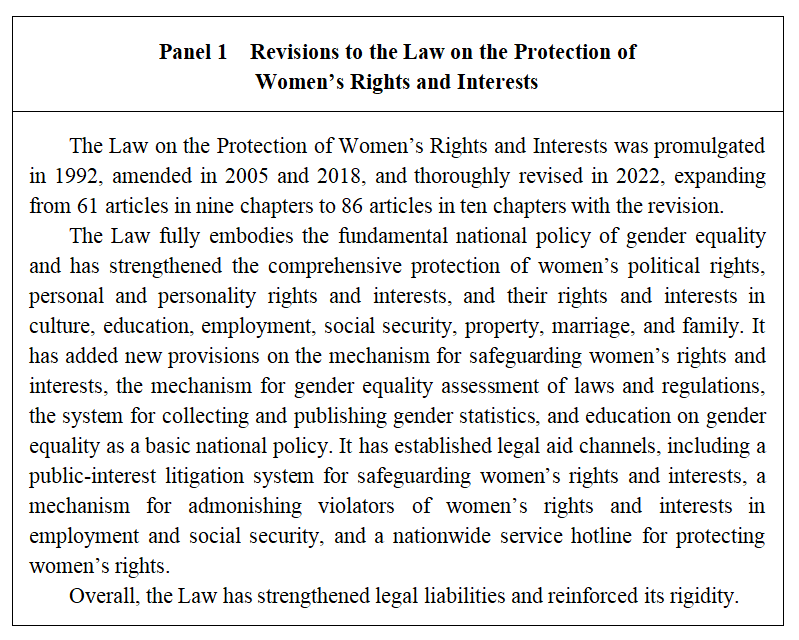
Continuing to improve the legal system. Legal protection of women's rights and interests is an integral part of advancing law-based governance. China has established a legal system anchored in the Constitution and centered on the Law on the Protection of Women's Rights and Interests, covering over 100 laws and regulations.
The Civil Code was compiled, which includes a Personality Rights section that clarifies the definition of sexual harassment and the responsibilities of employers. Its Marriage and Family section improves mechanisms for the identification and settlement of marital debts, and economic compensation for unpaid domestic work in divorce proceedings.
The Criminal Law has been revised to abolish the crime of "prostitution involving underage girls" and punish such acts as rape, raise the statutory minimum penalty for the crime of child molestation, and introduce harsher punishments for the crime of purchasing abducted and trafficked women. Additionally, the crime of sexual assault by a person with a duty of care has been added to the Criminal Law.
The amended Law on the Protection of Women's Rights and Interests has made more comprehensive and systematic provisions on the system and mechanism for protecting women's rights and interests. China has also formulated the Anti-Domestic Violence Law and created systems of compulsory reporting, admonition, personal safety protection order, and emergent protection.
The revised Law on Land Contract in Rural Areas has improved the legal guarantees for rural women's land rights and interests, ensuring their rightful entitlement to land and corresponding rights. The Law on Rural Collective Economic Organizations has been formulated to provide institutional safeguards ensuring that women do not lose their membership, rights and interests in such organizations due to changes in marital status.
In addition, the Legal Aid Law, the Law on Basic Medical and Health Care and the Promotion of Health, and the Population and Family Planning Law all have provisions for safeguarding women's rights and interests.
A gender equality review mechanism has been established at the national level and across all 31 provinces, autonomous regions, and municipalities directly under the central government. This mechanism conducts assessments of laws and regulations related to women's rights and interests, ensuring that the fundamental national policy of gender equality is implemented in laws and regulations at the source.
Strengthening law enforcement and judicial protection. China has taken resolute actions to combat criminal and illegal acts that infringe upon women's and girls' personal rights. Since 2013, public security agencies have continued to carry out special operations targeting the abduction and trafficking of women and children. By 2024, the number of such cases had decreased by 95 percent compared with 2013.
China has established an inter-departmental cooperation and consultation mechanism against domestic violence, issued guidelines on the implementation of admonitions against domestic violence and personal protection orders, and promulgated judicial interpretations clarifying specific interventions and prevention measures, and forms of evidence for identifying domestic violence.
The systems and measures for preventing and addressing workplace sexual harassment have been improved, with the addition of "dispute over liability for damages caused by sexual harassment" as an independent cause of action. To strengthen the protection of the personal rights and interests of girls, China has established a compulsory reporting system for cases of offenses against minors, as well as mechanisms for urging parental care and supervision over minors, for preventing violators from engaging in certain occupations, and for providing one-stop judicial support.
Procuratorates at all levels have registered and handled 3,810 public-interest cases concerning women's rights and interests. Since 2012, legal aid institutions across China have provided legal assistance for women involved in over 4.2 million cases, and free legal consultations for over 20 million women.
Raising public awareness of the rule of law. China continued to formulate and implement the seventh and eighth five-year plans for popularizing legal knowledge, both of which include laws and regulations on protecting women's lawful rights and interests. The country has strengthened law promotion and interpretation efforts, and the NPC Standing Committee has organized press conferences to expound on the principles in formulating and revising the Law on the Protection of Women's Rights and Interests and the Anti-Domestic Violence Law, and share their highlights.
Efforts have been made to raise public legal awareness through multiple channels and approaches. Since 2012, articles on protecting women's rights and interests published through the official WeChat account for law popularization have been viewed 91.36 million times, and the annual legal knowledge competition has attracted tens of millions of participants. The All-China Federation of Trade Unions has organized legal awareness activities for female employees for 11 consecutive years, and women's federations at all levels across China have held more than 3.76 million events to raise legal awareness and provide legal services since 2016, with the participation of over 400 million women.
In 2024, courts and procuratorates across the country, in conjunction with women's federations, organized more than 4,200 open day events on safeguarding the rights and interests of women and children and released over 3,800 typical cases. A legal education program for rural women reached more than 86 percent of China's rural areas.
4. Creating an Equal and Harmonious Social Environment
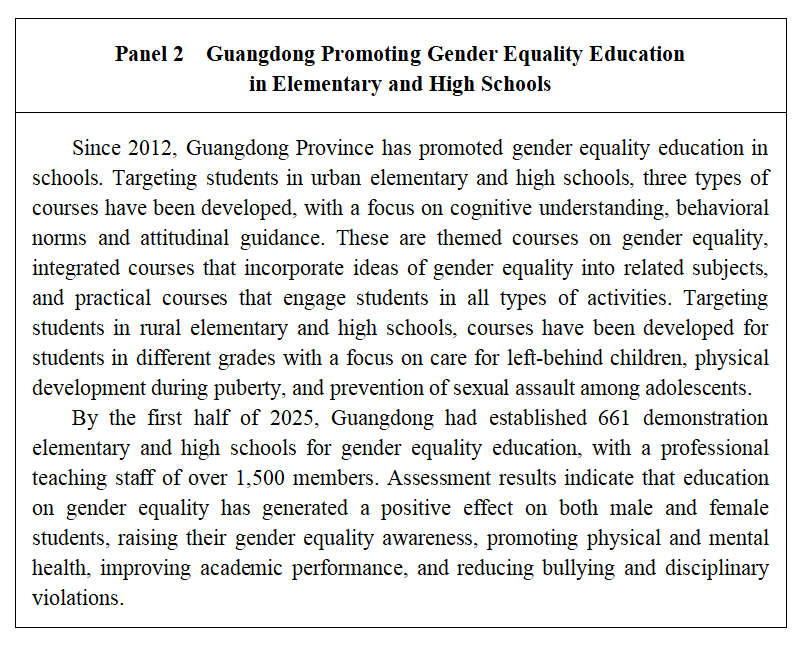
Vigorously promoting the fundamental national policy of gender equality. China has carried out targeted public education on gender equality across multiple dimensions and through multiple channels, promoting this basic national policy in government departments, schools, enterprises, urban and rural communities, and families.
For Party and government leaders, the Implementation of Gender Equality as a Basic National Policy has been compiled as a coursebook and incorporated into the curriculum and teaching plans of Party schools. For students, education on gender equality has been promoted in elementary and high schools, as well as in universities, and integrated into textbook planning and regulatory standards, and guides for related courses. Gender balance is emphasized in textbook illustrations, and excellent female writers have seen greater representation in textbooks, to eliminate gender stereotypes in teaching materials.
For the general public, gender equality has been incorporated into cultural and ethical development in both urban and rural communities, into self-regulations and rules for their residents, and into efforts to cultivate good family ties, values, and traditions. Party members and officials, experts, scholars, and those who work in women's affairs have given talks and lectures, and engaged in public communication on gender equality in approachable and popular forms, enabling the public to understand this basic national policy and apply it in their daily lives.
Strengthening the awareness of gender equality in the media. The Advertising Law and other relevant laws, as well as the Outline of Women's Development in China, all stipulate regulations regarding gender equality assessment and supervision in the media, prohibiting reports or advertisements with contents that disparage, undermine, or infringe upon women's dignity.
Gender equality reviews have been conducted throughout the script development, production, screening, and distribution of films and TV programs. News outlets have issued lists of prohibited and offensive terms to eliminate discriminatory expressions in news reports. Media organizations have implemented a social responsibility reporting system and upheld the professional ethic of safeguarding the lawful rights and interests of women, children, the elderly, and the disabled and protecting their physical and mental health.
The stories of women role models have been told through media coverage, special releases and events in recognition of their contribution, showcasing patriotism, devotion to the people, perseverance and progress in the face of challenges, and commitment to virtue and good deeds. Gender equality has now become a widely accepted social norm.
Creating a clean cyberspace. China has issued judicial interpretations, released exemplary cases, and carried out special operations to combat fraud, abduction, trafficking, rape, and other crimes against women and children committed or facilitated through online channels. Offenses that infringe upon women's personality rights, such as the illegal disclosure of personal information, defamation, and malicious online abuse, are strictly punished. Online platforms have taken on greater responsibility by addressing illegal and inappropriate content, including removing articles and short videos that advocate a preference for sons over daughters or exaggerate family disputes.
China has increased the supply of high-quality online content. Special campaigns have been launched to introduce new media products showcasing women in the new era and their commitment to the country, such as the theme song Blooms of China, the women's federation promotional video Together, and the family values promotional video I Love My Family. These products have reached hundreds of millions of women and families, and facilitated new progress in providing theoretical and political guidance to women.
Efforts have also been made to improve the digital literacy of the general public, foster responsible internet usage among women, tell engaging stories of China and Chinese women, spread mainstream values, and promote positive energy online.