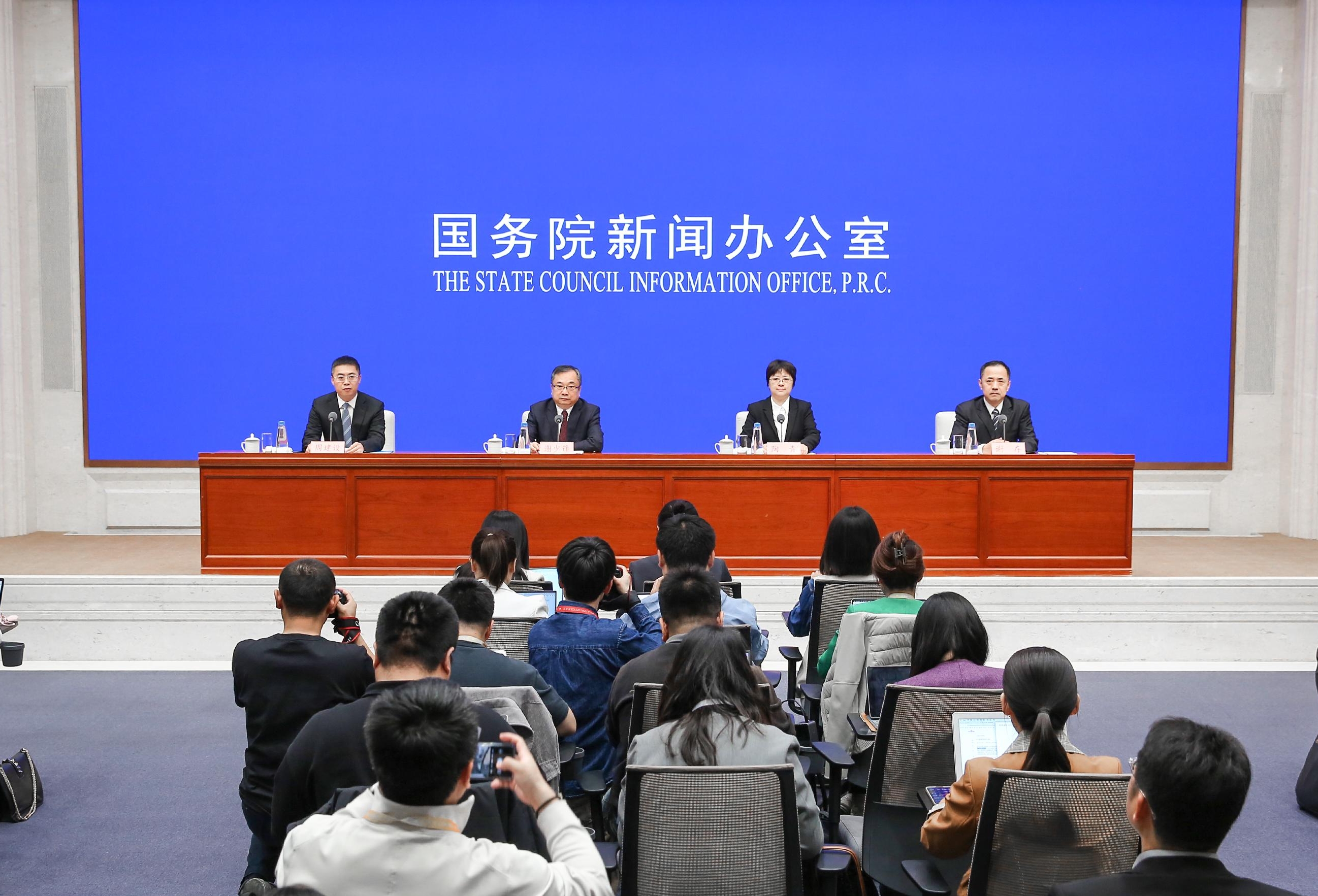
SCIO briefing on development of industry and information technology in the first quarter of 2025
China.org.cn | October 22, 2025

Cover News:
How did the information and communications industry perform in the first quarter? Can you detail what progress has been made? What are the key priorities for accelerating the industry's development moving forward? Thank you.
Xie Shaofeng:
Thank you for your questions. Mr. Xie Cun will answer your questions.
Xie Cun:
Thank you for your questions. Since the beginning of this year, the MIIT has adhered to the general working principle of seeking progress while maintaining stability and has promoted the steady and orderly development of the information and communications industry. In the first quarter, total telecommunications business volume increased 7.7% year on year, with cumulative business revenue reaching 446.9 billion yuan, establishing a solid foundation for the full year's work. This is mainly reflected in the following four aspects.
Network infrastructure continues to be strengthened. A total of 4.395 million 5G base stations have been built, achieving 5G coverage for every township, with 5G connectivity reaching 90% of administrative villages. Building on the achievements of gigabit optical network coverage for every county, pilot projects for 10-gigabit optical networks have been launched, with trial deployments in 168 communities, factories and parks across 86 cities nationwide. Radio frequencies from 2G, 3G, and 4G systems have been refarmed for 5G, continuously improving 5G network capacity and signal coverage. The number of standard racks in operational computing power centers has exceeded 9 million.
Applications continue to drive significant benefits. Networks built well also need to be used well. We have continued to expand the popularization and application of 5G and other networks. In terms of individual users, 5G mobile subscribers have reached 1.068 billion and gigabit broadband users now total 218 million. In the industrial field, China has launched more than 18,500 "5G plus Industrial Internet" construction projects nationwide and selected 700 high-level 5G factories. 5G applications have been integrated into 80 of the 97 major categories of the national economy, with total use cases exceeding 138,000. The technology has achieved large-scale deployment in mining, ports, and other sectors, effectively helping industrial enterprises improve quality, reduce costs and increase efficiency. In health care and education, 5G has achieved comprehensive coverage across all processes and scenarios, strongly supporting the efficient, convenient and balanced development of public services.
Industrial innovation continues to deepen. China holds more than 42% of 5G standard essential patent declarations worldwide, demonstrating world-leading technological and industrial capabilities. Given widespread interest in 6G R&D, we guided the establishment of the IMT-2030 (6G) Promotion Group to consolidate efforts in advancing 6G innovation. The group has released more than 50 research outcomes, including the "6G Overall Vision and Potential Key Technologies" white paper, and organized testing and verification of key 6G technologies, such as integrated sensing and communication and wireless AI, to accelerate technological development. At the same time, we have further strengthened international collaboration on 6G technology with the EU, South Korea, India, and other countries and regions.
We have continued to expand opening up. In the first quarter, China granted pilot licenses for value-added telecommunications services to 13 foreign-funded enterprises, encouraging foreign investment and deeper market engagement in China. As of the end of March, China had more than 2,400 foreign-invested telecoms companies, up 26.5% from the same period last year.
Going forward, the MIIT will thoroughly implement the government work report's directives, strengthen policy support and resource guarantees, and make greater efforts in terms of scope, depth and intensity to promote high-quality industry development. We will focus on expanding the scope of network construction and applications, continuously enhancing coverage of "dual gigabit" 5G and fiber networks, and systematically advancing computing infrastructure network development. We will thoroughly implement the upgraded "5G plus Industrial Internet" 512 project and the three-year industrial internet identifier integration action plan. We will conduct comprehensive assessments of key cities in the 5G "Setting Sail" action plan and continue promoting large-scale deployment across typical industries and key fields. China is actively developing innovative applications in emerging sectors such as marine industry and low-altitude equipment. We will focus on deepening the integration of scientific and technological innovation with industry by bringing together stakeholders from industry, academia, research institutes and application sectors. This includes accelerating 6G technology R&D, standards development, pilot testing and industrial deployment while strengthening breakthroughs in integrated technologies, including communications, sensing, AI and computing. We will also proactively establish and cultivate a 6G-oriented application ecosystem. We will focus on expanding the opening up of the telecoms industry by systematically advancing the first batch of value-added telecoms service pilot programs. We will study opportunities to further expand the scope of opening up at appropriate times, with the aim of attracting more qualified foreign-funded enterprises to invest and operate telecom services in China. Thank you.