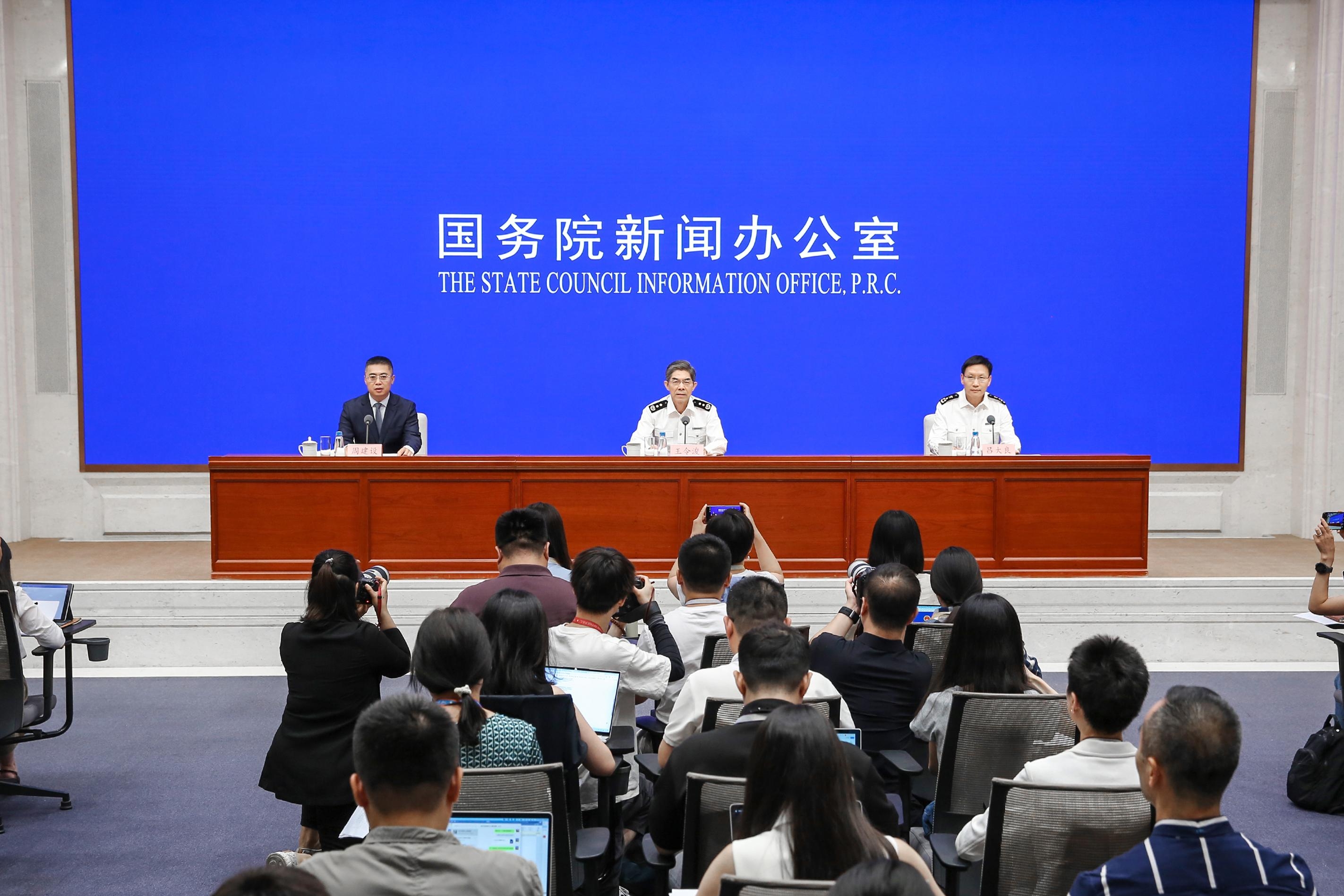
SCIO briefing on China's imports, exports in H1 2025
China.org.cn | September 17, 2025

Dazhong Daily:
Could you please provide an update on the foreign trade performance of China's major trading provinces, as well as the central and western regions, during the first half of this year? What were the main features and highlights? Thank you.
Wang Lingjun:
Thank you for your questions. In recent years, China's approach to opening up has expanded step by step — from individual points to connecting lines, from lines to broader areas, extending from coastal to border regions, and from the eastern to the western parts of the country — with the regional layout being continuously optimized. Since the beginning of this year, all regions have earnestly implemented the central government's directives, working together in coordination to create a joint force for the development of foreign trade.
First, major foreign trade provinces shouldered the bulk of the responsibility. These provinces represent a significant share of the national total and play a key role in stabilizing the overall foreign trade landscape. In the first half of the year, Guangdong, Jiangsu, Zhejiang, Shanghai and Shandong made up 64.1% of China's total imports and exports, growing 4.8% year on year — 1.9 percentage points higher than the national average — and contributed 3 percentage points to overall growth. These major provinces are also the main drivers of export growth, contributing close to 60% of the growth in national exports.
Second, border provinces and regions began to unlock their potential. Leveraging their unique geographical advantages, the nine border provinces have continued to serve as vital bridges for trade with neighboring countries. In the first half of the year, their imports and exports with these countries exceeded 900 billion yuan, marking a 6.3% increase. These regions accounted for more than half of China's total trade with countries such as Kyrgyzstan, Mongolia and Tajikistan. With improved interconnectivity and the development of smart customs and smart ports, border regions have facilitated the faster entry of quality products from neighboring countries into the Chinese market. For example, imports of Laotian rubber and Kazakh flaxseed both experienced rapid growth.
Third, the central and western regions demonstrated strong growth momentum. In the first half of the year, 18 provinces in central and western China achieved a total trade volume of 3.95 trillion yuan, growing 11.2% — 8.3 percentage points higher than the national average. Their share of national foreign trade rose 1.3 percentage points to 18.1%. The central and western regions actively promoted the coordinated development of international logistics channels and industries. In the first half of the year, imports and exports through the New International Land-Sea Trade Corridor increased 20%.
If the major foreign trade provinces represent the points, the border regions the lines, and the central and western regions the areas, then together these points, lines and areas create a vivid picture of China's foreign trade performance in the first half of the year. This clearly demonstrates that the pace of China's comprehensive opening up, characterized by coordinated land-sea development and mutual support between the east and west, is accelerating. The scope for high-level opening up is broader than ever.
Thank you.
Zhou Jianshe:
That concludes today's press conference. Thank you to our two presenters and to all the journalists for joining us. Goodbye, everyone!
Translated and edited by Mi Xingang, Liu Caiyi, Cui Can, Gong Yingchun, Wang Mengru, Li Xiao, Yang Chuanli, Xu Kailin, Xiang Bin, Wang Qian, Liu Sitong, Huang Shan, Fan Junmei, Li Huiru, David Ball and Jay Birbeck. In case of any discrepancy between the English and Chinese texts, the Chinese version is deemed to prevail.