SCIO briefing series on 'high-quality achievements during the 14th Five-Year Plan period': Commerce development
China.org.cn | September 17, 2025
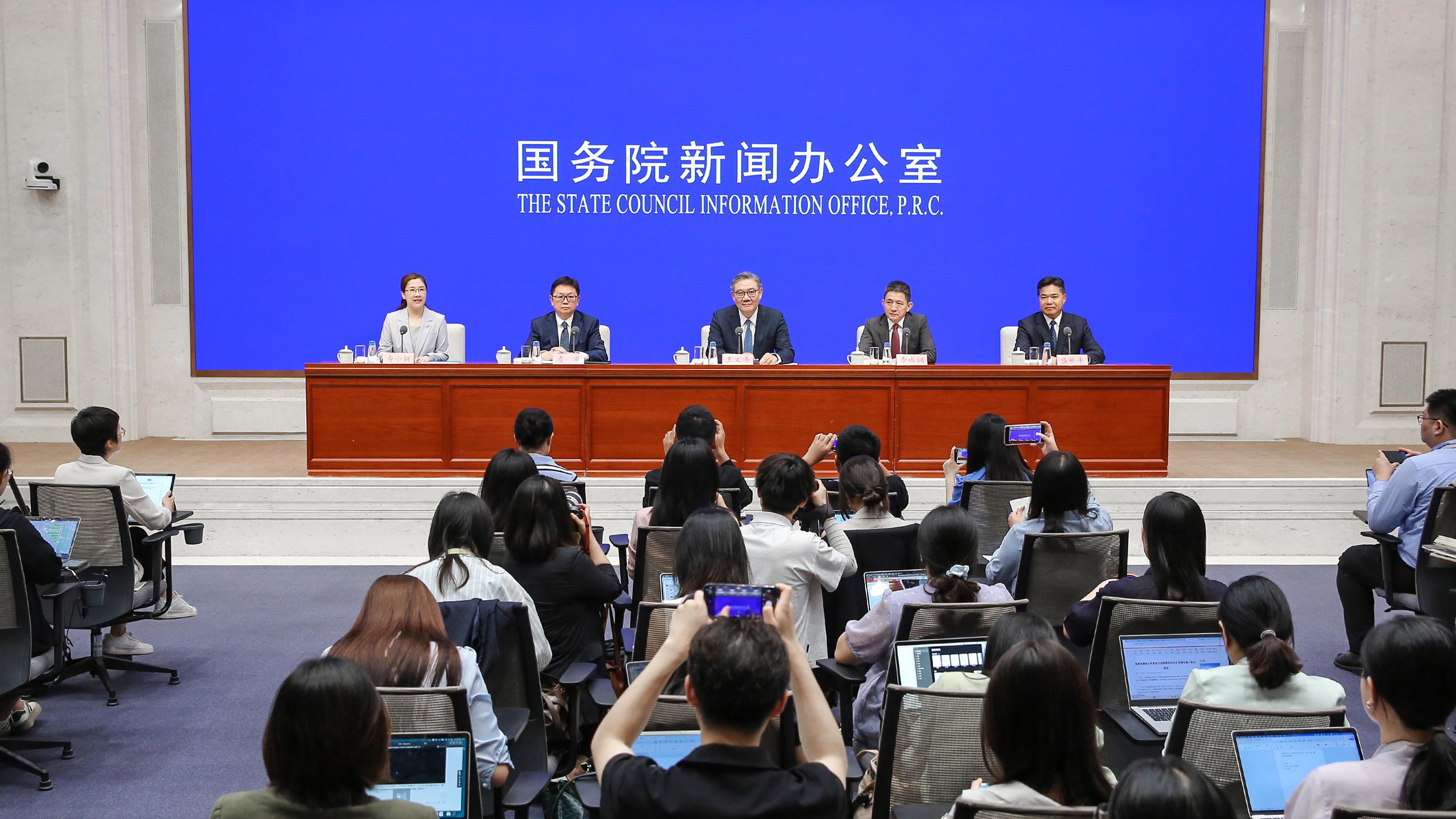

Speakers:
Mr. Wang Wentao, minister of commerce
Mr. Li Chenggang, China international trade representative and vice minister of commerce
Mr. Ling Ji, vice minister of commerce and deputy China international trade representative
Mr. Sheng Qiuping, vice minister of commerce
Chairperson:
Ms. Shou Xiaoli, director general of the Press Bureau of the State Council Information Office (SCIO) and spokesperson of the SCIO
Date:
July 18, 2025
Shou Xiaoli:
Ladies and gentlemen, good morning. Welcome to this press conference held by the State Council Information Office (SCIO). Today, we are continuing to hold the series of briefings titled "high-quality achievements during the 14th Five-Year Plan period." We are very pleased to have invited Mr. Wang Wentao, minister of commerce, to brief you on China's achievements in high-quality commerce development during the 14th Five-Year Plan period, and to answer your questions. Also present today are Mr. Li Chenggang, China international trade representative and vice minister of commerce; Mr. Ling Ji, vice minister of commerce and deputy China international trade representative; and Mr. Sheng Qiuping, vice minister of commerce.
Now, I'll give the floor to Mr. Wang for his introduction.
Wang Wentao:
Thank you, Ms. Shou. Hello, everyone. First of all, I would like to extend my gratitude to you for your interest in and support for China's commerce-related work. Today, I am very pleased to share with you the development of commerce during the 14th Five-Year Plan period.
These five years have been truly extraordinary and remarkable. Under the strong leadership of the Central Committee of the Communist Party of China (CPC) with Comrade Xi Jinping at its core, we have earnestly implemented the various tasks set out in the 14th Five-Year Plan. Guided by the three important roles of commerce-related work (as an important part of the domestic economic flow, an important link connecting domestic and international economic flows, and an important factor for the new development paradigm), we have overcome difficulties, dared to struggle and excelled in doing so, embraced innovation, and solidly advanced the delivery of all targets and tasks. Overall, commerce development has withstood wave after wave of shocks, and endured historical tests. Major targets and indicators in areas such as consumption, foreign trade, foreign investment, and outbound investment and cooperation have been on track. Key tasks have been advanced smoothly, and significant progress has been made in high-quality commerce development, contributing to the successful conclusion of the 14th Five-Year Plan. Next, I will briefly review the main achievements in commerce during the 14th Five-Year Plan period from four aspects:
First, consumption has taken on a greater role as a key driver and stabilizer, highlighting the advantages of a robust domestic market. China's consumer market remains the second largest in the world. Over the past four years, total retail sales of consumer goods grew at an average annual rate of 5.5% and are expected to exceed 50 trillion yuan (about $6.98 trillion) this year. Service consumption has maintained rapid growth, with household spending on services increasing by 3.5 percentage points to 46.1%. New types of consumption have flourished, with a wide variety of new business forms and scenarios, making people's pursuit of a better life more tangible and vivid. Consumption has contributed around 60% annually to economic growth, further highlighting its role as a primary engine. The strength and vitality of China's robust domestic market have been significantly enhanced.
Second, China's status as a major economic and trading nation has been further consolidated, securing marked outcomes in high-quality development. Foreign trade has remained resilient under pressures. China has maintained its top position globally in trade in goods, with its share of global exports and imports remaining steady at over 14% and 10%, respectively. Trade in services has remained the second largest in the world and surpassed $1 trillion for the first time last year. The quality of foreign investment has improved. Total foreign investment attracted during the 14th Five-Year Plan exceeded the expected target of $700 billion. The "Invest in China" brand has continued to shine, and the structure of foreign investment has been continuously optimized. International cooperation in industrial and supply chains has progressed in an orderly manner. Outbound investment grew at an average annual rate of over 5%, ranking among the top three globally. Overseas contracted projects have generally maintained stable growth. China has signed multiple memorandums on industrial and supply chain cooperation with Belt and Road partner countries.
Third, the pace of high-standard opening up has accelerated, and win-win cooperation has continued to expand. The negative list of foreign investment has been continuously shortened. All access restrictions in manufacturing have been lifted. Pilot programs for opening up service sectors such as value-added telecommunications and biotechnology have been carried out in an orderly way. The 22 pilot free trade zones have effectively served as comprehensive experimental platforms for reform and opening up, actively aligning with high-standard international economic and trade rules and conducting pioneering trials. China has steadily expanded autonomous and unilateral opening up, granting zero-tariff treatment for 100% tariff lines for the least developed countries and African countries that have diplomatic relations with China. We have implemented the Regional Comprehensive Economic Partnership (RCEP) to a high quality, and are actively advancing the process of joining the Comprehensive and Progressive Agreement for Trans-Pacific Partnership (CPTPP) and Digital Economy Partnership Agreement (DEPA). In 2024, trade in goods between China and its free trade partners (including Hong Kong, Macao and Taiwan) accounted for 43% of the country's total goods trade volume.
Fourth, the institutional framework for safeguarding economic security has continued to improve, with significantly enhanced risk prevention and shock response capabilities. The legal framework for foreign-related economic and trade matters has been developed at a faster pace, introducing regulations on export control of dual-use items and improving the export control system. Trade remedy tools have been used appropriately to handle trade frictions. Foreign investment security reviews have been conducted in accordance with regulations to safeguard high-standard opening up. China has negotiated, signed and upgraded investment agreements with relevant countries, properly handled major emergencies abroad, and safeguarded its overseas interests.
Looking back over the past five years, we have deeply realized that the greater the difficulties and challenges, the more our institutional strengths, vast market and complete industrial system stand out; the more the vast potential, strong resilience and robust dynamism of China's economy shine through; and the more China's role as a major responsible country is fully demonstrated. Next, the Ministry of Commerce (MOFCOM) will follow the unified deployments of the central government, proactively adapt to evolving circumstances, focus on strategic priorities and targets, and actively plan and promote the high-quality development of commerce in the 15th Five-Year Plan period.
That concludes my introduction. My colleagues and I are now ready to answer your questions. Thank you.
Shou Xiaoli:
Thank you, Mr. Wang. We now move to the Q&A session. Please identify the media organization you represent before raising your questions.