Chinese neurotech company helps users regain hand function
China SCIO | June 10, 2026

At the exhibition hall of BrainCo, a neurotechnology company based in Hangzhou, eastern China's Zhejiang province, an employee with upper-limb amputations wrote the Chinese characters "technology for good" with a brush, using an intelligent bionic hand fitted to his right arm. Nearby, a co-worker of him, also wearing a bionic hand on his right arm, played a familiar melody on an electronic keyboard, showing how the five-fingered, intelligent bionic hands can move objects with remarkable precision, much like a natural human hand.
The prosthetic hands, powered by brain-computer interface (BCI) technology, are among the company's flagship products. By translating neural signals into movement commands, the system enables people with limb loss or disabilities to control the fingers of the prosthetic hands through their thoughts, allowing them to perform everyday tasks with greater independence and ease.
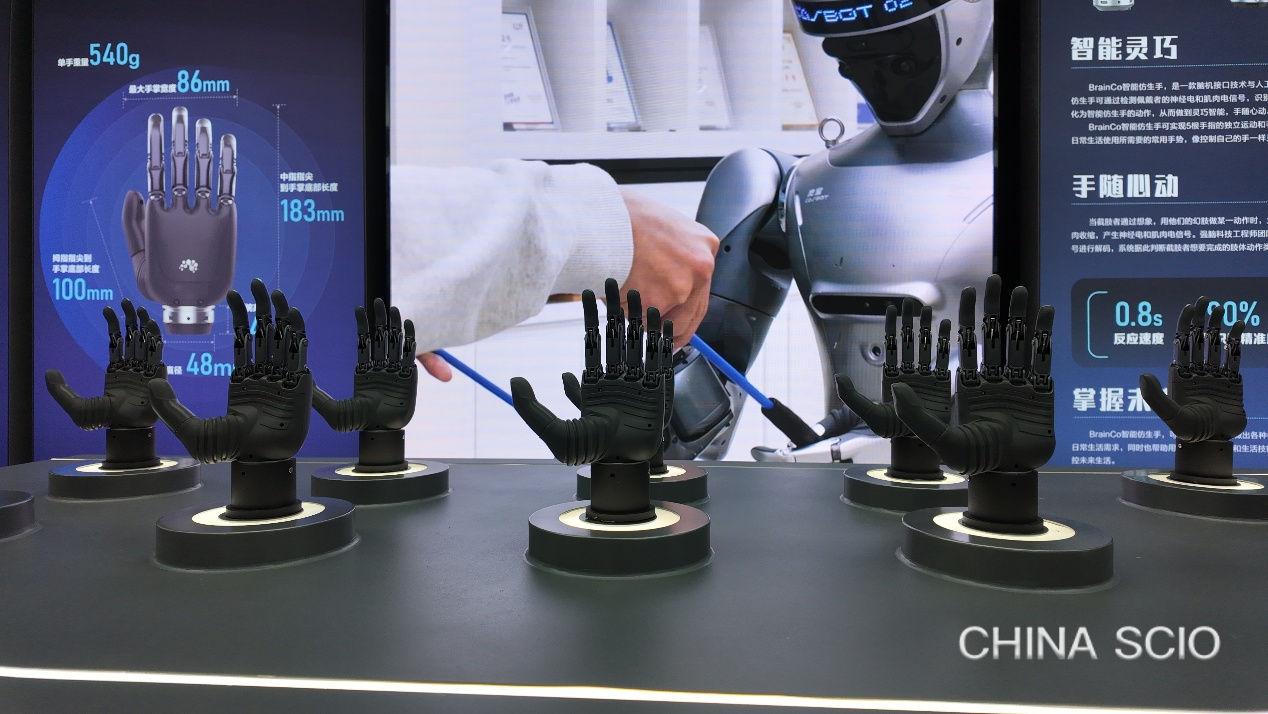
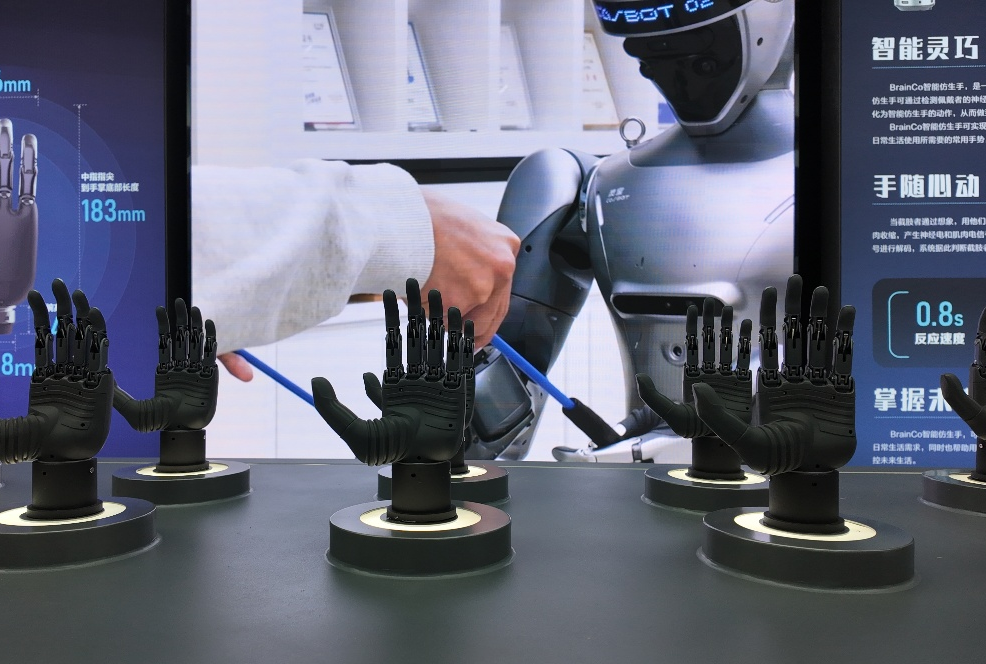
Dexterous hands developed by BrainCo are on display in Hangzhou, eastern China's Zhejiang province, June 1, 2026. [Photo by Wang Xingguang/China SCIO]
BCI technology is what sets BrainCo's dexterous hands apart from traditional prosthetic limbs, which are often bulky and offer limited functionality. According to Nyx He, senior vice president of the company, many conventional prosthetic limbs serve primarily a cosmetic purpose and cannot help users perform many of the tasks required in daily life. As a result, they tend to have a very high abandonment rate among users.
"However, with advanced BCI sensing technology, people with disabilities can regain a sense of having their natural limbs back," she said. "As a result, they are more willing to wear and use the prosthesis, because it can bring about a fundamental improvement in their daily lives."
Based on BCI technology, the company also develops neuromodulation products to control brain-related conditions, helping to tackle neurological issues such as depression, anxiety, and insomnia.
Committed to becoming the world's leading provider of non-invasive BCI technology solutions, BrainCo aims to make the technology more widely accessible, enabling organizations across different industries to develop innovative products and improve the lives of more people, according to the company, she said.
Some robotics companies, including Unitree Robotics, which is also based in Hangzhou, are already purchasing BrainCo's dexterous hands, according to He.
"Over the next five to 10 years, we aim to help 1 million people with disabilities regain mobility and reintegrate into society, assist 10 million people with neurological conditions in their recovery, and enable 100 million people to experience the convenience that BCI technology can bring to their daily lives," she said.
As BCI technology enables people with limb loss to regain the functions of their hands and legs, it demonstrates the potential to break through the physical limitations of the human body and expand human capabilities. It may also enable able-bodied individuals to perform an even wider range of tasks, she said.
"In the future, not only will people with disabilities be able to function like able-bodied individuals, but people without disabilities may also be able to perform many tasks like superhumans," she said.