Xinhua | July 20, 2026



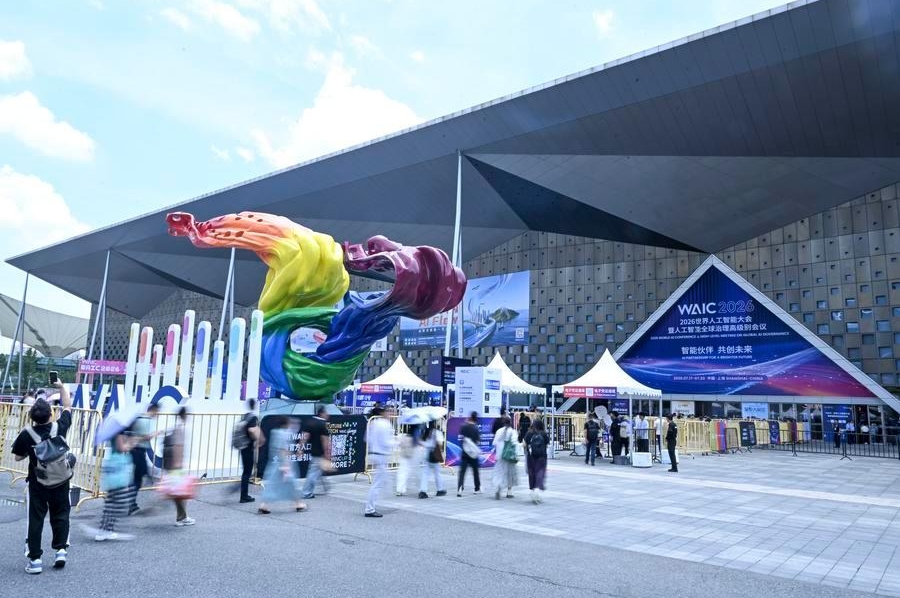
This photo taken on July 17, 2026 shows the exterior view of the Shanghai World Expo Exhibition and Convention Center in Shanghai, east China. The 2026 World AI Conference (WAIC) and High-Level Meeting on Global AI Governance opened here on Friday. (Xinhua/Chen Haoming)
As the first light spread across an orchard on the outskirts of Wuhan in central China, Zhang Shuwang loaded crates of freshly picked fruit onto a small autonomous delivery van. After scanning a QR code with his customers' addresses, he stepped back and watched as the vehicle quietly made its way down a country road.
Developed by Zelostech, the van uses real-time sensing and artificial intelligence (AI) to navigate without relying on costly high-definition maps, making autonomous deliveries feasible even in remote rural areas.
For years, getting fruit to market was Zhang's biggest headache. The nearest wholesale market is about 60 kilometers away, and truck drivers were often reluctant to make the trip. At best, he could make one delivery a day. Sometimes the fruit spoiled before it ever left the orchard.
That changed last year, when Zhang's son suggested he try the robovan. "Within a month, I saw the difference," Zhang said. "Now the fruit we pick in the early morning reaches customers the very same day. On busy mornings, the van can make three to four trips, and my annual income has gone up by at least 30 to 40 percent."
Zhang is one of a growing number of ordinary people in China who are benefiting from AI as the technology spreads beyond big cities and large corporations to improve the lives of farmers, doctors and small business owners.
That shift is also the backdrop to the 2026 World AI Conference (WAIC) and High-Level Meeting on Global AI Governance, which opened in Shanghai on Friday.
Inside the exhibition halls, visitors crowd around Huawei's latest AI computing supernode system Atlas 950; Kimi K3, the world's largest open-source model with 2.8 trillion parameters; and the world's first agentic AI phone, alongside a range of humanoid robots and AI-powered dexterous hands. Yet many of the technologies drawing attention at the conference are already quietly transforming everyday life far beyond the exhibition floors.
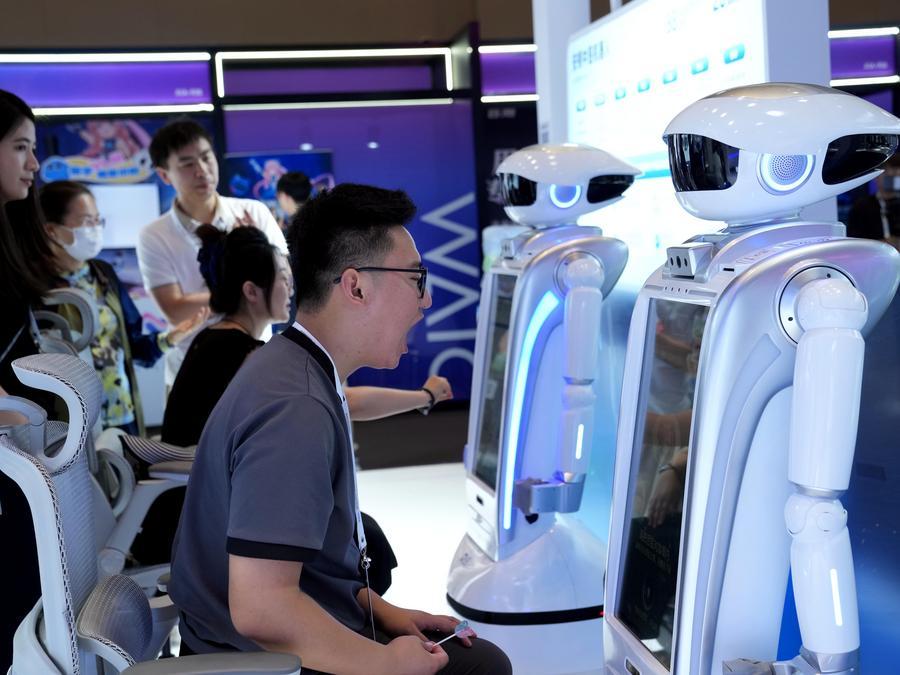
Visitors experience tongue diagnosis by TCM robots at the West Bund International Convention and Exhibition Center in Shanghai, east China, July 17, 2026. (Xinhua/Liu Ying)
BRIDGING THE GAPS
On the conference's opening day, Zelostech announced mass production of its L4 map-free autonomous driving solution, making it the world's first company to achieve this milestone. By removing the need for high-definition maps, the new system cuts deployment time from one month to under a day, reduces costs and extends efficient logistics to remote regions.
Until recently, autonomous vehicles depended on high-definition maps, which are expensive and time-consuming to produce. To reach more remote areas, Zelostech developed its own algorithms for a "light-map" solution, then advanced to a "map-free" system that uses multi-sensor fusion to identify lanes, traffic signs and other road users in real time -- handling positioning and driving decisions through AI.
"Physical AI products must solve real-world problems, such as labor shortages driven by an aging population and geographical constraints in logistics, so that more people can enjoy e-commerce and a better quality of life," said Kong Qi, CEO of Zelostech.
Kong said China is building a more inclusive logistics network, with many cities opening public roads to self-driving delivery vehicles and transportation authorities supporting the innovation.
"This is a shared effort between the government and enterprises," Kong said. "Our goal is to use AI to make cities smarter and more people-centered."
As autonomous vehicles fan out across remote mountains and plateaus, AI applications across China are running at full speed, processing over 140 trillion tokens daily with 1,882 EFLOPS (FP16) of intelligent computing power, and helping millions of people bridge the digital divide.
In the Lyuliang Mountains on the Loess Plateau, village doctor Li Huayu provides healthcare services more than 1,000 residents. As a general practitioner in a remote area, he must weigh each patient's medical history and medications while making quick diagnoses across a wide range of conditions, a daunting workload for any single doctor. Today, he has a smart medical assistant -- an AI system from Xunfei Healthcare.
The system draws on over 13,000 clinical guidelines, 1,400 standard clinical pathways and a database of more than 6,000 diseases. It suggests possible diagnoses and treatment options, reconciles new prescriptions with patients' medical histories, highlights symptoms that require further examination, and follows the latest national treatment protocols.
To date, the system has rolled out to 811 county-level regions nationwide, supporting over 250,000 doctors in primary health care institutions with more than 1.2 billion diagnostic recommendations. Xunfei Healthcare is also piloting AI-based chronic disease management programs for more than a dozen conditions, including diabetes, aiming to shift the focus from treatment to prevention.
"The smarter our models get, the better we can support primary healthcare," said Tao Xiaodong, president and executive director of Xunfei Healthcare. "Our goal is to improve diagnostic accuracy so that more people can access quality care close to home."
That same effort to bring specialist expertise within reach of more people is now extending beyond healthcare. In education, finance and law, vertical AI models are increasingly turning services once dependent on scarce experts into tools that ordinary people and small businesses can use directly.
Wenge AI offers a tool that helps high school graduates choose which universities to apply to, comparing their chances of admission across different schools and majors. Ant Group has launched a platform that delivers cash-flow analytics to small business owners, helping them select wealth management products that fit their needs.
In Chongqing's Beibei District in southwest China, the justice bureau offers businesses free access to an AI legal platform featuring contract review and risk alerts in minutes, with the cost covered by the government.
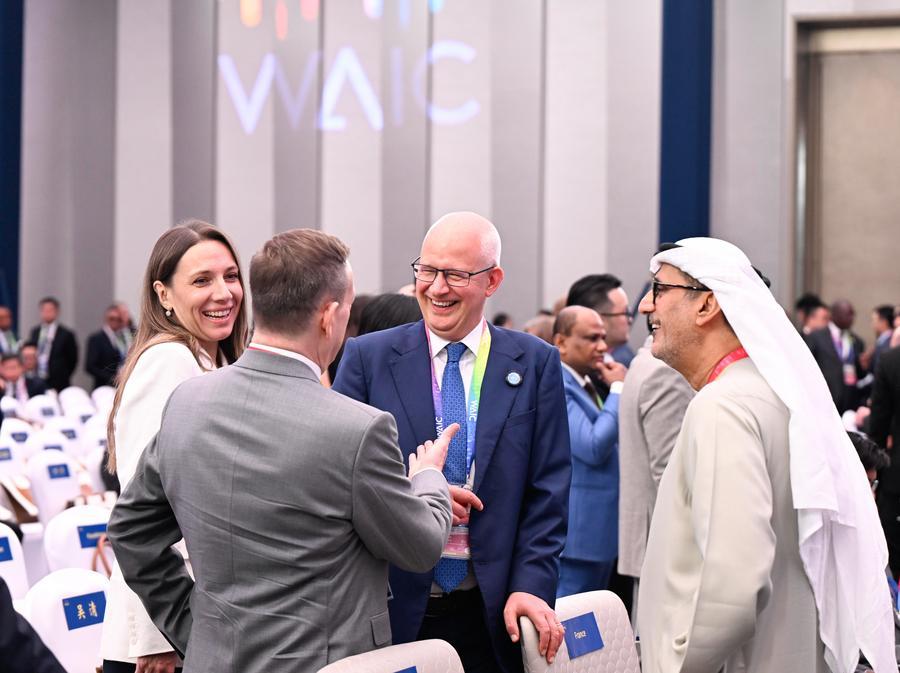
Guests talk with each other before the opening ceremony of the 2026 World AI Conference and High-Level Meeting on Global AI Governance in Shanghai, east China, July 17, 2026. (Xinhua/Shen Hong)
AI FOR ALL
These applications reflect China's broader AI vision: expanding access to knowledge and opportunity, not just improving efficiency.
China issued a new generation AI development plan as early as 2017, and unveiled guidelines on further implementing the "AI Plus" initiative last year. The country's 15th Five-Year Plan (2026-2030) also calls for fully implementing the initiative to foster AI-driven development, fueling the burgeoning growth of its AI innovations.
In education, health care, agriculture and community-level governance, intelligent systems can bring premium resources to places previously beyond reach. True inclusion means packaging complex capabilities into tools that small businesses, grassroots organizations, and ordinary workers can afford and deploy, said Su Hao, inaugural dean of the Fudan Institute of General Physical Intelligence.
That vision also shaped discussions at this year's WAIC, where China announced the establishment of the World Artificial Intelligence Cooperation Organization (WAICO), the world's first intergovernmental international organization to seize opportunities and address challenges posed by AI.
Airlangga Hartarto, Indonesian Coordinating Minister for Economic Affairs, said the mastery of technologies, including AI, must be maximized to improve social well-being.
"The open source models coming out of China are transparent, easy to post-train, and freely available to anyone. Most importantly, they are making AI practical for economically valuable applications," said Alex Zhavoronkov, founder and co-CEO of Insilico Medicine.
China has also pledged to provide developing countries with 5,000 opportunities in AI training and seminar programs in the next five years. It will enable 30 countries to use the AI-powered meteorological warning system, known as MAZU, to safeguard homes around the world.
Zheng Changzhong, a professor at Fudan University in Shanghai, said the country will continue to work toward greater inclusiveness, accessibility and the benefit of humanity, in a bid to ensure that the benefits of intelligent technology are shared more broadly and equitably by countries and populations at different stages of development.
For Su, however, the ultimate measure of AI lies in how many lives it improves.
"The value of AI should not be measured by efficiency gains for a few, but by whether more people can live better because of it," he said.