China SCIO | June 23, 2026


For 41 years, Yin Yuzhen has been planting trees in the Maowusu Desert in northern China's Inner Mongolia autonomous region.
When she arrived as a 19-year-old bride in 1985, shifting dunes stretched as far as the eye could see. Sandstorms could bury the entrance to her family's cave dwelling overnight.
To prevent the desert from encroaching on their home, she and her husband spent decades planting trees to stabilize the dunes.
"I would rather exhaust myself planting trees than let the sand drive us out," Yin recalled.
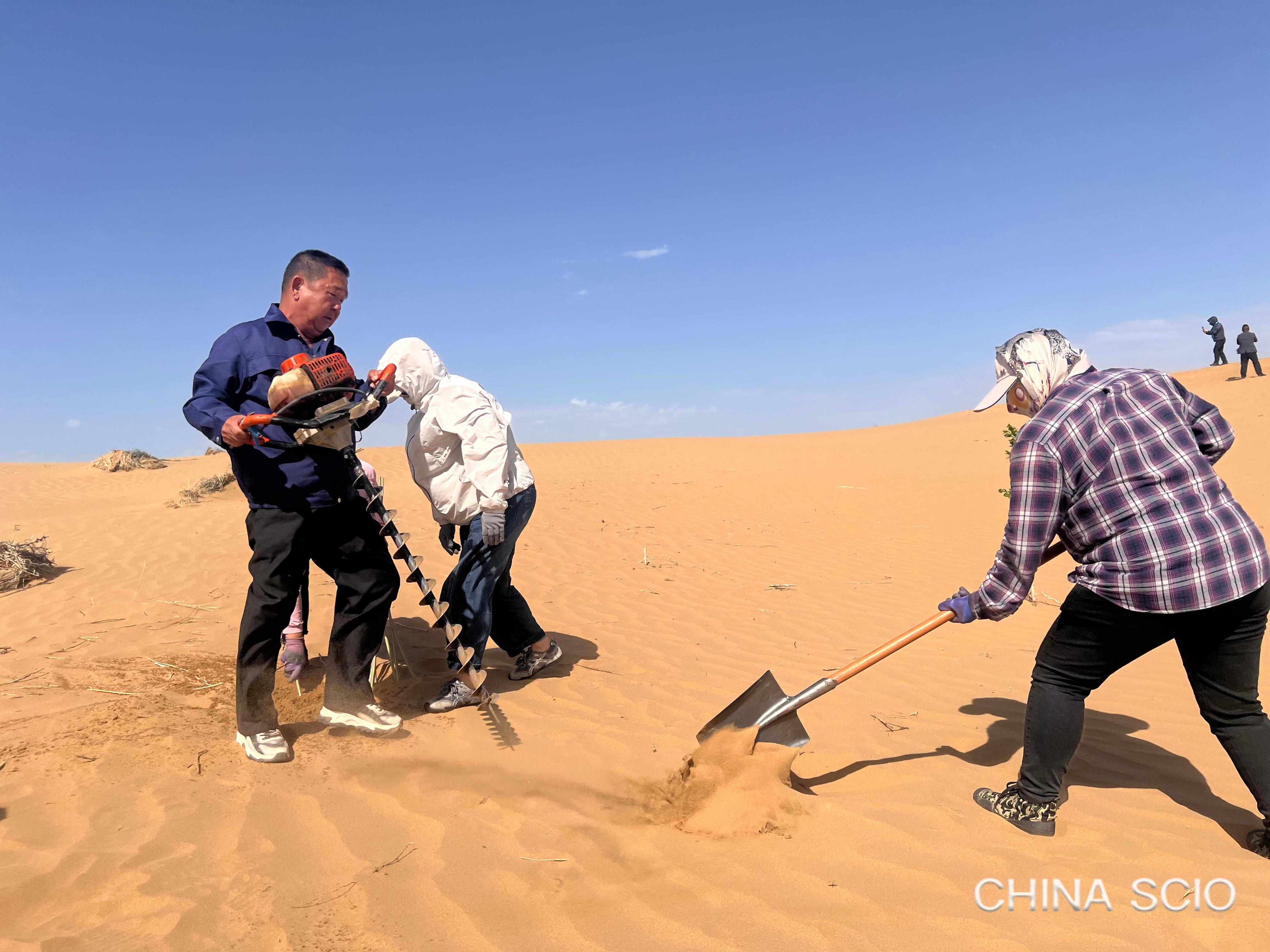
Workers drill holes for planting saplings in the Kubuqi Desert in Ordos, Inner Mongolia autonomous region, June 12, 2026. [Photo by Guo Yiming/China SCIO]
One turning point came in 1999, when an American teacher, Ronald Sakolsky, donated US$5,000 after learning about her story through a television program. Yin spent nearly all of the money on seedlings.
More than two decades later, those saplings have matured into a forest.
Yin's journey mirrors a broader transformation across Inner Mongolia, where decades of desert-control efforts are reshaping landscapes once dominated by shifting sands.
From encroaching sands to expanding greenery
Inner Mongolia is one of the regions most affected by desertification in China. It encompasses vast desert, sandy and Gobi landscapes and plays a critical role in shielding northern China from sandstorms.
According to Huang Zhiqiang, executive vice chairman of Inner Mongolia autonomous region, the region has completed ecological restoration on 138 million mu (9.2 million hectares) of land since 2021.
"We've turned the tide on desertification — from a time when expanding sands forced human retreat, to where greenery is reclaiming the land," Huang said.
Across the region, major desert-control projects are underway. More than 80% of the Maowusu Desert is now blanketed with vegetation. In the Horqin sandy land, efforts to tame active shifting dunes are helping restore grassland ecosystems. Along the border between Inner Mongolia and Gansu province, large shelterbelts have been established to arrest the expansion of major deserts.
Officials attribute much of that progress to scientific sand control. "We adhere to scientific and precise desert control," said Wang Zhaosheng, director of the autonomous region's forestry and grassland bureau.
Rather than planting trees indiscriminately, restoration projects are tailored to local conditions. Water availability determines what can be planted. Native species such as willow, caragana and saxaul are widely used because they are adapted to droughts and poor soil. More than 90% of the trees and shrubs used in restoration projects are native species.
Technology is also changing how the work is done. Water-saving irrigation systems, drones, aerial seeding and other new technologies are helping improve efficiency while reducing pressure on scarce water resources.
Engineering measures play an equally important role. Inner Mongolia has built thousands of kilometers of roads through desert areas, dividing large stretches of shifting sand into manageable sections. Combined with straw checkerboards, sand barriers and vegetation belts, these projects have helped stabilize dunes and reduce erosion, Wang said.
Turning sunshine into a resource
Restoring vegetation is only part of the challenge. Sustaining those gains over the long term requires funding, infrastructure and economic activity that can support local communities.
In recent years, Inner Mongolia has sought to answer that challenge by linking desert control with renewable energy development.
The region possesses some of China's richest solar resources, much of which is concentrated in desert and Gobi areas. Rather than viewing these landscapes solely as areas in need of restoration, local authorities began exploring whether the same land could also support clean energy generation.
The idea was to make ecological restoration and economic development reinforce one another.
"We have promoted the integrated development of desertification control and renewable energy," Wang explained.
According to him, the region has restored 2.48 million mu of degraded land through photovoltaic desert-control projects while adding 27.27 million kilowatts of renewable energy capacity.
The model relies on aligning environmental goals with commercial incentives. Companies developing solar projects are required to undertake ecological restoration work as part of their projects, effectively giving renewable energy installations a built-in land rehabilitation mission.
At the same time, project developers are encouraged to adopt what officials describe as a three-dimensional model: generating electricity above the panels, controlling sand beneath them, and growing vegetation or crops between them.
"The goal is to create a virtuous cycle in which ecological benefits drive environmental improvement, environmental improvement supports industrial development, and economic returns help sustain further restoration," Wang said.
To ensure those goals are met, authorities have introduced a cross-department evaluation system. Indicators such as the area restored and vegetation coverage are assessed alongside energy targets and are included in project acceptance and grid-connection requirements.
The approach is intended to ensure that ecological restoration and renewable energy projects are planned, built and evaluated together.
The results are already clear to see. In some photovoltaic desert-control project areas, vegetation coverage has risen from less than 5% to more than 30%. Meanwhile, the projects generate around 1.6 billion kilowatt-hours of green electricity annually, or equivalent to reducing 1.6 million metric tons of carbon dioxide emissions each year.
What were once expanses of barren sand are increasingly becoming corridors of both vegetation and renewable energy.
For Yin, the transformation is visible every time she looks across the land she has spent four decades helping restore.
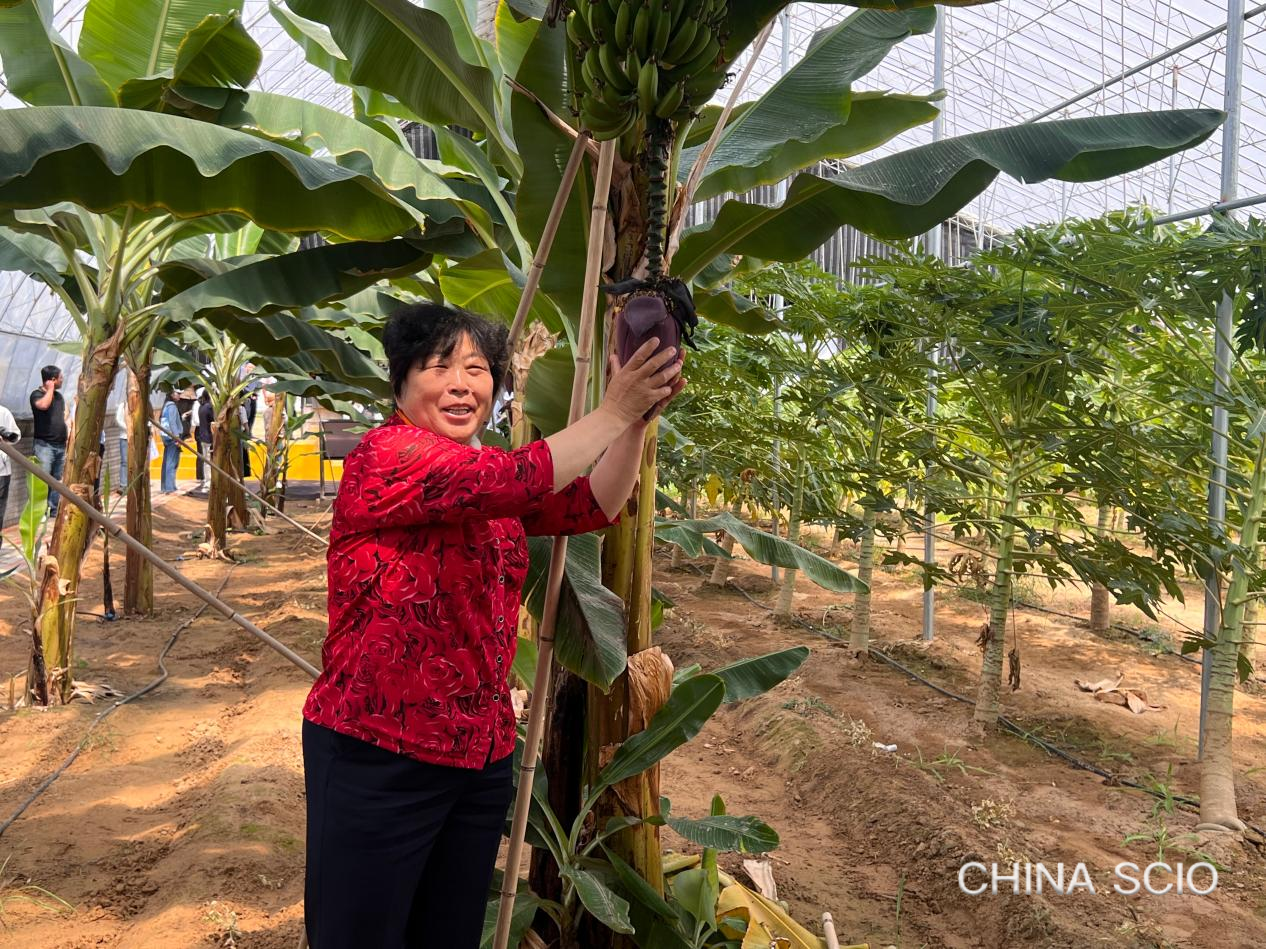
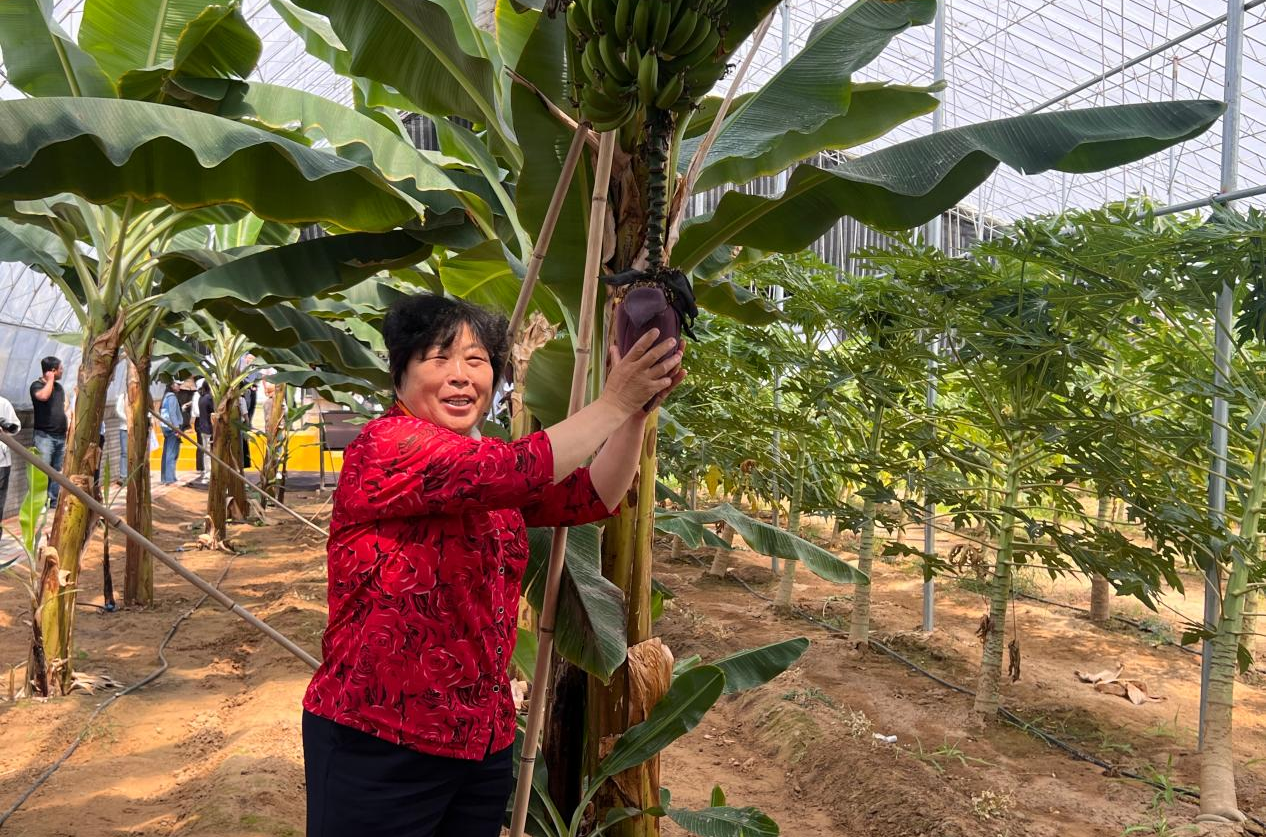
Yin Yuzhen shows banana trees cultivated in the sand in Ordos, Inner Mongolia autonomous region, June 12, 2026. [Photo by Guo Yiming/China SCIO]
The dunes that once threatened her home are now dotted with trees. Across Inner Mongolia, solar panels are appearing alongside new vegetation, turning stretches of desert into hubs of both energy and growth.
Sitting on a sandy slope overlooking the trees she helped plant, Yin reflected on four decades of work.
"The sand made me who I am," she said. "I transformed it, and it transformed me."