China SCIO | June 5, 2026


After learning about a newly approved hepatitis D treatment developed by a Chinese biopharmaceutical company, a Russian patient flew to Beijing in mid-May to seek treatment at a hospital that serves international patients.
He was not alone. Another patient from Uzbekistan and several others from Mongolia have also traveled to China in recent months seeking access to the treatment.
The journeys reflect a broader trend in China's healthcare sector, where a growing number of homegrown innovations are seeking to address diseases and conditions affecting patients well beyond the country's borders.
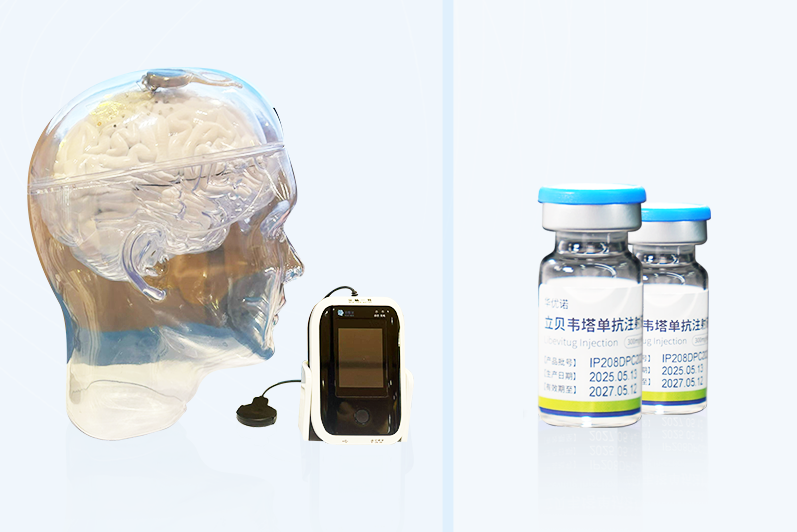
At Huahui Health, located in Beijing’s Zhongguancun Life Science Park, researchers recently achieved a milestone with the approval of Libevitug, which the company describes as the world's first antibody drug for viral hepatitis and China's first treatment for hepatitis D.
The disease remains a significant global health challenge. Over 250 million people worldwide are living with chronic hepatitis B infection, while an estimated 12 million are also infected with hepatitis D, a more aggressive virus that dramatically increases the risk of liver cirrhosis and cancer.
The drug Libevitug was approved in China in January, and the first prescription was issued at Beijing Friendship Hospital in March.
Beyond China, Huahui Health is pursuing emergency-use access in countries including Mongolia and Pakistan while conducting late-stage clinical trials in the U.S. and Europe, with the goal of bringing the drug to a wider international market.
"There are two languages that connect people around the world: One is science and the other the desire for health. What we do here at Huahui is using the language of science to respond to the second, that is, people's desire for a healthier life," Huahui Health CEO Chen Bin said on Saturday.
Just a one-minute walk from Huahui Health, researchers at the Chinese Institute for Brain Research, Beijing, are pursuing another technology with global ambitions: brain-computer interfaces (BCIs).
A BCI creates a direct communication pathway between the brain and an external device. By recording and interpreting brain signals, BCIs allow users to control assistive devices with only their thoughts.
Luo Minmin, director of the institute, said they are pursuing what he described as a relatively uncommon dual-track strategy in the global BCI field, developing two systems simultaneously to help patients suffering from paralysis and other movement disorders regain mobility.
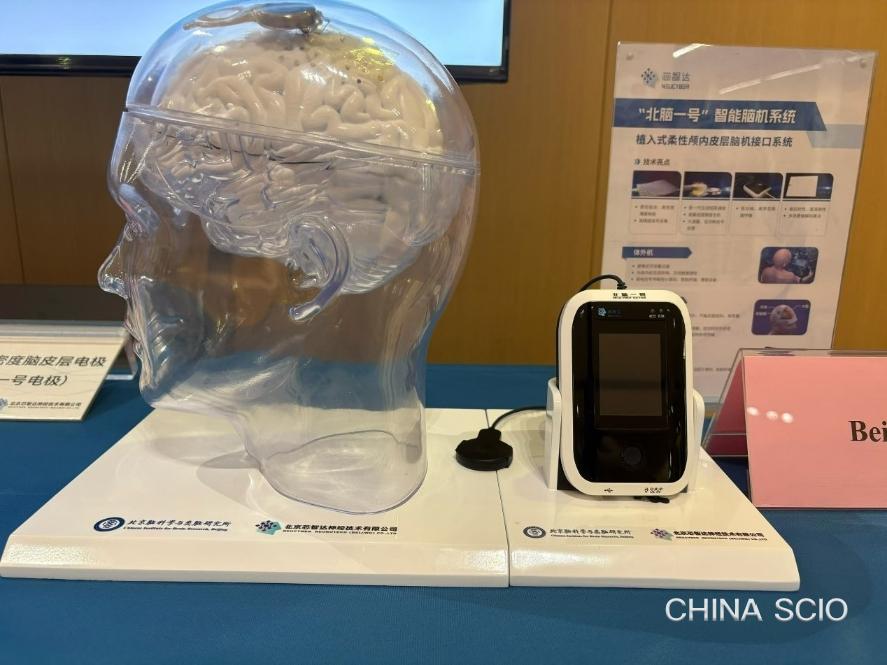
A model of Beinao No. 1 brain-computer interface is displayed at the Chinese Institute for Brain Research, Beijing, May 30, 2026. [Photo by Zhang Lulu/China SCIO]
The first, the semi-invasive Beinao No. 1, was designed with safety and accessibility as priorities. Instead of implanting electrodes into brain tissue, the system places them outside the dura mater – the tough, outermost membrane covering the brain and spinal cord. This reduces surgical complexity and makes the technology easier to deploy in clinical settings.
The second pathway, Beinao No. 2, takes a more invasive approach, using flexible microwire electrodes implanted into the brain to capture higher-quality neural signals.
Luo said the institute's first implanted patient has now used the system for about 15 months while continuing to generate stable brain-signal recordings.
Since February 2025, Beinao No. 1 has been implanted in more than 20 patients and accumulated over 45,000 hours of safe operation, according to the institute.
Luo said one of the most surprising findings from clinical trials of Beinao No. 1 has been the technology's apparent role in rehabilitation.
While BCIs are often viewed as tools that allow patients to control computers or other devices using neural signals, he said some patients also appeared to regain elements of motor function during the rehabilitation process.
"That was not something we fully anticipated," he said. "When the technology was applied in real-world clinical settings, we began to see rehabilitation benefits that had not been widely reported before."
Looking ahead, Luo said researchers hope to see the system operate in both directions, in other words, become capable of both decoding and stimulating neural activity. Such advances could broaden the technology's applications beyond movement impairments to conditions including mood disorders and epilepsy, he said.
Luo said the institute has already received inquiries from overseas patients and hopes to eventually bring the technology to international markets.
Both Libevitug and Beinao are emerging from a healthcare ecosystem that Beijing officials say integrates research institutions, universities, and biotech companies.
At a May 30 press briefing, city officials highlighted Beijing's deep pool of scientific talent, noting that the city is home to nearly 100 universities, more than 1,000 research institutions, and almost half of China's national academicians of sciences and engineering.
The city has identified BCI among a group of future-oriented industries it plans to support through dedicated policies, research platforms, investment funds, and pilot applications.
For companies and researchers in Beijing's life sciences sector, the goal is increasingly not only to serve China's healthcare needs but also to contribute solutions to global medical challenges.
Whether treating hepatitis patients who travel across borders in search of new therapies or helping paralysis patients regain movement, researchers say success will ultimately be determined by the number of lives improved.
"We're not doing this for competition. We're doing it to improve the wellbeing of humanity," Luo said.