China SCIO | June 3, 2026


At Xiaomi's sprawling electric vehicle factory in southeastern Beijing, hundreds of robotic arms move in near-perfect synchronization, welding vehicle frames, assembling components, and conducting quality inspections.
The factory, which began operation in 2024, has become one of the most visible examples of China's push toward intelligent manufacturing. By late April, more than 650,000 vehicles had rolled off its production line, with company executives attributing the efficiency largely to extensive automation and AI-powered inspection systems.
Yet while robotic arms have become commonplace in modern factories, many in China's technology sector see them as only an intermediate stage in the evolution of robotics.
The next frontier, they argue, is embodied intelligence — robots capable not only of performing repetitive tasks but of understanding and interacting with the physical world in ways that resemble humans.
Just a short drive from Xiaomi's factory, Beijing is attempting to build the infrastructure needed to make that vision a reality.
At the Embodied Artificial Intelligence Robot Data and Training Base of the Beijing Innovation Center of Humanoid Robotics, technicians spend their days teaching robots how to perform everyday tasks.
The training base recreates dozens of real-world scenarios, ranging from homes and supermarkets to offices, industrial workshops, and healthcare facilities.
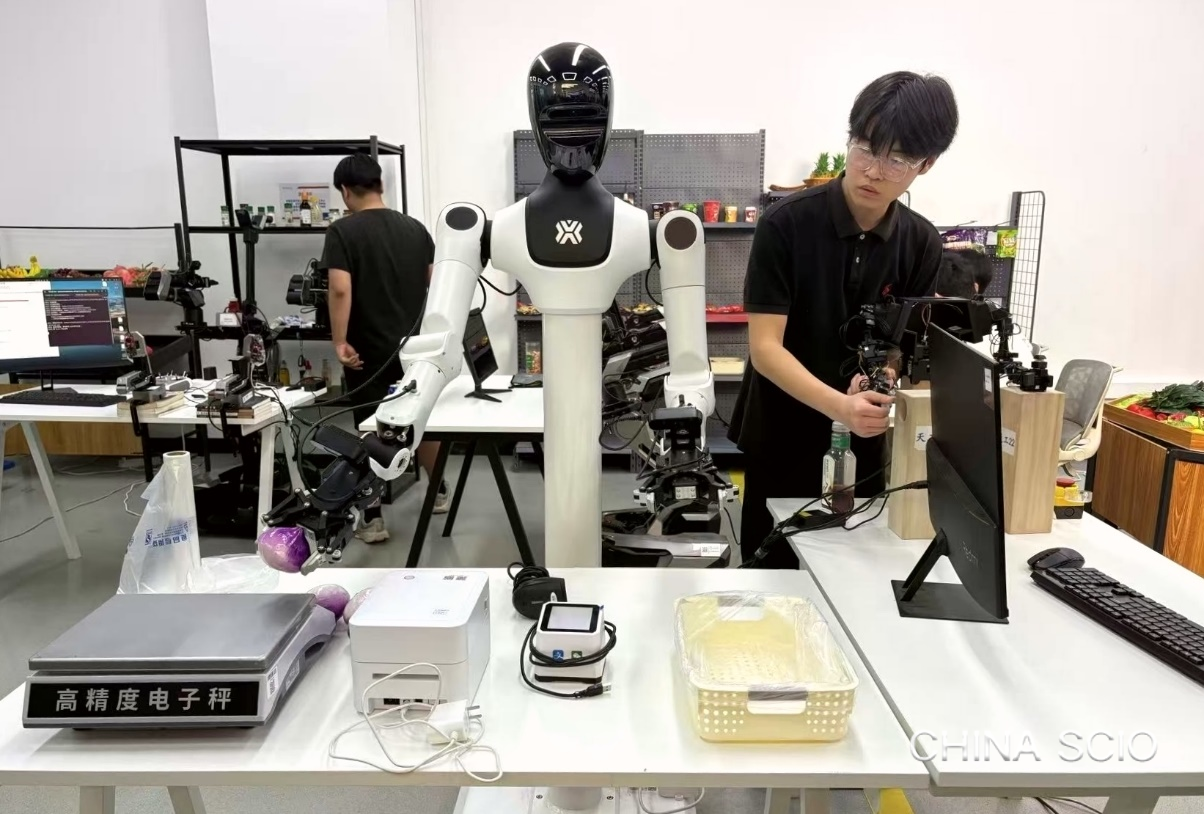
A technician teaches a humanoid robot to pick up vegetables at a robot training base in southeastern Beijing, May 29, 2026. [Photo by Zhang Lulu/China SCIO]
At one station, a technician taught a robot to carefully pick up onions, place them on a scale, and return them to their original positions. The process may appear mundane, but it forms part of a highly structured data-generation pipeline.
According to training specialists at the facility, each task is repeated hundreds or even thousands of times. Objects are regularly rearranged, substituted, or repositioned to ensure diversity in the training data and to prevent robots from simply memorizing a fixed sequence of actions.
"We first receive a task and determine what objects and tools are needed," said Kong Chao, operation director at the training base. "After completing the task, we restore the entire scene and repeat the process, often with slight variations. The goal is to create diverse data rather than identical repetitions."
The approach reflects one of the biggest challenges facing humanoid robotics today: obtaining large quantities of high-quality real-world data.
Unlike large language models, which can be trained on vast amounts of online text, robots must learn how to interact with physical environments. That requires real-world demonstrations, often collected one movement at a time.
According to the training base, the facility is capable of generating more than 500 hours of data per day and more than 150,000 hours annually. Nearly 20,000 hours of high-quality data have already been produced.
The data forms the foundation of the center's intelligent robots.
Xia Hualin, director of the training base, said the company first trains general-purpose models using large volumes of data before fine-tuning them with data collected in specific environments such as homes, hospitals, and factories.
"Once the model reaches a certain level of capability, we collect data from real scenarios and use it to further adapt the system," Xia said. "Only then can the robot perform effectively in specific environments."
The data is currently used by the Beijing Innovation Center of Humanoid Robotics and a number of Chinese humanoid robot developers. Xia said overseas companies have also expressed interest in cooperation, though cross-border data sharing remains subject to compliance requirements.
The emphasis on data reflects a broader belief within the industry that humanoid robots will ultimately require human-like learning processes to achieve broad deployment.
"We are building a general-purpose platform for the entire industry," Xia said. "The long-term goal is still the humanoid form because the world is designed by humans, for humans. A robot that resembles humans can adapt more naturally to the environments and carry out tasks for us."
The technology is already being deployed in a limited number of industrial applications, though executives say broader commercialization will likely progress in stages as robots become more capable, reliable, and cost-effective.
Che Zhengping, head of embodied AI at the Beijing Innovation Center of Humanoid Robotics, said he expects small-scale deployments in mature scenarios to expand over the next several years.
Manufacturing and commercial services are likely to be among the earliest adopters, while more generalized household applications may take longer to emerge, as they are more open-ended and diverse, he said.
According to Che, robots developed by the innovation center have already been deployed in pilot projects with State Grid, where they perform inspection tasks and operate electrical equipment in environments that could pose electrocution risks to human workers.
Five minutes from the robotics center stands the newly opened LY iTECH Beijing Embodied Intelligence Super Factory, one of the first facilities in the Beijing-Tianjin-Hebei region dedicated to large-scale humanoid robot manufacturing.
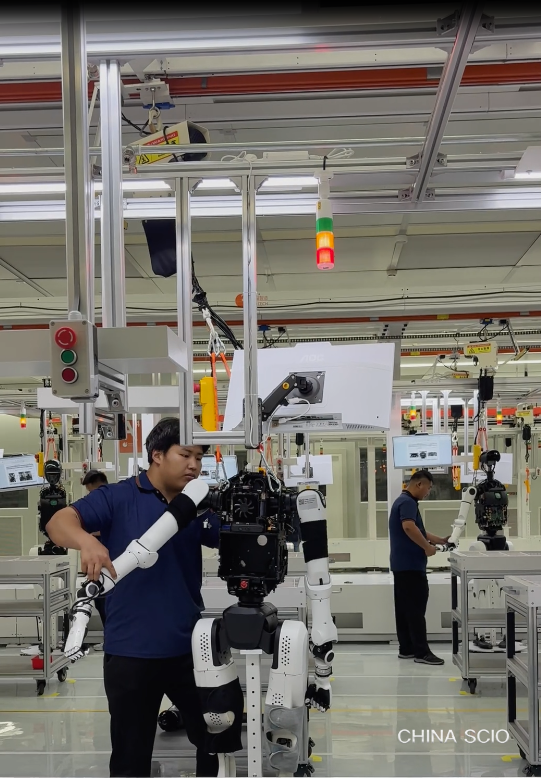
Workers assemble humanoid robots at the LY iTECH Beijing Embodied Intelligence Super Factory, in Beijing, May 29, 2026. [Photo by Zhang Lulu/China SCIO]
The factory, which began operations in May, provides manufacturing, assembly, and testing services for humanoid robot companies. Its clients include several of China's leading robot developers, including the Beijing Innovation Center of Humanoid Robotics.
Although still in the early stages of ramping up production, the company has ambitious plans.
Yang Xinyu, vice president of LY iTECH, said the first phase of the factory is designed for annual production of 10,000 units, with capacity expected to double by the end of next year. Longer-term plans envision annual production reaching 100,000 units by 2028 and eventually 500,000 units by 2030.
Such scale, Yang said, is critical to bringing down costs and accelerating commercialization.
Humanoid robots today can cost anywhere from tens of thousands to hundreds of thousands of yuan, depending on their capabilities and configuration.
Yang said the factory benefits from the manufacturing expertise of its Guangdong-based parent company, LY iTECH, which has spent years supplying major global electronics firms including Apple. That experience in engineering optimization and automated production could help significantly reduce the cost of humanoid robots over time, he said.
"I expect the price of humanoid robots to fall by at least half, or even two-thirds, by 2030," he said.
Yet the company's role extends beyond simply manufacturing.
Many humanoid robot firms remain young startups focused primarily on research and development. Turning laboratory prototypes into mass-produced products requires engineering optimization, supply-chain coordination, and manufacturing expertise, according to Yang.
"There is often a gap between a research prototype and a product that can be manufactured at scale," Yang said. "Our job is to help bridge that gap."
Yang said the company aims to automate much of the production process itself, with a long-term goal of creating a fully automated manufacturing line for humanoid robots.
"We hope to eventually realize the vision of robots manufacturing robots," he said.
Yang said the company has chosen to set up a factory in Beijing because the city and the broader Beijing-Tianjin-Hebei region are home to many of China's leading humanoid robot developers.
"The proximity between research teams and manufacturing facilities allows us to move much faster from prototype development to mass production," he said.
For Beijing, the broader goal extends beyond developing individual robots.
At a press briefing on Saturday, Vice Mayor Jin Wei said the city has focused on building an integrated robotics ecosystem encompassing research, manufacturing, and real-world applications. In the years ahead, Beijing plans to accelerate product iteration and scale up deployment as part of its broader push to develop future-oriented industries.
And across the city's southeast, the hard work has begun — moving humanoid robots from demonstrations into factories, hospitals, and homes.