Xinhua | May 14, 2026


Industry leaders attending the on-going 2026 China International Intelligent Transportation Systems Industry Expo in Xiamen in east China's Fujian Province, are describing "AI plus transportation" as the new driving force for building China into a transportation powerhouse.
"'AI plus transportation' has become the new development paradigm for advancing the country's strength in transportation," said Wang Yunpeng, chairman of the China Intelligent Transportation Systems Association, cohost of the event, and president of Beihang University, when speaking at the expo which opened on Wednesday.
Wang noted that China has basically formed a modern, comprehensive and three-dimensional transport network and is accelerating toward a more digitalized, intelligent, coordinated and greener system.
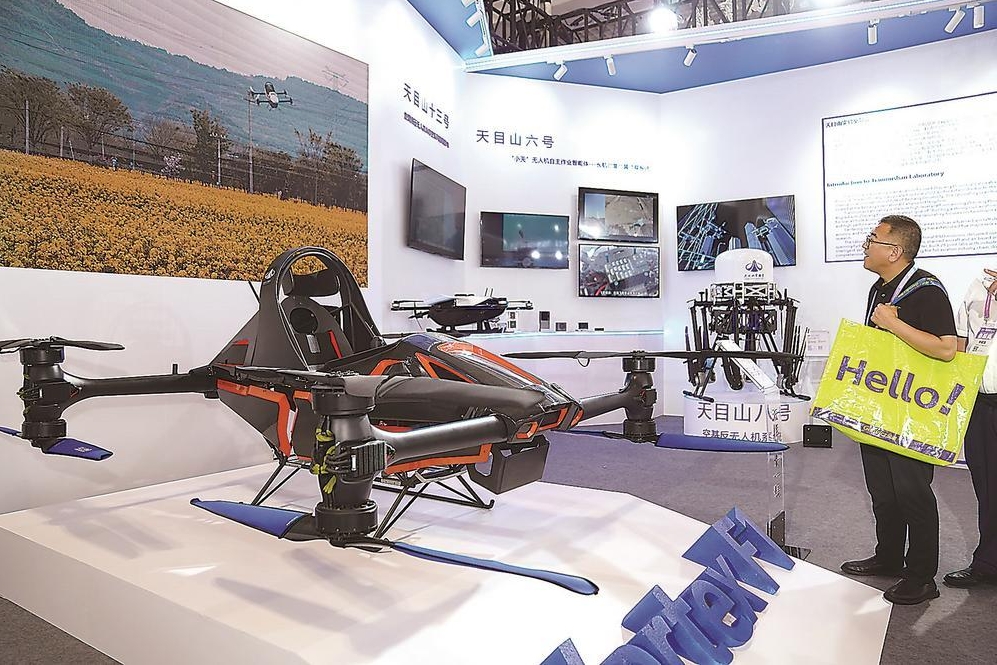
Nowhere is this more evident than at this three-day expo, where AI is on full display across every facet of transport planning, construction, management and services. The event features over 1,000 innovative products and solutions spanning the entire industrial chain, from vehicle-road coordination and low-altitude inspection to digital twins and computing power support.
CONVERGING TECHNOLOGIES RESHAPE MOBILITY
At the expo in Xiamen, BYD, one of China's leading electric vehicle makers, unveiled a "vehicle-road-home-person" interconnected ecosystem.
Lian Yubo, an academician of the Chinese Academy of Engineering and chief scientist at BYD, said that while vehicle electrification has laid a solid foundation for the industry, the next frontier lies in intelligent technologies.
"Future cars will transcend their traditional role as mere mobility tools and become key hubs for mobile energy, as well as intelligent information terminals that are perceptible, computable and interactive," Lian said, envisioning a future where vehicles, roads, homes and people are fully coordinated to support efficient, safe and low-carbon smart mobility.
Intelligent transportation also relies on reliable energy infrastructure. CATL, the world's largest electric vehicle battery maker, is showcasing an ultra-fast battery swapping solution for logistics trucks.
Yang Jun, general manager of CATL's battery-swapping business, said the solution allows for five-minute battery swaps, effectively solving long charging duration and low efficiency issues for logistics fleets.
Compatible with more than 95 percent of mainstream heavy-duty truck models, this system can help logistics companies reduce comprehensive operating costs by 25 percent, while also cutting carbon emissions.
"We hope the industry will accelerate the standardization of battery swapping specifications and promote a separation of vehicle and battery ownership to support the nationwide construction of a green refueling network," Yang said.
Global industry leaders are, notably, making their mark at the expo's international pavilion.
Solera, a specialist in vehicle lifecycle data and software platforms, is showcasing its solutions alongside Mobileye, which develops vision-based advanced driver assistance systems (ADAS). Danlaw Technologies, meanwhile, is displaying its connected vehicle technologies and automotive electronics in Xiamen.
Together, these companies span key areas including intelligent driving, connected vehicle applications, digital transport management and automotive data services, bringing the latest global trends and industry practices to the event.
POLICY PUSH FOR TRANSPORT AI ADOPTION
AI is rapidly reshaping the transport sector, according to Weng Youling, deputy director of the department of science and technology at China's Ministry of Transport (MOT).
Weng said the MOT has joined forces with other ministries to issue implementation guidelines on "AI plus transportation."
The ministry has also approved the construction of the country's first three national-level AI application pilot bases for transportation in Xiamen, Qingdao in east China's Shandong Province and Mianyang in the southwestern province of Sichuan.
Looking ahead, Weng outlined four priorities for accelerating the large-scale application of AI in transport.
The ministry will enhance technological breakthroughs through national research programs and innovation platforms, while building a comprehensive transport data foundation that includes large models and high-quality datasets.
It will also promote innovation demonstrations to achieve landmark results in intelligent integrated transport, and establish standards for "AI plus transportation" to foster future industries such as intelligent driving, smart equipment and low-altitude transport.
The expo has attracted more than 200 leading companies, universities and research institutions from over 30 countries and regions. It also features a series of matchmaking events and new product launches, with more than 20 product launch events scheduled and over 30 cutting-edge innovations making their debuts.