Xinhua | May 13, 2026


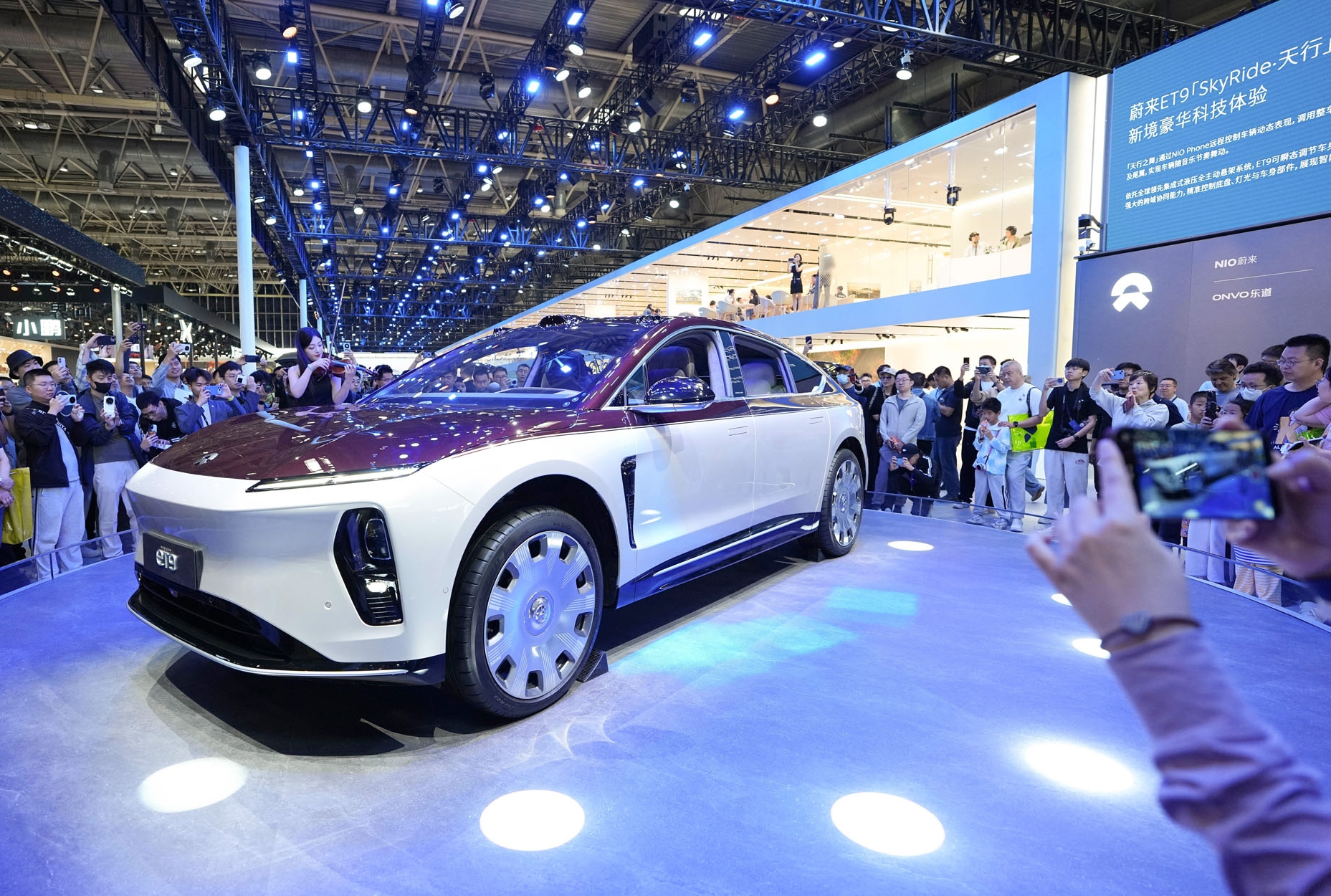
China's auto industry is accelerating its green and high-quality transformation, powered by the rapid growth of new-energy vehicles (NEVs), which signaled a structural shift by accounting for more than half of China's monthly car sales in April.
NEVs made up 53.2 percent of total new car sales in April, up from 47.3 percent a year earlier, according to the China Association of Automobile Manufacturers (CAAM).
In the first four months of 2026, NEV sales reached 4.304 million units, while total auto exports surged 61.5 percent to 3.127 million units, with NEV exports more than doubling to 1.384 million units.
"Recent policy measures have sent positive signals that will help improve domestic demand, consolidate foreign trade advantages and promote stable and high-quality development of the sector," said Chen Shihua, deputy secretary-general of CAAM.
GREEN MOMENTUM
Beyond market share, China's green mobility push is underpinned by rapid technological advances and expanding infrastructure. At last month's Beijing auto show, BYD unveiled a new-generation battery that can add 400 kilometers of range in five minutes, comparable to refueling a conventional car.
Meanwhile, an industry analysis based on enterprise announcements at the show projected that semi-solid-state batteries will see large-scale deployment in vehicles from the second half of 2026 through 2027, with all-solid-state batteries expected to reach small-batch mass production by 2027-2028.
According to market research firm SNE Research Chinese battery makers maintained a leading position in the global electric vehicle battery market in 2025, with six Chinese companies among the world's top 10 holding a combined market share of over 70 percent for the first time.
"New-energy vehicles are shifting from policy-driven to market-driven growth, entering a critical phase of quality improvement," said Wang Qing, deputy head of the market economy research institute at the Development Research Center of the State Council.
Wang also noted that charging infrastructure is rapidly expanding to China's county-level areas, and improved charging networks will unleash greater consumption potential in lower-tier markets.
DEEPENING TIES
"China will deepen exchanges and cooperation with the global automotive industry with a more open attitude, actively integrating into the global industrial chain, innovation chain and value chain," said Fu Bingfeng, executive vice president and secretary-general of CAAM, at an industry forum held in late April.
Stressing the importance of collaboration amid industry-wide transformation, Shailesh Chandra, president of the International Organization of Motor Vehicle Manufacturers, said that "maintaining a global perspective and strengthening international cooperation is increasingly important."
Data released at the forum showed that global vehicle sales reached 99.8 million units in 2025, with growth driven mainly by Asia and emerging industrial centers, while China remained the world's largest auto market.
Concrete cooperation cases underline the shift from mere trade to deep industrial integration. Volkswagen has teamed up with Xpeng in the Chinese city of Hefei to jointly develop new models, while in Brazil, Geely and Renault are investing 5.1 billion yuan (about 745 million U.S. dollars) to produce two NEV models based on Geely's new energy architecture.
Stellantis, which has formed a joint venture with Leapmotor, also considers an expansion of alliance to deploy the Hangzhou-based company's electric vehicle technology across several of its European mass-market brands. Their first co-developed electric vehicle recorded significant sales growth in Europe during the first quarter, data showed.
China's experience in electrification and intelligent technologies can be shared with global partners, ultimately benefiting consumers, according to Yang Xueliang, senior vice president of Geely.
QUALITY UPGRADE
Chinese NEVs are gaining traction with consumers worldwide, not by displacing rivals but by offering competitive value. In Peru, Chinese brands held a 33.7 percent market share, the largest among 25 bestsellers, as of February 2026, according to the Automobile Association of Peru. "It's no longer about where the car is made, but the value it offers," said Marco Reyes, brand manager of Changan Peru.
A survey by consulting firm Horváth found that "a consolidated 55 percent" of European consumers would consider buying a Chinese brand for their next vehicle, while emerging markets exhibit higher acceptance.
Domestically, Chinese brands are moving steadily upmarket, with premium NEVs gaining stronger consumer acceptance. In April, sales of Chinese-brand passenger vehicles captured a record 75 percent of the domestic market, CAAM data showed.
"Through integrated innovation and open global cooperation, we have created a virtuous cycle where technological innovation empowers industrial progress, and industrial progress feeds back into technological advancement," said BYD Chairman Wang Chuanfu. "This helps China's NEV industry consolidate its global presence."
As policy support, including tax incentives and the expansion of charging networks, continues, and as international cooperation deepens, China's auto industry is poised to play a constructive role in shaping a cleaner, smarter and more interconnected global mobility future.