Xinhua | May 9, 2026


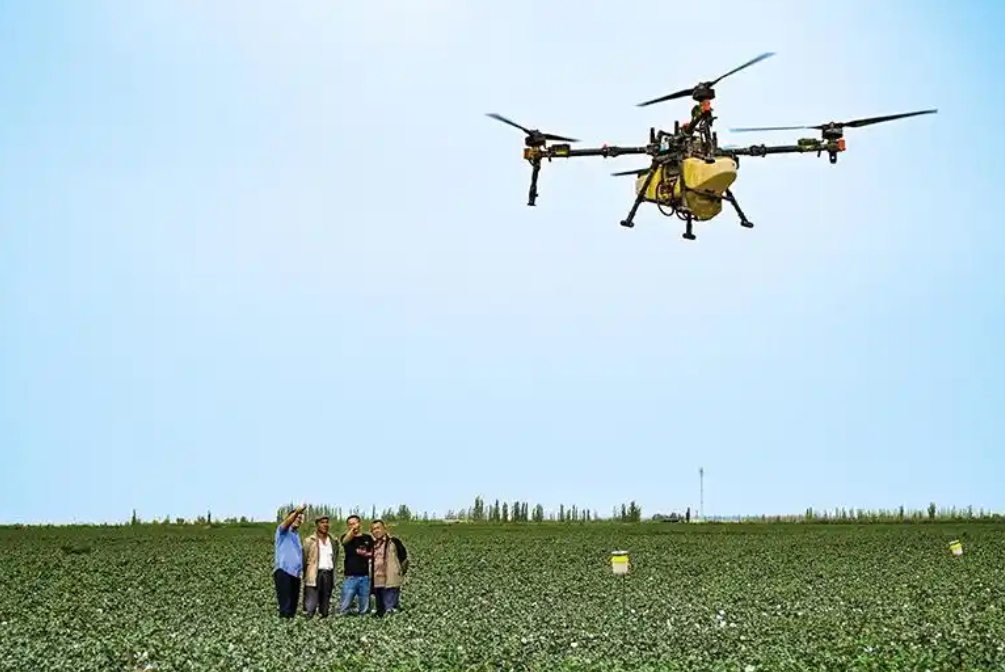
How many hectares of cotton can two people plant? In northwest China's Xinjiang Uygur Autonomous Region, Ai Haipeng and Ling Lei, both born in the 1990s, have a striking answer -- 200 hectares.
The two young men have fully mechanized their cotton field in Yuli County, on the edge of the Taklimakan Desert, covering every step from plowing and harvesting to irrigation.
"We can check everything on our phones and manage the farm anytime," Ai said. "It feels like playing a video game."
The "super cotton field" project shows how Xinjiang is transforming its agriculture. Digital technologies are reshaping traditional farming and speeding up agricultural development in the region.
SMART TRANSFORMATION
The "super cotton field" project started in 2021, when XAG, an agritech robot maker based in the tech hub of Guangzhou in southern China, decided to build an unmanned farm in Xinjiang to develop a replicable smart model. The company tasked Ai and Ling with managing 200 hectares of cotton.
They found that spring sowing and autumn harvest in Xinjiang were already mostly mechanized, with drones and other smart equipment becoming more common each year. The most labor-intensive part of cotton farming was irrigation.
So in the first year, they installed wired smart valves to control irrigation remotely, only to find that buried wires were prone to short circuits. "That year, we were either fixing valves or on the way to fix them," Ling recalled.
Over the next two years, they switched to wireless smart valves and also adopted a "cotton-wheat co-sowing" technique to protect young seedlings from wind.
With support from the company's tech team, the two upgraded to a smart irrigation hub in 2024, making the system more stable. They also had a smartphone app developed, so most farm work can now be done with just a phone.
By 2024, their average seed cotton yield rose from 3,810 kg per hectare in 2021 to 7,935 kg per hectare, with premium cotton exceeding 96 percent -- a national top-tier level.
"We've achieved our first-phase goal of automation, and the next phase is intelligence," Ai said, adding that the team plans to use AI more widely to reduce manual labor even further.
Their success quickly drew farmers from across the region, who came to learn from their advanced practices. By the end of 2025, their management model had been expanded to over 133,000 hectares across Xinjiang.
Building on this momentum, Ai and Ling have been promoting the "super cotton field" management model and training people across China. Meanwhile, XAG has brought its modern agricultural equipment and farming systems to nearly 70 countries and regions worldwide. Beyond cotton, the technology and model have also been adapted for other crops, including rice, corn, citrus, and soybeans.
MECHANIZATION TAKES OVER
Xinjiang accounts for over 90 percent of China's cotton output. In 2025, the region's cotton production exceeded 6 million tonnes for the first time, reaching 6.17 million tonnes -- 92.8 percent of the national total.
In recent years, advances in agricultural technology have become key helpers for Xinjiang's farmers. Mechanization and intelligent facilities are now widely used from planting to harvesting.
The shift to machines began in the 1990s, when the region introduced imported harvesters and gradually increased the area of machine-picked cotton.
Since the start of this century, cotton picking costs have risen sharply, while a growing shortage of seasonal workers left cotton rotting in fields, forcing farmers to turn to machines.
In the 1990s, less than 5 percent of Xinjiang's cotton was machine-picked. Today, that figure has exceeded 90 percent, and overall mechanization in cotton farming has surpassed 97 percent.
Mechanized seeding and harvesting using BeiDou satellite navigation, along with drone-based crop dusting, are now common practices for cotton farming in Xinjiang.
This trend aligns with China's 15th Five-Year Plan (2026-2030), which calls for all-around digital and intelligent support to develop various sectors, including smart agriculture.
Influenced by the "super cotton field" project, farmer Chen Xiujian from Yuli County retrofitted his 333-hectare cotton fields with the same smart valves. In just two years, his workforce dropped from 25 to 13.
The 38-year-old said smart agricultural technology has made young people like him more willing to stay and work on the land.
"I used to hate toiling in the fields. Now it's getting interesting," he said.