Xinhua | April 23, 2026


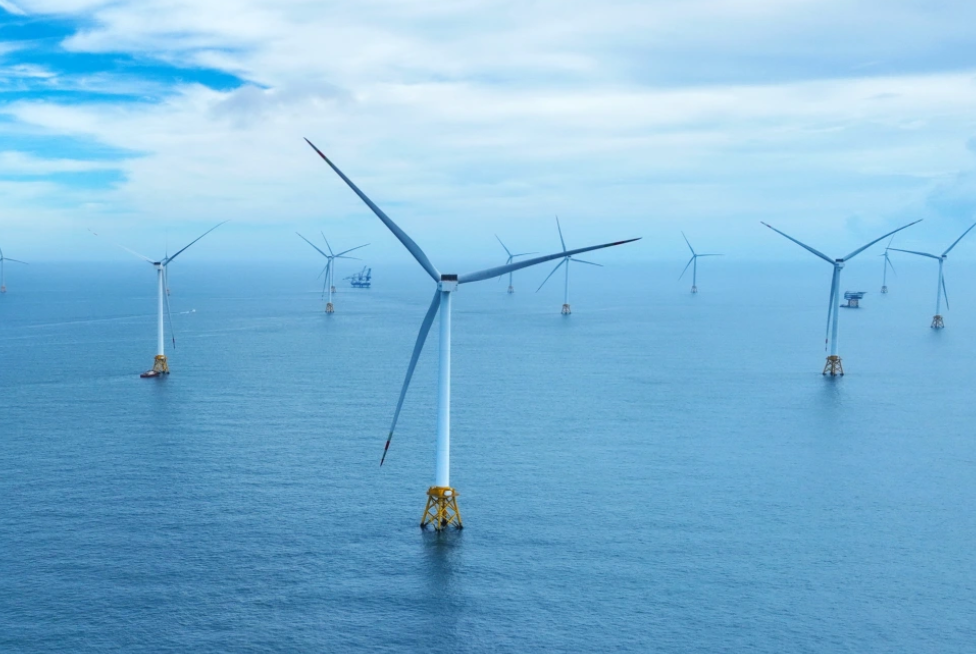
China is ramping up its offshore wind capacity by developing a number of advanced offshore wind projects, accelerating its energy transition, and solidifying its leading edge in the global wind power sector.
Several major offshore wind projects have come online or broken ground across the country's coastal regions this year, setting new benchmarks for long-distance and deep-water operations.
BOOMING WIND FACILITIES
In south China's Guangdong Province, a major offshore wind farm project developed by China Huadian Corporation, situated off the coast of Yangjiang City, has started full-scale construction. Known as China's farthest offshore wind project under development, the facility, located up to 89 km offshore, will generate 1.6 billion kWh of clean power annually and reduce carbon emissions by 1.26 million tonnes upon completion.
Meanwhile, in east China's Shandong Province, the country's deepest operational offshore wind farm has achieved full grid connection. The 504,000-kW project, developed by China Huaneng Group, operates in waters ranging from 52 to 56 meters deep, approximately 70 km offshore. In south China's Hainan Province, a pilot wind project has also commissioned its first grid-connected turbines, which are expected to generate 150 million kWh of clean power per year.
Data from the National Energy Administration shows China's total wind power installed capacity hit 650 million kW at the end of February 2026, up 22.8 percent year on year. Its cumulative offshore wind installed capacity has surpassed 47 million kW, leading the world for five straight years.
Generally, projects with water depths exceeding 50 meters are categorized as deep-sea offshore wind, and those over 65 kilometers from the shore as far-offshore wind.
To further unlock wind energy potential, China is shifting its focus to deeper, more distant waters, where winds are stronger and more stable but pose greater operational challenges.
To address these challenges, advanced technologies have become critical. Cutting-edge foundation designs, BeiDou (China's BeiDou Navigation Satellite System) high-precision positioning, intelligent piling systems, and drone-assisted subsea cable laying have greatly improved construction efficiency and safety for deep-sea wind farms.
ROBUST INDUSTRIAL CHAIN
Building on these technological breakthroughs, China has also developed a robust, clustered offshore wind industrial supply chain, with key hubs in coastal provinces such as Guangdong, Jiangsu, Shandong, and Fujian, covering turbine manufacturing, auxiliary equipment, construction and installation, and operation and maintenance services.
In Shantou, Guangdong Province, local authorities are exploring diversified utilization models for offshore wind to build a world-class high-end offshore wind equipment cluster.
The integrated one-stop service model, encompassing design, process, delivery, and inspection, here reduces land use by 75 percent and triples production efficiency, laying a solid foundation for enhanced global competitiveness.
Key components for wind turbines, including generators, gearboxes, and bearings, are produced and assembled seamlessly within the industrial cluster, reducing long-distance transportation costs and the risk of damage.
The city also boasts a key offshore wind innovation hub, equipped with a world-leading training center and an advanced wind turbine testing platform, which provides professional technical support and performance testing services for the global offshore wind industry.
In Yancheng, east China's Jiangsu Province, China's largest offshore wind industrial cluster has taken shape, with a complete supply chain covering R&D, manufacturing, and operation. Its total wind turbine production capacity accounts for over 40 percent of the national total, and blade production accounts for about 20 percent of the country's output, underpinning China's offshore wind expansion.
Backed by the sound industrial foundation of these clusters, China's offshore wind industry has fostered dozens of national-level specialized enterprises that excel in key segments such as wind turbine bearings, submarine cables, and monitoring sensors, helping address core technical challenges.
BROADER FUTURE
During the 15th Five-Year Plan period (2026-2030), China aims to further develop large-scale offshore wind bases across the Bohai Sea, the Yellow Sea and the East China Sea, and steadily scale up deep-sea wind development. The country targets over 100 million kW of cumulative offshore wind capacity by 2030.
The ambitious build-out will spur massive market demand for wind turbines, marine engineering equipment, and specialized new materials, bringing substantial growth opportunities across the entire industrial chain.
Buoyed by self-reliant technological advances and falling costs, Chinese wind power enterprises have accelerated their "going global" efforts. As of early December 2025, their cumulative export capacity had exceeded 20 million kW across 57 countries and regions, providing high-quality products and services to the global market.
According to Stefan Gsänger, secretary-general of the World Wind Energy Association, the world has roughly 1.2 billion kW in installed wind capacity and 83 million kW in offshore wind capacity. China accounts for over half of global offshore wind installations and boasts the world's largest onshore and offshore wind markets, underscoring its leading role in the global offshore wind industry.