Xinhua | March 27, 2026


As the humid spring breeze drifts in from the South China Sea, Boao, a tranquil town on China's tropical island of Hainan, once again draws global attention.
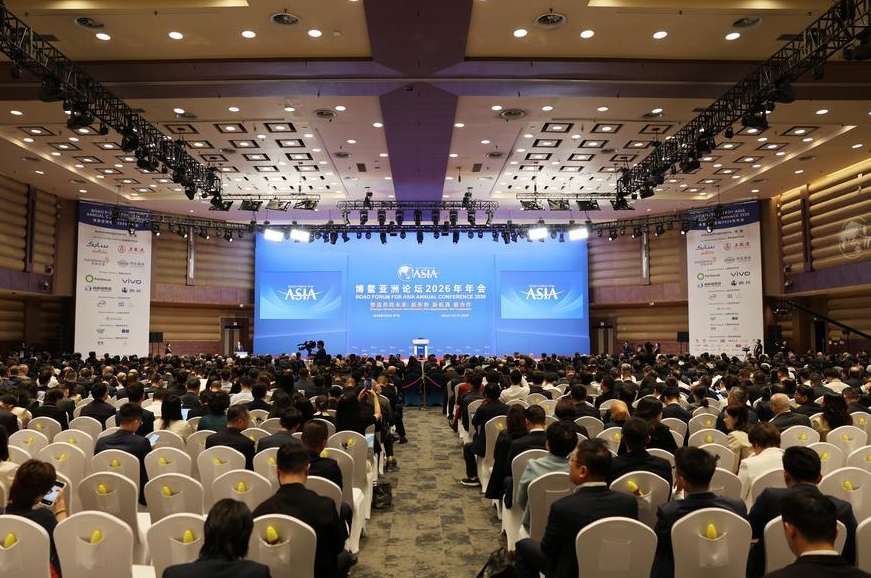
The 2026 annual conference of the Boao Forum for Asia (BFA) is being held here from March 24 to 27 under the theme "Shaping a Shared Future: New Dynamics, New Opportunities, New Cooperation."
As the world faces increasing geopolitical tensions and rising protectionism, policymakers, business leaders and scholars from across the globe have gathered at the resort town with a shared expectation that "Boao voices" can offer clarity, confidence and consensus at a time of mounting uncertainty.
This year marks the 25th anniversary of the BFA. Zhao Leji, chairman of the National People's Congress Standing Committee, said at Thursday's plenary that the forum has become a prestigious platform for promoting exchanges, collaboration and common development among Asian nations and the wider world.
Only by working together in solidarity can humanity address global risks and challenges and create a better future, Zhao said.
This year, participants have widely viewed Boao as more than an annual gathering. It has become a barometer of Asia's confidence and a venue where ideas for a more inclusive and balanced form of globalization are tested, an indication that even in turbulent times, dialogue and cooperation remain within reach.
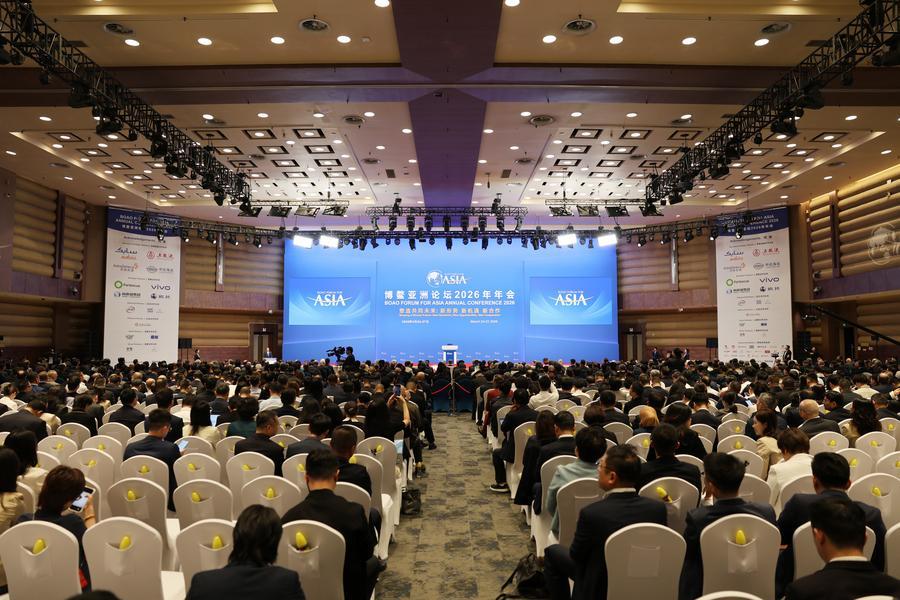
A plenary of the Boao Forum for Asia (BFA) Annual Conference 2026 is held in Boao, south China's Hainan Province, March 26, 2026. (Xinhua/Wang Yiliang)
A QUARTER-CENTURY LONG COMMITMENT
Founded in 2001, the BFA is celebrating its silver jubilee at this year's annual conference, underscoring both its symbolic weight and the scale of Asia's transformation.
Over a quarter century ago, few in this once-quiet fishing village at the mouth of the Wanquan River would have imagined it could command the world's attention one day, nor could they foresee a key platform promoting the development of the whole continent rising from their flake yard.
Yet over the past 25 years, Boao has grown into a platform closely intertwined with Asia's rise, serving as both a witness to and participant in the region's transformation.
When the forum was founded, China's GDP stood at roughly 9.59 trillion yuan (about 1.38 trillion U.S. dollars) and was just a newcomer to the World Trade Organization. Today, the figure has surpassed 140 trillion, with China emerging as a leading advocate of globalization and trade liberalization.
The broader region has followed a similar trajectory, transforming from a fast-moving latecomer into a pace-setter in many fields and turning Asia from a participant in global development into one of its central hubs.
Today, Asia is home to the world's largest population, generates roughly half of global GDP, and serves as a key anchor for globalization and free trade.
"Many people believe that the 'Asian Century' has already arrived," BFA Secretary General Zhang Jun said when addressing a press conference.
A BFA report said Asia remains the world's primary growth engine, with its share of global GDP expected to rise to 49.7 percent in 2026 from 49.2 percent in 2025 on a purchasing power parity basis.
The report also noted that Asia continues to be the premier destination globally for foreign direct investment, recognized for its resilience, growth potential and enduring appeal to global investors, with China and ASEAN leading as the most attractive destinations.
Emphasizing the sweeping changes reshaping the global landscape, along with the rise of unilateralism and protectionism, Ban Ki-moon, BFA chairman and former UN Secretary-General, said that Asia's robust growth has been driven largely by globalization, free trade and regional integration.
"We are proud to be one of the few international organizations that are still committed to rebuilding trust, reuniting solidarity and rekindling cooperation," Ban noted.
"Over the past 25 years, we can recall many pictures when Asia had to overcome a multitude of challenges, ranging from financial crises, non-traditional security issues, public health challenges, natural disasters, even the challenge of having to navigate various potential for disputes in our region," said Marty Natalegawa, BFA board member and former Foreign Minister of Indonesia.
But it is precisely thanks to the Boao forum and similar approaches that Asia, as a region, has grown stronger over the past 25 years, Natalegawa noted.
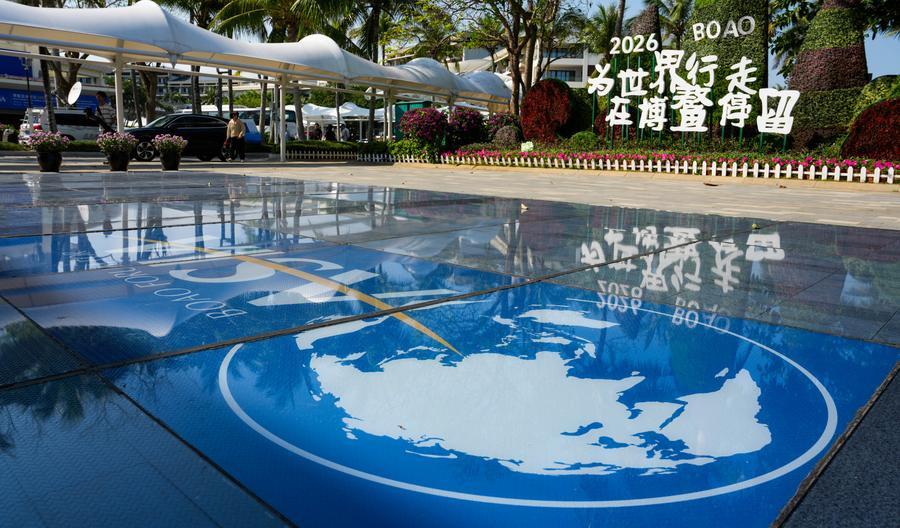
This photo taken on March 23, 2026 shows the outdoor photovoltaic floor tiles in the Boao zero-carbon demonstration zone in Boao, south China's Hainan Province. (Xinhua/Yang Guanyu)
ANSWERS FOR UNCERTAINTY
Unilateralism, protectionism and power politics are on the rise, casting a long shadow over the global outlook. From debates at the World Economic Forum in Davos earlier this year to the latest flare-ups in the Middle East, signs of fragmentation have become increasingly hard to ignore.
There is far more uncertainty than certainty in the world today, Zhang Jun said during this year's BFA annual conference. Many believe Asia plays a crucial role in this context; this also means the BFA carries greater responsibility and a heavier task at a time like this.
At this year's event, China's high-quality development and further opening up took center stage as an answer to the uncertainties in the world.
Facing headwinds including tariffs and global crises, China has demonstrated strong resilience in recent years, injecting invaluable stability into global supply chains, said Denis Depoux, global managing director at Munich-based consultancy Roland Berger.
Over the past five years, China's economy has grown at a notable average annual rate of 5.4 percent. Its contribution to global economic growth has remained at around 30 percent, underscoring its role as a key engine of the world economy.
China unveiled the outline of its 15th Five-Year Plan (2026-2030) at the "two sessions" earlier this month, stirring interest among BFA participants.
"In an increasingly uncertain geopolitical landscape, the new Five-Year Plan provides a level of institutional certainty that is rare globally," said Zheng Yongnian, a renowned scholar and professor at the Chinese University of Hong Kong, Shenzhen.
Highlighting China's status as the largest trading partner for more than 160 countries and regions, Kazakhstan's First Deputy Prime Minister Roman Sklyar echoed this view, noting that China's economic sustainability remains a key pillar of global stability due to its central role in supporting the world economy.
"The 15th Five-Year Plan will not only present opportunities for China, but also for the global community at large," said Sklyar.
Zheng said that the "open-source" nature of Chinese modernization offers a new path to solving the problems of unbalanced and inadequate global development. "China's open-source approach extends the 'ladder' after its own rise, advancing common global modernization through encouraging and assisting other nations' development."
This approach is reflected in China's continued push for opening up. During this year's four-day BFA annual conference, China's Hainan Free Trade Port (FTP), the world's largest FTP by area, marks the 100th day since the launch of the island-wide special customs operations, a landmark policy in China's efforts to promote free trade and expand high-standard opening up.
In the 100 days, total imports and exports of the FTP have exceeded 80 billion yuan, up 32.9 percent year on year.
Underscoring China's commitment to free trade and deeper international cooperation, Zhao Leji, the top legislator, said the country will expand institutional opening up and enhance the quality and standards of trade and investment cooperation.
"China will further expand high-standard opening up and share opportunities and create a better future together with the rest of the world," Zhao said.