Xinhua | March 20, 2026


As China's annual "two sessions" wrapped up, a people-centered vision has taken center stage, aiming to tap domestic demand and guide the economy toward a more sustainable trajectory.
In the outline of the 15th Five-Year Plan (2026-2030), the country's policymakers have set a dual strategy focusing on investment in "both physical assets and people." The government work report also highlighted investment in human capital for the second consecutive year.
Investment in physical assets such as infrastructure and machinery has fueled China's economic boom, but its returns have gradually declined. Meanwhile, global industrial competition is shifting from capital-intensive to talent-intensive. Therefore, it has become imperative to increase investment in human capital to foster innovation-driven and demand-led growth.
"'Investing in people means allocating resources to support their all-round development and their aspirations for a better life, and it is about unlocking human potential, thereby boosting not only social productivity, but people's wellbeing and happiness as well," said Huang Qunhui, a national political advisor and a researcher with the Chinese Academy of Social Sciences.
CULTIVATE TALENT
The strategy of "investing in people" emphasizes the needs of national strategy and industrial upgrading, calling for efforts to cultivate talent in high-end manufacturing and core technologies, said Hou Yongzhi, a deputy to the 14th National People's Congress (NPC) and a researcher at the Development Research Center of the State Council.
China has strong fundamentals for fully tapping human potential. The country is home to nearly 20 million scientists and engineers, and each year, over 5 million students graduate in science, technology, engineering and mathematics from Chinese colleges, the highest number in the world.
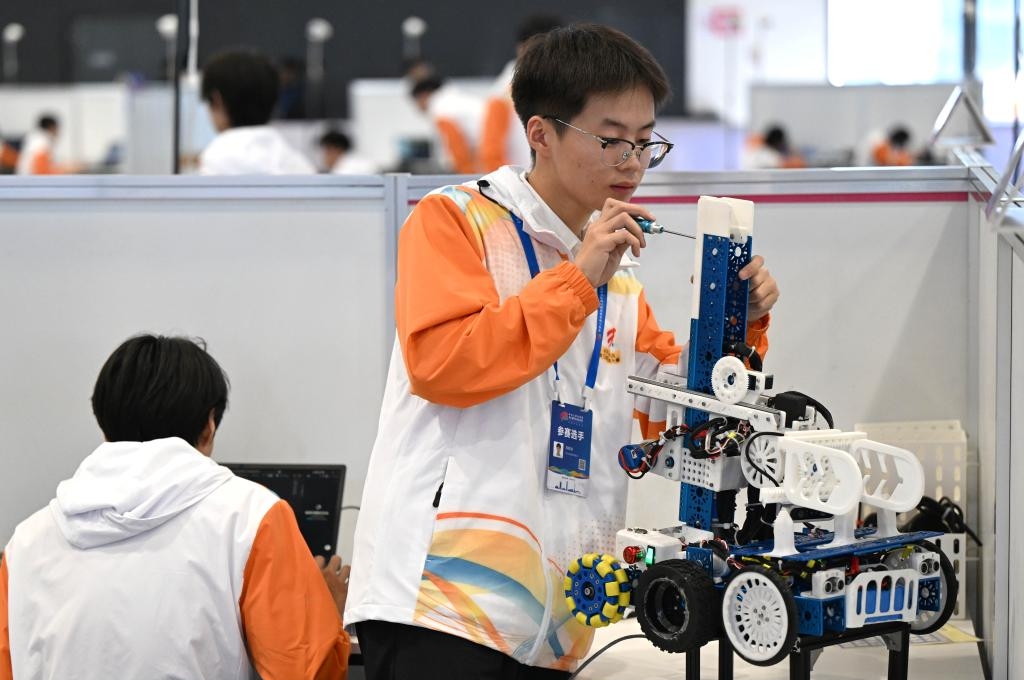
Over the next five years, China will ramp up investment in human capital in response to the rise of new quality productive forces. A reformed education system will prepare students to navigate the rise of artificial intelligence and humanoid robots, while vocational training and lifelong learning will equip the workforce to thrive in an algorithm-driven economy.
"Talent is the primary resource, and its cultivation must be an important direction of 'investing in people,'" said Li Feng, an NPC deputy and head of Shandong's provincial department of finance.
His views were echoed by Fei Gaoyun, another NPC deputy and secretary of the Hefei Municipal Committee of the Communist Party of China, who emphasized the need to coordinate all types of resources, foster an employment-friendly development model, and accelerate the shift from a demographic dividend to a talent dividend.
With a focus on Hefei's leading sectors like integrated circuits, artificial intelligence and new energy vehicles, the city is helping its universities update academic programs and training methods to meet market demands. The efforts have yielded fruitful results, Fei said.
When the workforce gains more knowledge and skills, and their potential for innovation is unleashed, they become a driving force behind technological progress and industrial upgrading, thus injecting sustained momentum into high-quality economic development, said Zheng Changzhong, a professor at Fudan University.
BOOST SPENDING POWER
Zheng believes that "investing in people" not only unlocks innovative potential on the supply side but also unleashes domestic demand potential. Consumption, as the ultimate form of demand, serves as a fundamental driver of economic growth.
The 2026 government work report highlights the need to "advance special initiatives to boost consumption," noting that the country will formulate and implement an income growth plan for urban and rural residents and roll out a range of practical measures to boost the earnings of low-income groups, increase property income, and refine the remuneration and social security systems.
"These pragmatic measures are designed to ultimately boost spending power as consumption will increase when people have more money in their pockets," said Quan Heng, an NPC deputy from the Shanghai Academy of Social Sciences in east China.
Over one third of China's major development targets for the 2026-2030 period will focus on resolving the pressing difficulties and problems that concern the people most, such as education, healthcare, elderly care and childcare services.
"'Investing in people' extends beyond improving their lives today to mitigating future risks. When people no longer feel anxious about major expenses, precautionary savings can be transformed into current consumption, truly unleashing the potential of domestic demand," Zheng said.
Beyond rolling out concrete policy support to enable and reassure consumers, local authorities across China are also creating diverse new consumption scenarios and upgrading the provision of quality services, with the goal of stimulating consumption and tapping into people's desire to spend.
In 2025, the "Su Super League" captured the hearts of Chinese fans, running for nearly six months and attracting more than 2.43 million spectators, with an average of 28,000 per game. Nighttime cultural and tourism zones set up as secondary viewing sites generated over 21 billion yuan (about 3.05 billion U.S. dollars) during that period.
"The 'Su Super League' serves as a model for how sports events can promote the integrated development of culture, tourism and commerce. It fully illustrates that 'investing in people' will open up new opportunities for the modern services sector," said Wang Chengbin, a national political advisor and head of Jiangsu Provincial Federation of Philosophy and Social Sciences.
Wang also noted that, compared with investment in major industrial projects and infrastructure, "investing in people" takes longer to show results, requires a longer-term perspective and delivers less direct returns, making comprehensive planning and careful design essential.
Government departments should focus on delivering basic public services while enhancing policy support to stimulate private investment. By leveraging new technologies such as AI to empower "investing in people," they can create new supply that generates new demand, fostering new platforms, business formats and business models, Wang said.