Xinhua | March 20, 2026


In the early morning, Vo Thi Lan Phuong, a Vietnamese national, crossed the China-Vietnam bridge and, after clearing customs procedures, made straight for the People's Hospital of Hekou Yao Autonomous County in southwest China's Yunnan Province.
Just a few blocks from Vietnam's Lao Cai Province, this "gateway hospital" in China serves not only local communities but also a growing number of patients from Southeast Asia, offering medical care that transcends borders.
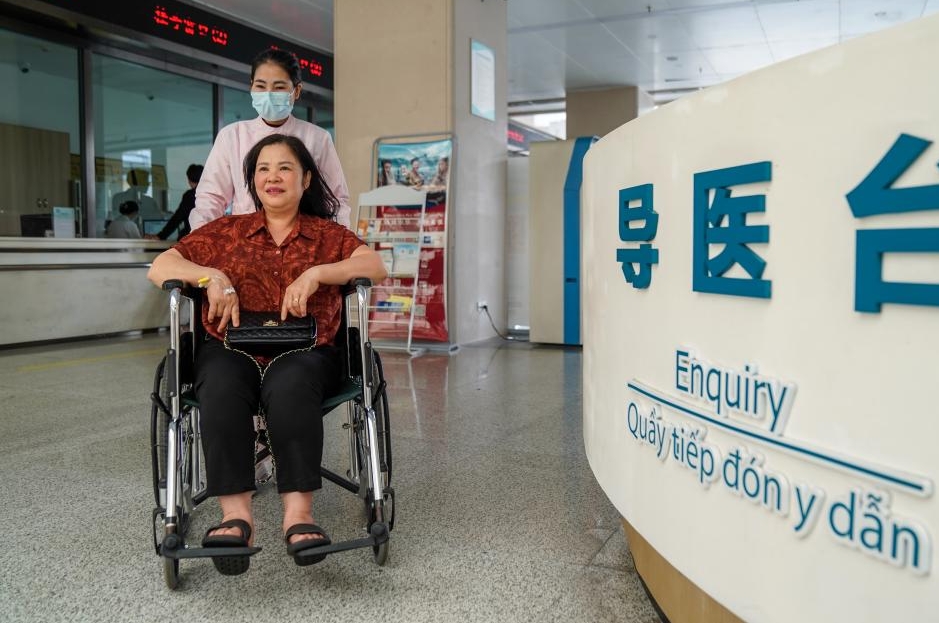
"This is my third time here," said Vo Thi Lan Phuong. Despite the language barrier, staff guided her through registration, consultation and pharmacy pickup. "I feel as safe here as I do at home," she added.
Inside the hospital, signs in Chinese, English and Vietnamese guide patients with ease, while multilingual staff and translation devices help bridge language gaps. For many foreign patients, traditional Chinese medicine (TCM) is a major draw.
In the TCM rehabilitation department, director Gao Haitao unfolded a handwritten thank-you note in Vietnamese from a stroke patient who arrived in a wheelchair. After a month of acupuncture and massage, the patient could walk again with support.
"Thank you, Chinese doctors. I can walk on my own now," the note read.
Nearby, Vo Thi Lan Phuong was undergoing TCM treatment, where ancient diagnostic methods blend with modern technology. Doctors' offices display thank-you notes and banners in various languages, reflecting widespread trust in Chinese medicine.
In the neurology department, Tran Thi Oanh, a Vietnamese doctor, was consulting patients in her native language, her gentle accent putting foreign patients instantly at ease.
"Vietnam raised me, and China trained me," said Tran Thi Oanh, a graduate of Kunming Medical University. Now working in Hekou, she has become a living bridge for cross-border medical exchange.
Growing cross-border mobility is driving demand. In 2025, Hekou Port recorded 6.42 million border crossings, up 11.9 percent year on year.
"As the port thrives, so does foreign patients' need for medical care," said Xu Ankou, president of the hospital. Last year, the hospital treated over 10,000 foreign patients from countries including Vietnam, Thailand, and Laos.
In emergencies, the hospital's role becomes even more critical. A coordinated "green channel" with customs and border agencies accelerates entry and treatment for urgent cases. A Malaysian patient, severely injured in a car accident last April, was rushed through this channel.
Located along the ancient Southern Silk Road, Hekou has long been a hub for China-Southeast Asia exchanges. Today, this "gateway hospital" continues that legacy, one patient at a time.