Xinhua | December 5, 2025


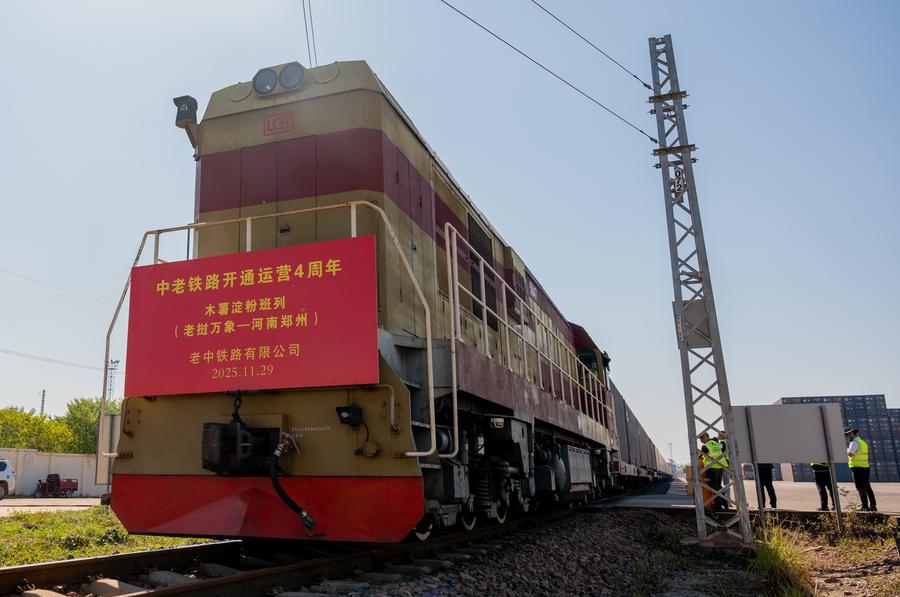

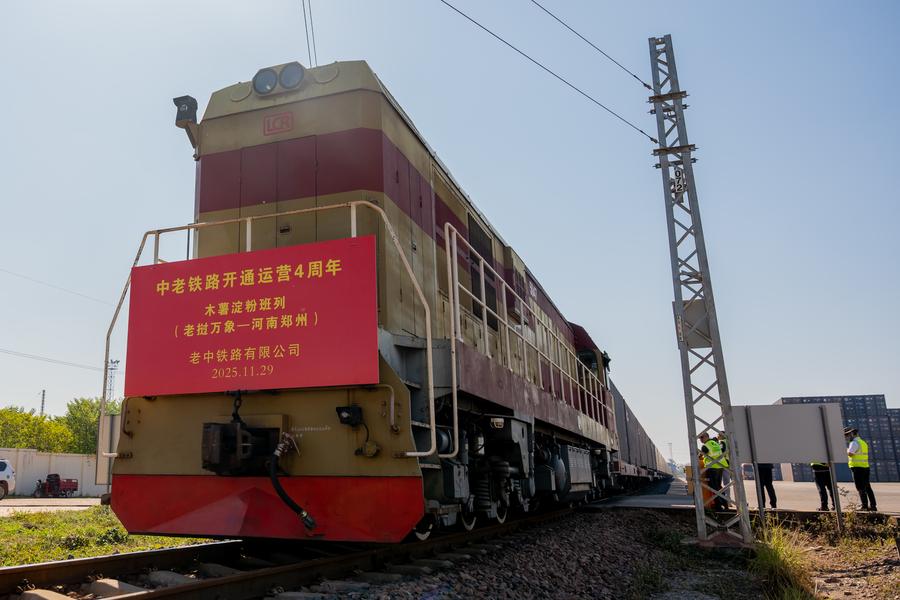
An aerial drone photo shows a container train carrying 1,000 tonnes of cassava starch bound for Zhengzhou, capital of central China's Henan Province, ready to depart from the Vientiane South Station on the China-Laos Railway in Vientiane, capital of Laos, Nov. 29, 2025. (Photo by Kaikeo Saiyasane/Xinhua)
Four years after the China-Laos Railway traversed the rugged mountain ranges, this cross-border line has become far more than a transport corridor. It has won growing trust from Lao people and businesses, while reshaping community livelihoods and serving as a key driver of local economic progress.
Stretching 1,035 kilometers from Kunming in southwest China's Yunnan Province to Lao capital Vientiane, the China-Laos Railway commenced operations on Dec. 3, 2021. To meet growing cross-border travel demand, international passenger train services between Kunming and Vientiane were introduced on April 13, 2023.
Since its launch, the railway has carried over 62.5 million passengers and transported more than 72.5 million tons of cargo, injecting significant momentum into regional economic and social development.
The railway has significantly boosted rail transport, according to Lao Minister of Public Works and Transport Leklay Sivilay, who stressed the government's commitment to developing infrastructure to drive growth, enhance regional and international connectivity, and improve livelihoods.
Before the China-Laos Railway, traveling to northern Laos was difficult and time-consuming due to winding, challenging roads. Since its opening, residents and tourists have embraced the railway for its safety, comfort, and punctuality.
Nantaxay, a resident of Vientiane, told Xinhua on Thursday that the experience of traveling north has changed dramatically. "Traveling to northern Laos used to be tiring and stressful, especially for families or elderly travelers, as unpredictable road conditions made even short trips exhausting," said Nantaxay.
"Now, taking the train is our first choice. It is comfortable, always on time, and we don't have to worry about the road conditions anymore," he added.
Passengers also appreciate the railway staff's consistent maintenance and safety measures, which have earned the growing trust of locals, travelers, and businesses alike.
"I've noticed the staff constantly inspecting the trains and tracks, which gives us confidence," said Tina, an office worker in Vientiane. "After four years of smooth operations, I think the railway has proven itself as a great choice for travel. For me, the best part is not having to face broken roads or traffic; the railway provides a faster and more reliable way to travel," she added.
Tourists traveling on the China-Laos Railway also praise it for its comfort, noting that the train provides a smoother and more enjoyable journey than other modes of transport.
"I always choose the train because the journey is smooth, and I can enjoy the scenery without worrying about traffic or bumpy roads. The best part is that the train is always on schedule," said Noun, a tourist from Thailand.
"The landscapes along the route are the highlight of traveling north on the railway. The train makes the journey stress-free and truly enjoyable," said Bobby, a tourist from the United States.
For businesses, the railway offers faster, lower-cost transportation, allowing products to be delivered on schedule and safely.
The railway has cut logistics costs by up to 50 percent on the route from Kunming to Thailand via Laos, while transport costs within Laos have been reduced by up to 40 percent, according to the China State Railway Group Co., Ltd, operator of the railway's Chinese section.
In late November, a container train carrying 1,000 tons of cassava starch, produced by a local cassava starch processing factory in Laos, departed from Vientiane South Station on the China-Laos Railway to Zhengzhou, capital of central China's Henan Province. It marked the first time cassava starch from Laos has been exported to China via a full train consignment.
To further boost exports, the Laos-China Railway Co., Ltd., operator of the railway's Lao section, said it will continue working closely with Chinese railway authorities to operate regular freight train services for agricultural products in a bid to provide a safe, efficient, and high-quality logistics channel for Lao exporters.

