Xinhua | November 8, 2025



VI. Strong Impetus to Global Climate Governance
Climate change is a common challenge for all humanity, and one that demands widespread participation and collective action to address. Through its commitment to multilateralism and international cooperation, China is now charting a new course for global climate governance.
1. Engaging in and Leading Global Climate Governance
China remains a leader in steering the course of global climate governance. It has actively pushed for the signing, effecting and implementation of the Paris Agreement, and has championed the goals, principles and frameworks set in the United Nations Framework Convention on Climate Change (hereinafter referred to as the Convention) and the Paris Agreement under it. It is committed to the principle of equity and common but differentiated responsibilities and respective capabilities, in a bid to build a fair and rational global climate governance system for win-win results through cooperation.
Participating in the formulation of international rules. China has actively participated in the global climate negotiations agenda in a constructive manner and made historic contributions to the conclusion, signing, effecting and implementation of the Paris Agreement. It has also engaged in negotiations and substantive work via a range of multilateral channels, including the Group of 20, the Intergovernmental Panel on Climate Change, the International Maritime Organization, and the International Civil Aviation Organization outside the Convention, to build broad consensus.
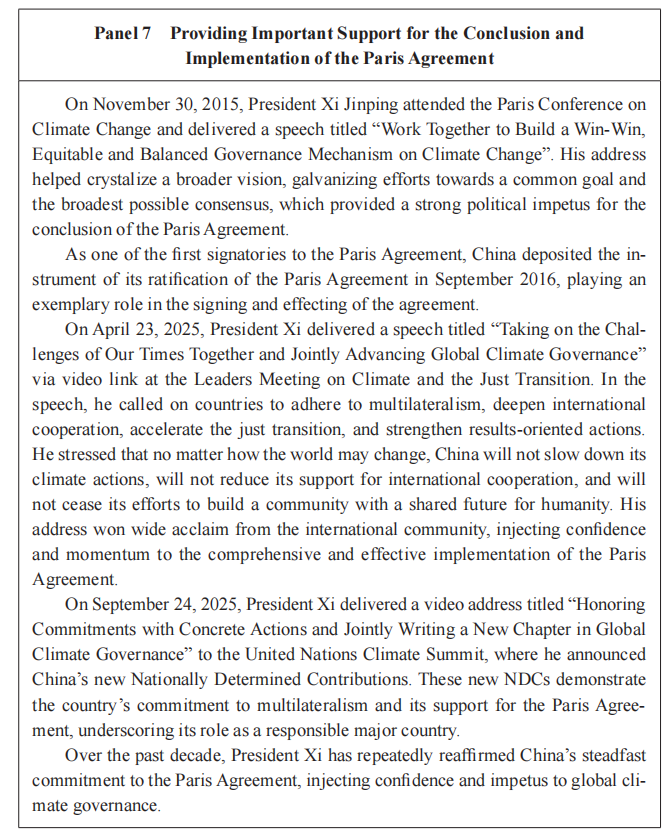
Implementing the Convention and the Paris Agreement. In line with the requirements of the Paris Agreement, China has demonstrated the highest possible ambition in its national climate action plan (also known as NDCs), taken the most substantial measures for action, and advanced its goals resolutely. China has actively fulfilled reporting obligations, compiling and submitting National Greenhouse Gas Inventory, National Communication, Biennial Update Report, and Biennial Transparency Report on a timely basis as mandated, demonstrating high-standard and consistent compliance.
2. Promoting Green Development under the Belt and Road Initiative
With the cooperation in green infrastructure, energy and transport between China and other Belt and Road partner countries continuing to expand, "green" has become the defining feature of high-quality Belt and Road cooperation.
Pragmatic cooperation in green energy. China has built energy cooperation platforms with six regional organizations, namely the Association of Southeast Asian Nations, the League of Arab States, the African Union, Central and Eastern Europe, the Shanghai Cooperation Organization, and the Asia-Pacific Economic Cooperation; established energy partnerships with 34 countries along the Belt and Road; and worked with more than 100 countries and regions on green energy projects. Over the years, China has developed numerous clean power projects in Belt and Road partner countries, contributing to their green energy transition and high-quality development.
Institutional connectivity of standards and norms for green development. China has continued to align its green and low-carbon industrial and technical standards with those of Belt and Road partner countries by promoting mutual recognition of standards for green electricity, green electricity certificates, and carbon footprints. It has improved institutional connectivity with those countries in terms of green projects screening, and environmental and climate information disclosure. The Green Investment Principles for the Belt and Road Initiative have been launched to create an enabling investment environment.
Physical connectivity of green infrastructure. In conducting cooperation with Belt and Road partner countries in the infrastructure of power and transport, China has acted on the principles of low carbon emissions and eco-friendliness throughout the planning, construction and operation processes. This is showcased by projects like the China-Laos Railway, an electrified railway reducing carbon emissions by more than 70 percent compared with traditional diesel locomotives, and the Addis Ababa Ring Road in Ethiopia, which incorporates innovative green solutions such as citywide new energy infrastructure and rainwater recycling systems to significantly reduce energy and resource consumption.
3. Fruitful International Cooperation on Green and Low-Carbon Development
Committed to the principle of common but differentiated responsibilities, China has advanced high-standard and high-quality international cooperation on green and low-carbon development, offering financial, technological and capacity-building support to the best of its ability to countries of the Global South.
Green products trade. China consistently provides quality, efficient and low-carbon energy solutions to the world, particularly to developing countries. Its photovoltaic and wind power equipment and new energy vehicles have been exported to over 200 countries and regions, supplying 70 percent of the world's wind power equipment and 80 percent of photovoltaic panels, which have helped to reduce the global cost of wind and photovoltaic power generation by more than 60 percent and 80 percent, respectively. The wind power equipment and photovoltaic products China exported during the 14th Five-year Plan period have reduced carbon emissions of around 4.1 billion tonnes in other countries.
Green technology cooperation. China has expanded cooperation on green and low-carbon innovation with an open and inclusive approach, initiated international science and technology innovation cooperation plans on carbon neutrality, and built regional international low-carbon organizations and international cooperation platforms for green and low-carbon technology. By the end of October 2025, China had established science and technology cooperation with over 160 countries and regions, signed 120 intergovernmental agreements on science and technology cooperation, and joined over 200 international organizations and multilateral mechanisms in this field.
Deeper South-South cooperation in coping with climate change. China supports other developing countries in building their capacity to respond to climate change through a holistic approach that integrates green vision, green technology, and clean energy. Since 2016, it has provided and mobilized RMB177 billion worth of project funds in this regard. By the end of October 2025, China has signed 55 memoranda of understanding on South-South cooperation to address climate change with 43 developing countries and conducted over 300 sessions of capacity-building programs.

