China SCIO | June 30, 2026


The 4th China-Central and Eastern European Countries (CEEC) Spokespersons Dialogue was held in Beijing on Monday, featuring discussions on the role of government communication in national governance, opportunities and challenges for communication in the age of AI, and shared development through openness and inclusiveness.
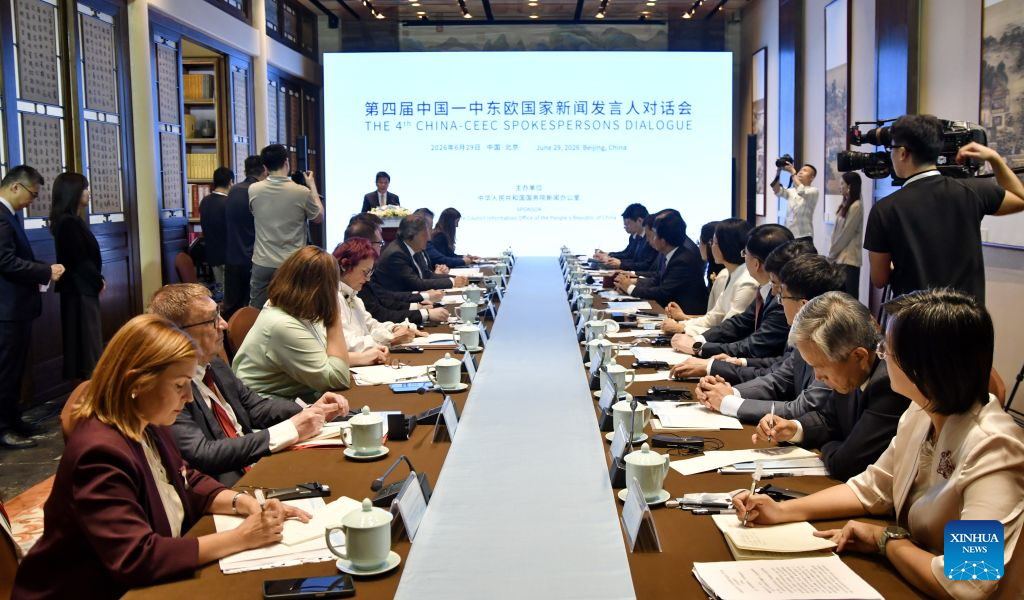
Participants attend the 4th China-Central and Eastern European Countries Spokespersons Dialogue in Beijing, capital of China, June 29, 2026. [Photo/Xinhua]
The event brought together more than 20 spokespersons from China and CEEC. Participants shared their experiences in public communication and discussed one of the most prominent trends of the time: the rise of AI.
Mo Gaoyi, deputy director of the Publicity Department of the Communist Party of China Central Committee and minister of the State Council Information Office of China, said in his keynote speech that in the digital and intelligent era, the ways people access and share information have changed dramatically, placing new demands on reform and innovation in government communication work. In particular, the rapid iteration of AI technologies is profoundly reshaping the ways of information production and dissemination.
He noted that government communication should remain objective, truthful, professional and accurate, while keeping pace with the times by innovating information sharing channels, improving forms of expression, and making communication more effective.
Ivan Maric, spokesperson of the Ministry of Foreign and European Affairs of the Republic of Croatia, shared the story of Marco Polo in his keynoted speech, highlighting the enduring power of storytelling in public communication. "People remember stories. They remember symbols. They remember examples. Facts matter, but facts need meaning," he said.
Maric also addressed the role of new technologies, saying that AI can support communication efforts, but should remain a tool rather than a substitute for human judgment.
"AI is like a knife. It can be a good tool to cut something, to help somebody, but it can also be used in a different way, which is not always positive," Maric said in an interview on the sidelines of the event. He said that human judgment will not be replaced, as people still need sensitivity and intuition to assess whether AI-generated content is accurate and appropriate for specific situations.
Matija Miklavcic, head of media affairs for the secretary-general of the National Assembly of Slovenia, also emphasized the need to combine AI capabilities with human judgment. "Human judgement remains essential, particularly when dealing with legal procedure or sensitive matters," he said.
He noted that the future lies not in replacing human judgement with AI, but in using AI responsibly to help communication services work fast, analyze information more effectively, and provide better services to citizens. However, he stressed that transparency, accuracy, accountability, and professional oversight must remain at the center of communication.
Gong Xian, spokesperson of the Ministry of Industry and Information Technology of China, invited guests to try on AI glasses with simultaneous interpretation functions. Gong said that AI can support government information release in three major aspects: improving the presentation of topics to better reflect public concerns and adapt to communication trends in the mobile internet era; enabling more targeted communication and greater efficiency; and strengthening the collection of public feedback and intelligent analysis of public opinion.
At the same time, AI has created new challenges, including fake images, fabricated videos, and misinformation, which require a coordinated response, Gong added.
Piotr Gadzinowski, head of media affairs of the New Left within Poland's ruling coalition, said the threat to social communication is not AI but the human desire to manipulate. He stressed that the future of social communication is a "human-led, AI assisted" model, underscoring the importance of citizens' trust in public communication.
Olivera Cvetkovska-Janushevska, an advisor on public relations of North Macedonia, said the essence of communication lies not in how much information is transmitted, but in how much understanding is created.
The dialogue concluded with the release of the Beijing Consensus. Representatives agreed to strengthen multilateral exchanges, build sustained and professional communication platforms, and foster people-to-people ties.

