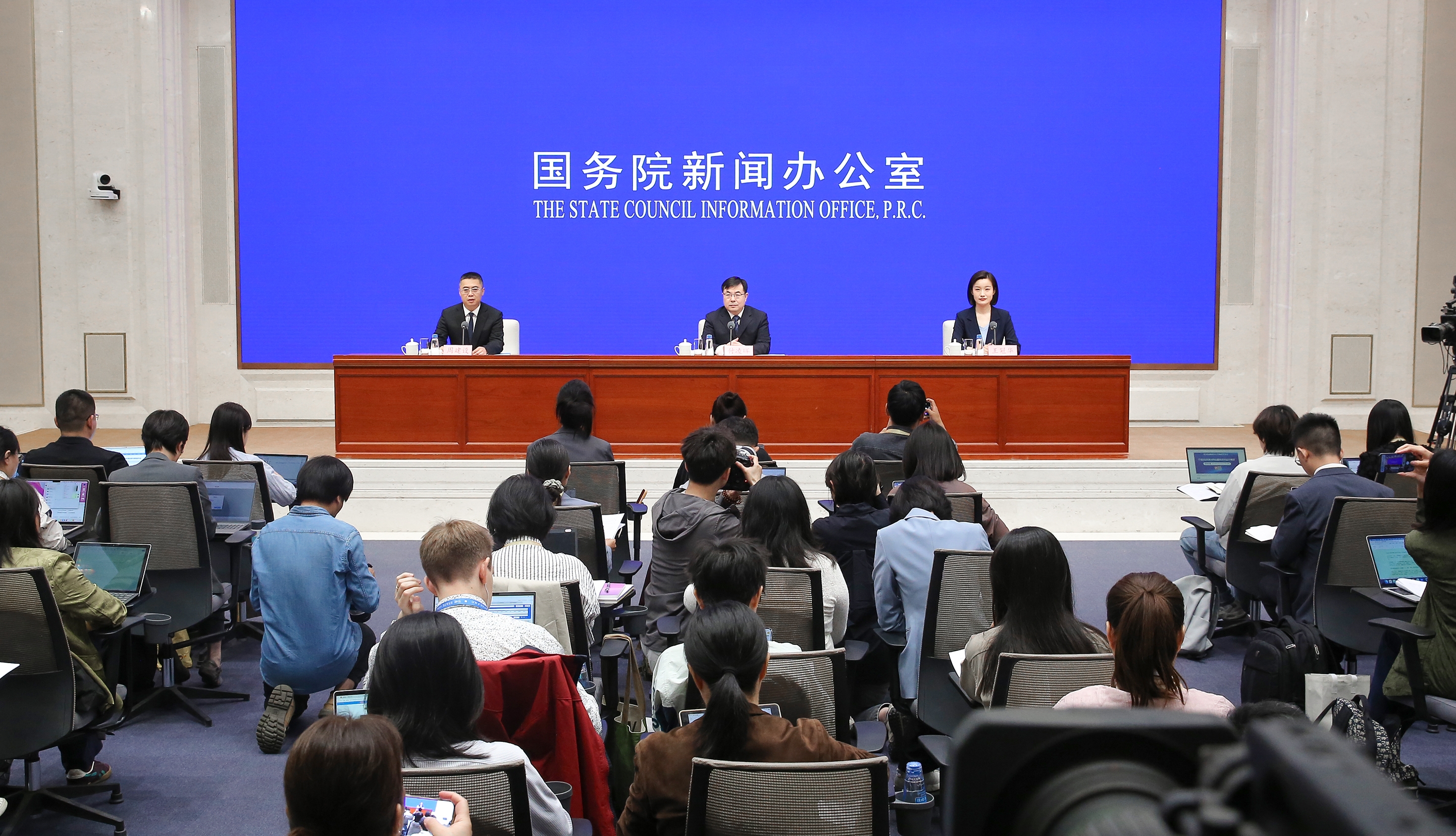

SCIO briefing on China's economic performance in April 2026
Beijing | 10 a.m. May 18, 2026
Speakers

Fu Linghui, spokesperson and chief economist of the National Bureau of Statistics (NBS) and director general of the Department of Comprehensive Statistics of the NBS
Wang Guanhua, spokesperson of the NBS and deputy director general of the Department of Comprehensive Statistics of the NBS
Chairperson
Speakers:
Mr. Fu Linghui, spokesperson and chief economist of the National Bureau of Statistics (NBS) and director general of the Department of Comprehensive Statistics of the NBS
Ms. Wang Guanhua, spokesperson of the NBS and deputy director general of the Department of Comprehensive Statistics of the NBS
Chairperson:
Mr. Zhou Jianshe, deputy director general of the Press Bureau of the State Council Information Office (SCIO) and spokesperson of the SCIO
Date:
May 18, 2026
Zhou Jianshe:
Ladies and gentlemen, good morning. Welcome to this press conference held by the State Council Information Office (SCIO). This is a regular briefing on China's economic data. Today, we are joined by Mr. Fu Linghui, spokesperson and chief economist of the National Bureau of Statistics (NBS) and director general of the Department of Comprehensive Statistics of the NBS, and Ms. Wang Guanhua, spokesperson of the NBS and deputy director general of the Department of Comprehensive Statistics of the NBS, to brief you on China's economic performance in April 2026 and then take your questions. Now, I'll give the floor to Mr. Fu for his introduction.
Fu Linghui:
Thank you. Friends from the media, good morning. As usual, I will start by briefing you on the main economic indicators for this April, and then we will take your questions.
The national economy maintained steady growth momentum in the first four months.
From January to April, under the strong leadership of the Central Committee of the Communist Party of China (CPC) with Comrade Xi Jinping at its core, all regions and departments fully implemented the decisions and arrangements made by the CPC Central Committee and the State Council, adhered to the general principle of pursuing progress while ensuring stability, fully and faithfully applied the new development philosophy on all fronts, and moved faster to foster a new pattern of development. All regions and departments implemented more proactive and effective macro policies and focused on keeping employment, enterprise operations, markets and expectations stable. As a result, production and supply grew steadily, market sales expanded, foreign trade demonstrated strong resilience, employment and prices were generally stable, new growth drivers witnessed robust development, and high-quality development advanced toward greater innovation and stronger performance.
First, industrial production grew rapidly, as did equipment manufacturing and high-tech manufacturing.
In the first four months, the total value added of industrial enterprises above designated size grew by 5.6% year on year. In terms of sectors, the value added of mining increased by 5.5% year on year, that of manufacturing grew by 5.8%, and that of the production and supply of electricity, thermal power, gas and water went up by 4.5%. The value added of equipment manufacturing increased by 8.7% year on year and that of high-tech manufacturing increased by 12.6%, which were 3.1 percentage points and 7.0 percentage points faster than that of industrial enterprises above designated size, respectively. In terms of ownership, the value added of state-controlled enterprises was up by 4.4% year on year; that of share-holding enterprises was up by 6.0%; that of enterprises funded by foreign investors and investors from Hong Kong, Macao and Taiwan was up by 3.9%; and that of private enterprises was up by 5.2%. In terms of products, the production of 3D printing devices, lithium-ion batteries and industrial robots grew by 50.9%, 36.0% and 25.7% year on year, respectively. In April, the value added of industrial enterprises above designated size increased by 4.1% year on year, or up by 0.05% month on month. In April, the Manufacturing Purchasing Managers' Index stood at 50.3%; and the Production and Operation Expectation Index was 54.5%, 1.1 percentage points higher than that of the previous month. In the first three months, the total profits made by industrial enterprises above designated size were 1,696.0 billion yuan, up by 15.5% year on year.
Second, the service sector grew steadily and modern services developed well.
In the first four months, the Index of Services Production grew by 4.9% year on year. Specifically, that of information transmission, software and information technology services, leasing and business services and finance grew by 10.9%, 9.3% and 6.7% year on year, respectively. In April, the Index of Services Production increased by 4.3% year on year. In the first three months, the business revenue of service enterprises above designated size grew by 6.5% year on year. In April, the Business Activity Index for Services stood at 49.6%; and the Business Activity Expectation Index for Services was 55.4%, 0.6 percentage point higher than the previous month. Specifically, the Business Activity Index for railway transportation, postal services, and telecommunication, broadcast, television and satellite transmission services stayed within the high expansion range of 55.0% and above.
Third, market sales expanded and the growth of service retail sales accelerated.
In the first four months, the total retail sales of consumer goods reached 16,494.1 billion yuan, up by 1.9 % year on year. Analyzed by different areas, the retail sales of consumer goods in urban areas reached 14,292.1 billion yuan, up by 1.8% year on year, and that in rural areas stood at 2,202.0 billion yuan, up by 2.8%. Grouped by consumption patterns, the retail sales of goods were 14,605.8 billion yuan, up by 1.7%; and catering revenue was 1,888.3 billion yuan, up by 3.8%. Sales of essential goods and certain upgraded goods grew quickly. The retail sales of grain, oil and food, of clothes, shoes, hats and textiles, and of communication equipment by enterprises above designated size increased by 8.6%, 8.1% and 17.7% year on year, respectively. In April, the total retail sales of consumer goods went up by 0.2% year on year, or down by 0.48% month on month. In the first four months, the retail sales of services went up by 5.6% year on year, 0.1 percentage point faster than that of the first three months. Specifically, that of communication and information services, tourism consulting and rental services, cultural, sports and leisure services and transportation and mobility services grew quickly. In the first four months, the online retail sales of goods and services reached 6,530.8 billion yuan, up by 6.6% year on year. Specifically, the online retail sales of goods were 4,118.5 billion yuan, up by 5.7%, accounting for 25.0% of the total retail sales of consumer goods; and the online retail sales of services totaled 2,412.3 billion yuan, up by 8.3%.
Fourth, investment in fixed assets declined year on year, while investment in high-tech industries grew quickly.
From January to April, the country's fixed-asset investment (excluding rural households) reached 14.1293 trillion yuan, down 1.6% year on year. Excluding real estate development investment, fixed-asset investment increased by 1.3%. Specifically, investment in intellectual property products increased by 8.9% year on year. By sector, investment in infrastructure grew by 4.3% year on year, that in manufacturing grew by 1.2%, and that in real estate development declined by 13.7%. The floor space of newly built commercial buildings sold was 252.58 million square meters, down by 10.2% year on year; and the total sales of newly built commercial buildings reached 2.3 trillion yuan, down by 14.6%. By industry, investment in the primary industry went up by 10.1% year on year, that in the secondary industry was up by 2.5%, and that in the tertiary industry was down by 4.2%. Private investment declined by 5.2% year on year. Excluding real estate development investment, private investment declined by 1.9%. Investment in high-tech industries increased by 6.1% year on year. Specifically, investment in the manufacture of aircraft, spacecraft and related equipment, in the manufacture of computers and office equipment, and in information services increased by 17.9%, 13.9% and 18.1%, respectively. In April, fixed-asset investment (excluding rural households) fell 2.36% month on month.
Fifth, imports and exports of goods grew quickly and the trade structure continued to be optimized.
From January to April, the total value of imports and exports of goods was 16.2252 trillion yuan, up by 14.9% year on year. Specifically, exports accounted for 9.328 trillion yuan, up by 11.3%; and imports were 6.8972 trillion yuan, up by 20.0%. General trade imports and exports increased by 8.5% year on year. Imports and exports with Belt and Road partner countries grew 13.5%. Imports and exports by private enterprises increased by 15.9%. Exports of mechanical and electrical products increased by 17.6%. In April, the total value of imports and exports of goods was 4.3778 trillion yuan, up by 14.2% year on year. Specifically, the total value of exports was 2.4817 trillion yuan, up by 9.8%; and the total value of imports was 1.896 trillion yuan, up by 20.6%.
Sixth, employment was generally stable and the surveyed urban unemployment rate declined.
From January to April, the average surveyed urban unemployment rate was 5.3%. In April, the surveyed urban unemployment rate was 5.2%, 0.2 percentage point lower than the previous month. The surveyed unemployment rate of population with local household registration was 5.3%. For the non-local household registration, it was 5.0%, among which, the rate of the population with non-local agricultural household registration was 5.0%. The surveyed urban unemployment rate in 31 major cities was 5.2%, which was 0.1 percentage point lower than the previous month. Employees of enterprises worked an average of 48.0 hours per week.
Seventh, consumer prices increased moderately, while the increase in producer prices widened.
From January to April, the Consumer Price Index (CPI) rose 0.9% year on year. Grouped by commodity categories, prices for food, tobacco, alcohol, and catering services were up by 0.2% year on year; clothing prices rose 1.7%; housing prices fell by 0.2%; articles for daily use and services rose by 2.0%; transportation and communication prices rose 0.3%; education, culture and recreation grew up by 1.1%; medical services and healthcare went up by 1.9%; and other articles and services were up by 13.3%. Within the category of food, tobacco, alcohol and catering services, prices for pork went down by 12.2%, grain down by 0.3%, fresh fruits up by 3.0%, and fresh vegetables up by 5.7%. The core CPI, excluding the prices of food and energy, grew by 1.2% year on year. In April, national CPI rose 1.2% year on year, 0.2 percentage point higher than March, or up 0.3% month on month.
From January to April, the Producer Price Index for industrial products (PPI) increased by 0.2% year on year. Specifically, the prices in April went up by 2.8% year on year, 2.3 percentage points lower than the growth in the previous month, or up by 1.7% month on month. From January to April, the purchasing price index for industrial producers increased by 0.5% year on year. Specifically, the prices in April went up by 3.5% year on year, an increase of 2.7 percentage points from the previous month, and went up by 2.1% month on month.
Overall, the national economy maintained a steady and progressive development trend from January to April, with solid progress in high-quality development. However, it should also be noted that the external situation is complex and volatile, the domestic contradiction of strong supply and weak demand remains pronounced, some enterprises are experiencing operational difficulties, and the foundation for sustained economic improvement needs to be consolidated. In the next stage, we must adhere to the guidance of Xi Jinping Thought on Socialism with Chinese Characteristics for a New Era, uphold the general principle of seeking progress while maintaining stability, and fully and faithfully implement the new development philosophy on all fronts. We will move faster to create a new pattern of development, and implement more proactive fiscal policies and moderately loose monetary policies in a targeted and effective manner. We will continue to expand domestic demand and optimize supply, improve incremental growth while revitalizing existing stock, and enhance the internal drivers of economic development. We will further strengthen the domestic economic circulation and optimize the dual circulation of domestic and international markets to promote sustained and sound economic development. Thank you.
Zhou Jianshe:
Thank you for your introduction, Mr. Fu. The floor is now open for questions. Please identify the media outlet you represent before asking your questions.
_ueditor_page_break_tag_CCTV:
In the first quarter of this year, China's GDP grew by 5.0% year on year, achieving a good start. How do you view the performance of the main economic indicators since the beginning of this year? And how do you evaluate the current economic situation? What are the highlights? Thank you.
Fu Linghui:
Thank you for your questions. Since the beginning of this year, the international environment has undergone complex changes. In April, the international environment was complex and challenging. The spillover effects of geopolitical conflicts continued to emerge, the global energy market fluctuated significantly, and the recovery of the world economy faced growing difficulties. Amid the complex situation, all regions and departments have adopted comprehensive measures and effectively implemented a more proactive fiscal policy and a moderately loose monetary policy. The national economy has maintained a momentum toward innovation-driven and high-quality development, demonstrating strong resilience and vitality. The main achievements have been as follows:
First, production supply continued to grow. Meeting the people's needs in production and daily life requires the supply of goods and services, and achieving economic development requires sustained production growth. With the support of various policies, production and supply have maintained sustained growth this year, effectively meeting the needs of all sectors. In the industrial sector, from January to April, the value added of industrial enterprises above designated size grew by 5.6% year on year, maintaining relatively rapid growth. Specifically, the equipment manufacturing industry showed strong growth, providing solid support for industrial upgrading and consumption expansion. From January to April, the added value of the equipment manufacturing industry increased by 8.7% year on year, contributing more than 50% to the growth of industries above designated size. From the perspective of the service sector, the Index of Service Production increased by 4.9% year on year from January to April, remaining generally stable. The modern service industry has also developed well. From January to April, the Index of Service Production of information transmission, software and information technology services, as well as rental and business services, increased by 10.9% and 9.3% year on year, respectively, continuing to maintain a good momentum of development.
Second, employment and prices remained generally stable. Employment reflects the utilization of labor in the production of goods and services, while prices reflect the relationship between market supply and demand. From the perspective of employment, the national surveyed urban unemployment rate in April was 5.2%, down 0.2 percentage point from the previous month. The unemployment rate for the 30-59 age group was 4.2%, lower than that of the previous month. The employment situation remained generally stable. In terms of prices, CPI rose 1.2% year on year in April, with the increase expanding by 0.2 percentage point from the previous month, maintaining a moderate upward trend. The core CPI, excluding food and energy, rose by 1.2%, remaining generally stable. Stable employment and prices actually reflect the inherent logic of a stable economy.
Third, development momentum has been upgraded and optimized. The leading role of innovation continues to take effect, digital and green transformation is being promoted in depth, and new drivers of economic development are growing rapidly. High-end manufacturing maintained strong momentum. The added value of high-tech manufacturing enterprises above designated size increased by 12.6% year on year from January to April, continuing to maintain rapid growth. In high-end manufacturing, the added value of industries such as aircraft manufacturing and biopharmaceutical manufacturing increased by 25.7% and 12%, respectively. Emerging industries are gaining momentum. The digital economy is expanding rapidly, and industries such as electronics, information and communication are showing strong growth. The added value of the computer, communication and other electronic equipment manufacturing industry increased by 14% from January to April. New drivers of growth in the service sector continued to strengthen, with operating revenue of strategic emerging service enterprises above designated size increasing by 7.1% in the first quarter. With the rapid development of artificial intelligence, its role in driving industrial development has continued to strengthen. From January to April, the output of robot reducers and industrial robots increased by 73.3% and 25.7%, respectively.
Fourth, resilience and vitality continued to be demonstrated. Amid a turbulent international environment, global industrial and supply chains have come under strain. China has actively expanded its high-level opening up, relying on its complete industrial system and continuously improving product and service quality to promote rapid growth in foreign trade, injecting stability and certainty into the world economy. The total value of imports and exports of goods increased by 14.9% year on year from January to April. From the perspective of major trading partners, from January to April, China's imports and exports of goods to ASEAN, the EU and BRI partner countries all maintained double-digit growth. From the perspective of exports, new competitive advantages in the market are gradually being established, and exports of green products and high-tech products are growing rapidly. From January to April, China's exports of green and low-carbon products such as electric vehicles and wind turbines increased by more than 40%, while exports of high-tech products increased by 27.6%. From the perspective of imports, China's large market is becoming increasingly attractive to the world. From January to April, China's goods imports increased by 20% year on year. Imports from Latin America and Africa increased by 25.1% and 11.2%, respectively.
It should also be noted that in the face of fluctuations in the international energy market, China has actively stepped up efforts to ensure energy supply, implemented temporary price regulation and increased investment in people's livelihoods, thereby ensuring overall stability in domestic production and people's lives, and achieving positive results. These steps fully demonstrate that China's economy has a strong ability to cope with external risks and shocks, continues to move toward innovation- and quality-oriented development, and has achieved new results in high-quality development. Of course, we must also recognize that there are many uncertainties and destabilizing factors in the international environment, the impact of geopolitical conflicts continues to increase, the contradiction between strong supply and weak demand in the domestic market remains prominent, some enterprises are experiencing operational difficulties, and the foundation for sustained and steady economic growth still needs to be consolidated.
In the next stage, we will fully implement the decisions and plans of the CPC Central Committee and the State Council, strengthen the regulation role of macroeconomic policies, continue to expand domestic demand and improve supply, and deepen reform and opening up to further bolster domestic circulation, optimize the dual circulation of domestic and international markets, and foster sustained and sound economic development. Thank you.
_ueditor_page_break_tag_Jimu News:
We have noticed that some economic indicators fluctuated in April compared to March. Is this due to seasonal factors or does it reflect a certain changing trend? How should we view the trajectory of China's economy going forward? Thank you.
Fu Linghui:
Thank you for your questions. I would like to invite Ms. Wang to answer your questions.
Wang Guanhua:
Thank you for your questions. This year marks the start of the 15th Five-Year Plan period, and all sectors are paying close attention to the trends in China's economy. In the first quarter, the economy got off to a good start. Based on the data recently released for April, the economy continued its trend toward innovation- and quality-oriented development, demonstrating strong resilience and vitality in a complex and ever-changing external environment. This situation has not come easily. Regarding the economic trends in the next stage, we should take a comprehensive and dialectical view. While recognizing internal and external pressures and challenges in economic operations, we should be more aware that the internal driving force for the steady and positive economic development has not changed and will not change. We have opportunities for industrial upgrading brought about by the development of new quality productive forces, the dynamism and vitality stimulated by further comprehensive and in-depth reforms, and the policy reserves and work preparations to address risks and challenges. We have a good foundation and conditions for promoting steady and positive economic development.
First, despite facing new difficulties and challenges at home and abroad, the momentum of steady growth for the domestic economy remains unchanged. The slowdown in the growth rate of some indicators in April is a normal fluctuation between months. Judging from the cumulative indicators, macro indicators and some structural indicators, the steady growth momentum for China's economy has not changed. In the first four months of this year, the value added of industrial enterprises above designated size and the Index of Service Production increased by 5.6% and 4.9% year on year, respectively. The total value of imports and exports of goods increased by 14.9%, and retail sales of services increased by 5.6%. At the end of April, foreign exchange reserves exceeded $3.4 trillion. The surveyed urban unemployment rate remained stable, energy supply increased steadily, and people's basic living needs and secure development were well safeguarded. China is a super-large economy. When observing its economic performance, the key is to look at the overall situation and trend. China's economy has long been advancing by surmounting numerous difficulties and obstacles, and has also been actively adjusting itself by recognizing, responding to and seeking changes. After many years of development, we have gained a more solid material and technological foundation, a more resilient industrial system and a broader domestic market, enhancing the resilience and flexibility of economic development. These facts demonstrate the stable foundation, numerous advantages, strong resilience and huge potential of the Chinese economy, and also reflect the confidence and strength to maintain stable economic operation in the next stage. This is the first point I want to emphasize.
The second supporting factor comes from the cultivation and expansion of new growth drivers and new advantages, which has opened up space and accumulated strength for high-quality development. The performance of the Chinese economy demonstrates its growth resilience and also reveals profound changes toward innovation- and quality-oriented development. In recent years, China's innovation achievements and major breakthroughs have attracted worldwide attention. Technological innovation has driven the upgrading of industries, and new growth drivers such as advanced manufacturing, the modern service industry and green and low-carbon industry have emerged continuously. Many emerging industries have been built from scratch, grown in size and become stronger, gradually becoming key pillars for high-quality development. For example, the equipment manufacturing industry has been the most outstanding sector in China's manufacturing development for many consecutive years. In the first four months of this year, the equipment manufacturing industry's share of the value added of industrial enterprises above designated size rose to 35.7%, contributing more than 50% to the growth of the value added of industrial enterprises above designated size. On a monthly basis, with the growth rate accelerating month by month, and the contribution share increasing, the equipment manufacturing industry has effectively played a key role in stabilizing and supporting the economy. As another example, the digital economy and artificial intelligence have shown strong spillover effects. In addition to directly boosting investment in industries such as electronics, computing power enhancement and servers, they have also driven coordinated growth in upstream industries such as chemicals and electricity that provide raw materials and basic energy security along the industrial chain. China's green and low-carbon industries are also booming, and the international competitiveness in fields such as new energy vehicles, photovoltaics and lithium batteries continues to improve. In addition to these performances in the production sector, similar characteristics have also been observed in the consumption and investment sectors. The consumer market is expanding from the consumption of goods to services, and from meeting basic needs to pursuing quality experiences. Emerging fields such as high-end equipment, green energy and intelligent manufacturing continue to see an expansion in investment and production capacity. The cultivation and development of these new growth drivers is not something that can be achieved overnight or in one fell swoop, but rather a process of long-term efforts and gradual accumulation, and the result of the combined driving forces of policy guidance, market demand and technological innovation. This profound transformation is reshaping the driving force of China's development momentum and continuously enhancing the resilience and sustained momentum for high-quality development.
The third factor is the sustained combined effects of macroeconomic policies, which will safeguard economic operations. The policies of implementing major national strategies and building up security capacity in key areas as well as promoting large-scale equipment renewals and consumer goods trade-ins deployed by the CPC Central Committee and the State Council are being promoted on schedule. At the same time, the central government budgetary investment, ultra-long-term special treasury bonds and local government special-purpose bonds are also being accelerated. Recently, the focus has been on high-quality development, with a series of policies introduced to promote the expansion and upgrading of the service industry, ensure the security of the industrial and supply chains, deepen the reform of the investment approval system, and regulate industry order. Some of these policies have already begun to take effect, while the effects of others will continue to emerge. The meeting of the Political Bureau of the CPC Central Committee held at the end of April made comprehensive arrangements for the economic work in the next stage, and all regions and departments are accelerating the implementation and strengthening policy coordination. Overall, China has a rich toolbox of macroeconomic policies, with ample means and space for cross-cyclical and counter-cyclical adjustments. The precision and effectiveness of policy implementation are constantly improving, equipping China with the conditions and capabilities to cope with risks and challenges.
Of course, we are also keenly aware that there are still some new situations and old problems in the current economic operation, such as the deepening impact of changes in the external environment, the prominent contradiction between strong supply and weak demand in the domestic market, and the relatively difficult production and operation conditions facing some industries and enterprises. These difficulties and challenges stem from both the volatile and turbulent international environment and the key challenges that need to be addressed continuously during the process of domestic economic transformation and upgrading. In the next step, we will make full and effective use of macroeconomic policies, and implement targeted measures to enhance the endogenous driving force for economic development. Thank you.
_ueditor_page_break_tag_South China Morning Post:
In April, the value added of industrial enterprises above the designated size increased by 4.1% year on year. How would you illustrate this? To what extent does it reflect the impact of the situation in the Middle East? Thank you.
Fu Linghui:
Thank you for your questions. We all paid close attention to industrial production. In April, the growth rate of industrial production fluctuated, which is a normal wave between months. In the first four months, the value added of industrial enterprises above the designated size grew by 5.6% year on year, maintaining a stable and relatively rapid growth. Based on the data from April, the steady and positive trend in industrial production remained unchanged. It has been driven by the continuous momentum of industrial upgrading and optimization and faster growth of new drivers. In addition, business expectations improved due to price rebound and profit increase in industrial products. The characteristics are as follows:
First, equipment manufacturing performed well. With advances in industrial technology, China's equipment manufacturing gained robust capacity and maintained rapid growth. In April, the value added of equipment manufacturing enterprises above the designated size raised by 8.3% year on year, 0.1 percentage points faster than the previous month. Its contribution to the growth of all industrial enterprises above the designated size reached 74.5%. In particular, electronics and automotive sectors have become more important as advantageous industries in equipment manufacturing thanks to their continuously advanced competitiveness. The added value of the two sectors increased by 15.6% and 9.2%, respectively. Relying on enhanced manufacturing capabilities, Chinese products not only serve domestic development, but are also well-received by foreign markets. From January to April, the export volumes of automatic data processing equipment and automobiles increased by 28% and 49.5%, respectively.
Second, industrial optimization and upgrading advanced towards the mid-to-high end. In April, the value added of high-tech manufacturing enterprises above the designated size went up by 12.8% year on year, 1.1 percentage points faster than the previous month, and significantly faster than that of industrial enterprises above the designated size. Specifically, the added value of aircraft, spacecraft and equipment manufacturing increased by 15.4%, and that of electronic and communication equipment manufacturing grew by 17.4%. The shift toward digital and intelligent development in the manufacturing sector is progressing steadily. The production of digital and intelligent products has maintained rapid growth driven by the integration of technological and industrial innovation. In April, the added value of digital product manufacturing raised by 12% year on year, 2.4 percentage points faster than the previous month. Among them, the added value of electronic components and equipment manufacturing as well as intelligent equipment manufacturing lifted by 16.4% and 14.3%, respectively.
Third, new drivers grew rapidly. Given the progress in green transformation, new energy-related industries advanced quickly, enhancing the sustainable capacity of economic development, and accelerating the growth of new industrial drivers. In April, the production of hydro-turbine generator sets and lithium-ion batteries increased by 47.5% and 31%, respectively. Emerging industries also developed fast, this was led by cutting-edge technologies such as embodied intelligence and human-machine collaboration. In April, the output of robot reducers and industrial robots grew by 38.3% and 15.1%, respectively. New growth drivers thrive not only in development of emerging and future-oriented industries, but also in transformation and upgrading of traditional industries. In April, the added value of bio-based materials manufacturing increased by 19.5% year on year, contributing 65.6% to the overall growth of chemical fiber industry. Some traditional industries regained growth momentum through transformation and upgrading.
Fourth, business expectations improved. Since the beginning of this year, industrial product prices have rebounded with corporate profits increasing. This is because of both domestic and international factors. In the first quarter, profits of industrial enterprises above the designated size increased by 15.5% year on year. Specifically, profits of equipment manufacturing and high-tech manufacturing grew by 21% and 47.4%, respectively, and profits of high-end manufacturing also saw rapid growth. Steady progress was made in addressing involution-style competition through a holistic approach. This resulted in an optimized market environment, increased corporate profits, as well as improved business expectations. In April, the manufacturing PMI was 50.3%, this put it in an expansionary range for two consecutive months. The manufacturing production and operation activity expectation index was 54.5%, continuing its upward trend since the beginning of the year.
It should be noted that China has maintained stable industrial production despite escalating geopolitical conflicts in the Middle East, volatility in the international energy market, and disruptions to global industrial and supply chains. This performance is underpinned by its complete industrial system, strong supporting capabilities, and the momentum of green energy transformation. The country continues to advance industrial transformation and upgrading, unleashing innovative vitality and demonstrating strong resilience. Against the backdrop of global energy transition and accelerated development of artificial intelligence, China has actively expanded its exports of green and digital products, providing strong support for global economic growth. In the first four months, China's exports of integrated circuits increased by 78.3%, and exports of electric vehicles also increased by more than 60%.
Generally speaking, industrial production has made steady progress, maintaining a trend towards high-end, green, and intelligent development. However, it should be noted that some enterprises are still facing difficulties due to high external uncertainties and increased pressure on operating costs. Going forward, we will earnestly implement the deployment of the Central Conference on Economic Work and the annual meetings of the National People's Congress (NPC) and the Chinese People's Political Consultative Conference (CPPCC). Efforts will be focused on expanding domestic demand, strengthening innovation-driven development, cultivating new-quality productive forces according to local conditions, ensuring stable supply in energy and raw materials markets, alleviating difficulties facing enterprises, to promote high-quality industrial development. Thank you.
_ueditor_page_break_tag_Reuters:
How do you read the rise in producer prices, with PPI hitting a 45-month high of 2.8% in April? Is this mainly an energy-led cost shock rather than a sign of stronger underlying demand?
Fu Linghui:
I would like to invite Ms. Wang to answer your questions.
Wang Guanhua:
Thank you for your questions. The producer price index (PPI) for industrial products rose 0.2% year on year from January to April, reversing a 0.6% decline in the first quarter. This marks the first time the index has seen a positive cumulative growth since 2023. In April, the PPI rose 2.8% year on year, an increase of 2.3 percentage points compared to the previous month; it rose 1.7% month on month, an increase of 0.7 percentage point, maintaining a month-on-month upward trend for seven consecutive months. The current rebound in industrial product prices is the result of a combination of factors.
First, the imported inflationary pressure is becoming more apparent. In April, international crude oil prices continued to fluctuate, driving up prices in domestic oil-related industries. Prices in the oil and gas extraction industry rose 28.6% year on year, prices in the petroleum, coal and other fuel processing industry rose 14.2%, and prices in the chemical raw materials and chemical products manufacturing industry rose 8.9%.
The second reason is the driving effect of the optimization and upgrading of China's industrial structure. The manufacturing sector is accelerating its transformation towards high-end, intelligent, and green development. Artificial intelligence is being widely and deeply integrated into various fields, leading to a rapid increase in the demand for computing power and driving up prices of electronics, non-ferrous metals, and basic components. In April, prices for optical fiber manufacturing rose by 115.9% year on year, while prices for electronic specialty materials manufacturing and external storage equipment and components rose by 20% and 22.4%, respectively. Prices in the non-ferrous metal smelting and rolling processing industry rose by 22.5%. The green and low-carbon transformation is accelerating, and market demand in fields such as energy conservation, environmental protection, and green materials is increasing, driving up prices in the biomass fuel processing and waste resource comprehensive utilization industries by 6.8% and 2.8% year on year, respectively. The development of certain emerging industries and the upgrading of manufacturing equipment have driven up the demand for steel, and the year-on-year decline in the ferrous metal smelting and rolling processing industry narrowed significantly compared with the previous month. The price rebound in these industries reflects the increasing supporting and leading role of the new economy and new drivers of growth. The growth of these new impulses is not only conducive to driving the expansion of production and demand in related fields, but also provides positive support for the rebound of product prices and the improvement of corporate profits.
The third reason is the continuous improvement in domestic business environment and market competition order. The construction of a unified national market is advancing in depth, while the governance of production capacity in key industries and the comprehensive rectification of rat race competition continue to show results. As a result, the supply and demand balance in some industries is gradually improving, and prices in related industries are stabilizing and rebounding. For example, in April, prices for lithium-ion battery manufacturing and photovoltaic equipment and components manufacturing rose by 4.5% and 3.8% year on year, respectively, while the year-on-year decline in automobile manufacturing prices narrowed from the previous month.
These analyses show that the faster PPI growth in April was driven by both the imported impact of fluctuating international commodity prices and some domestic factors such as structural upgrading, gradual optimization of market competition order, as well as improved demand in some industries. The rebound in industrial product prices has a positive effect on improving corporate profit expectations. However, it should be noted this price recovery is not yet balanced, with the price increase of upstream production materials being relatively more significant. We need to pay attention to the potential impact on the costs of midstream and downstream enterprises. Looking ahead, there are still many uncertainties and unpredictable factors in the external environment, and the trend of international commodity prices remains uncertain. Their impact on domestic industrial product prices, as well as enterprise production and operations still needs further observation and assessment. Thank you.
_ueditor_page_break_tag_Dahe Finance Cube:
The service industry is a major focus of this year's work. The national conference on the service sector was held, and the State Council issued a guideline on expanding capacity and upgrading quality of the sector. Based on the data from April, what are the highlights in the service sector? Thank you.
Fu Linghui:
Thank you for your question. I will take this one. In recent years, China's service industry has steadily expanded in scale and continuously improved in quality and efficiency, playing an important role in supporting industrial development, meeting people's needs, and driving employment expansion. Since the beginning of this year, driven by various capacity-expanding and quality-upgrading measures in the service sector, China's service industry has maintained steady growth. The industrial structure has been optimized and upgraded, and new growth drivers have expanded steadily, showing a development trend of both quantitative and qualitative growth. In April, the service sector production index increased by 4.3% year on year. The main characteristics are as follows.
First, the modern service industry has shown a robust growth trend. With the accelerating pace of digitalization and informatization, the rapid AI development has driven the growth in demand for computing power and promoted the development of the information service industry. In April, the production index of the information transmission, software, and information technology services industry rose 11.7% year on year, significantly faster than the overall growth rate of the service industry. To enhance product value, businesses have strengthened brand planning and promotion, driving the expansion of demand for the service industry. In April, business service activities were relatively active, with the production index for leasing and business service industry increasing by 10.7% year on year, 0.6 percentage point faster than the previous month.
Second, the high-tech service industry has developed well. As the leading role of technological innovation has been reinforced, the service industry is increasingly trending toward high-end development, as embodied in the high-tech service sector. From January to March, the operating revenue of enterprises above the designated size in sci-tech services and R&D and design services each grew 9% year on year, significantly outpacing the overall growth rate of service enterprises above the designated size. The expansion of demand in the high-tech service market has also driven the growth of related investments. From January to April, investment in the high-tech service industry increased by 10.5% year on year, with investment in information services and inspection and testing services increasing by 18.1% and 13.7%, respectively.
Third, the service industry supporting residents' daily lives maintained steady growth. Residents' consumption of services maintained steady growth, and the number of tourists continued to increase during the Qingming Festival holiday. The service industry has also maintained steady growth. In the first four months, the retail sales of services grew by 5.6% year-on-year. Increased travel and leisure activities by residents boosted the growth of industries such as transportation. In April, the production index for transportation, warehousing and postal services increased by 4.3% year-on-year, 0.3 percentage points faster than the previous month. The expansion of visa-free entry significantly boosted inbound tourism, bringing new opportunities for the development of service industries such as tourism, accommodation, catering, and transportation.
Fourth, the driving force of emerging service industries has been strengthened. With the innovation and continued refinement of service scenarios and models, the driving effect on the development of the service industry has increased daily. Digital consumption developed rapidly, and new businesses form, such as the online services showing good growth. In the first four months, the retail sales of online services grew by 8.3% year-on-year. The platform economy continued to develop, and internet service transactions were relatively active. Data from a platform economy survey shows that from January to April, the transaction volume of tourism services increased by 15% year-on-year, the transaction volume of cultural and sports services increased by 10.4%, the application scenarios of new-generation digital technologies expanded rapidly, and the use of cloud services grew rapidly. From January to April, the transaction volume of software information service platforms increased by 7% year-on-year. Against the backdrop of green and low-carbon energy transformation, the construction and application of charging facilities accelerated, and related services achieved rapid growth. From January to April, the transaction volume of key charging platforms increased by more than 30%, which was clearly related to the use of new energy vehicles and the driving force of related infrastructure in China.
Overall, the service sector saw steady growth in April, with structural improvement and upgrading, new growth drivers continuing to expand, and potential for development continuing to be unlocked. Looking at the long term, China's service industry has ample space and enormous potential for development. In the next stage, we must implement the spirit of the national conference on the service sector. This means conforming to the trend of industrial upgrading and development, meeting the needs of residents for a high-quality life, further implement capacity-expanding and quality-upgrading initiatives in the service sector, and improve its overall performance and development. This in turn promotes high-quality economic development. Thank you.
_ueditor_page_break_tag_ThePaper.cn:
How would you assess April's consumption figures? What are the characteristics of consumption pattern? How has consumption recovered this year? Thank you.
Fu Linghui:
Thank you for your questions. I will take this one. Consumption is also an area of great concern to everyone. Since the beginning of this year, the special campaign to boost consumption has been implemented. New growth areas in consumption have been cultivated at an accelerated pace, and market sales have continued to expand. From what we saw in April, the growth rate of retail sales of goods slowed down due to factors like the high base of comparison compared to the same period last year. However, when considering the overall situation of retail sales of both goods and services, the trend of steady consumption growth has not changed. Retail sales growth of services has accelerated, retail sales of some upgraded goods have grown rapidly, and new types of consumption developed and expanded. Preliminary estimates indicate that total retail sales of consumer goods and services increased by 3.2% year-on-year from January to April, remaining generally stable compared to the first quarter. In analyzing consuming trends, we should not only focus on goods consumption, but also on service consumption. As consumption continues to upgrade in China, service consumption increasingly became an important part of overall consumption. The main characteristics are as follows:
First, service consumption expanded steadily. The demand for a high-quality life among residents continued to expand, with strong demand in service fields such as culture, tourism, and health, which increasingly supported consumption. From January to April, the retail sales of services increased by 5.6% year-on-year, 0.1 percentage points faster than the growth rate in the first quarter, and significantly faster than the growth rate of retail sales of goods. "Cultural tourism boom" and "sports event boom" have since become new highlights in the development of service consumption. Related service retail sales registered fast growth. From January to April, retail sales of tourism consulting and leasing services, transportation services, and cultural and sports leisure services all maintained double-digit growth, significantly faster than the growth rate of service retail sales. The Qingming Festival holiday in April, combined with the implementation of the spring break system for primary and secondary schools in some provinces, enhanced the driving effect on cultural and tourism consumption. During the Qingming Festival holiday, the number of domestic tourist trips and total spending both increased by over 6%. Data from the transportation department shows that the growth of both railway and waterway trips accelerated in April.
Second, new forms of consumption showed good growth momentum. New forms of consumption, such as online consumption, digital consumption, and green consumption, developed rapidly, injecting new momentum into the development of the consumer market. Online retail sales of goods and services increased by 6.6% year-on-year from January to April. Online service retail sales grew by 8.3%, continuing to outpace merchandise retail sales and maintaining rapid growth. Residents are showing growing demand for diversified and personalized services, while digital service consumption scenarios continue to expand, driving rapid growth in related services consumption. Retail sales of communication and information services increased by more than 10% year-on-year from January to April. Against the backdrop of green transition, sales of new energy vehicles grew rapidly. In April, China's sales of new energy vehicles increased by 9.7% year-on-year, achieving a relatively rapid growth rate despite a high base last year. New forms and scenarios of consumer spending constantly emerged, with new forms and models such as instant-delivery online retail growing rapidly. Instant-delivery online retail maintained rapid growth from January to April, with unmanned stores accounting for over 20% of retail sales.
Third, consumption upgrading continued. With consumers placing greater emphasis on product quality, the consumption structure has been upgrading steadily. While volume growth in basic household goods remains modest, retail sales of many daily necessities have posted relatively strong gains so far this year. This is largely because consumers are placing greater importance on branding and quality, pushing up overall retail sales growth in the process. In the first four months, retail sales of grain, oil and food products rose 8.6% while beverages climbed 6%, both outpacing overall retail sales growth. These figures point to rising demand for higher-quality everyday essentials. Consumption upgrading is increasingly reflected in consumers' growing appetite for variety and personalization, which has fueled relatively strong sales growth in upgraded product categories. In the first four months, retail sales of communication equipment rose 17.7% and cosmetics 5.6%, both maintaining relatively strong growth.
Looking ahead, China has many favorable conditions supporting the expansion of consumption. First, China benefits from a vast market and abundant consumption scenarios. Steady progress in urbanization and integrated urban-rural development has further broadened the scope for consumption growth. Second, the supply of goods and services continues to grow alongside a steadily improving modern logistics system, helping consumption expand in both scale and quality. In addition, China's per capita GDP has exceeded $10,000, and the country is now in a phase of rapid consumption upgrading. Demand for high-quality products, along with cultural and sports services, continues to rise. Combined with the effects of pro-consumption policies, these trends will help support sustained consumption growth.
It should also be noted that there are still some constraints on consumption growth. Household purchasing power and willingness to spend need to be further strengthened, while market supply still cannot fully meet the needs arising from consumption upgrading. Looking ahead, we will work to effectively implement the special initiative to boost consumption, strengthen measures to stabilize employment and raise incomes, and expand the supply of quality goods and services. Efforts will also be made to improve the consumption environment. These steps aim to better unleash consumption potential and promote sustained, healthy economic development as well as improvements in people's livelihoods. Thank you.
_ueditor_page_break_tag_Beijing News:
We have noted that China's CPI rose modestly in April, with the month-on-month increase exceeding seasonal norms. What were the main reasons for this? Meanwhile, international oil prices experienced considerable volatility in April. What impact has this had on China's CPI? What is your outlook for the months ahead? Thank you.
Fu Linghui:
I would like to invite Ms. Wang to answer your questions.
Wang Guanhua:
Thank you for your questions. Your questions focused mainly on consumer price trends and the impact of global oil prices on the domestic market.
As the data released earlier shows, consumer prices have continued to recover moderately. In the first four months of the year, the CPI rose 0.9% year on year. In April, the year-on-year increase in the CPI widened, while on a month-on-month basis, the CPI rebounded from a decline in the previous month, driven by factors including fluctuations in global crude oil prices and stronger holiday travel demand.
On a month-on-month basis, the CPI rose 0.3% in April after falling 0.7% in the previous month, mainly due to higher energy and travel service prices. Affected by rising global crude oil prices, domestic energy prices rose 5.7% from the previous month, 0.9 percentage point higher than in March. To cushion the impact of international crude oil price volatility, China continued to implement temporary adjustment measures for refined oil prices. As a result, domestic gasoline prices rose less sharply than international oil prices. In addition, many regions introduced spring breaks for primary and middle school students. Together with the Qingming Festival and May Day holidays, this boosted demand for family-oriented travel and tourism services. Prices for air tickets, vehicle rentals, travel agency services and hotel accommodation all rose from the previous month. Together, these four categories contributed about 0.17 percentage point to the monthly CPI increase.
On a year-on-year basis, the CPI rose 1.2% in April, up 0.2 percentage point from March, remaining above 1% for three consecutive months. Core CPI, which excludes food and energy prices, also rose 1.2%, edging up 0.1 percentage point from the previous month. Both the CPI and core CPI showed a moderate pickup. By category, food prices declined while prices for industrial consumer goods and services continued to recover. First, food prices turned negative after rising in the previous month. Food prices fell 1.6% year on year in April, compared with a 0.3% increase in March. Prices of fresh vegetables, fresh fruit and pork declined, while mutton, beef, aquatic products and eggs increased from a year earlier. Second, prices of industrial consumer goods rose at a faster pace. Prices of industrial consumer goods rose 3.5% year on year in April, up 1.3 percentage points from the previous month. Among these, prices of gold jewelry, household appliances and clothing increased 46.9%, 2.6% and 1.6%, respectively, while gasoline prices rose 19.3%. Third, service prices continued to pick up. Travel-related services remained robust in April, pushing up transportation and tourism service prices, which rose 3.7% year on year. In addition to travel services, prices of labor-intensive services, including pet care, dining out, housekeeping, vehicle repair and maintenance, also posted modest increases. Supported by these factors, service prices rose 0.9% year on year in April, up 0.1 percentage point from the previous month.
Overall, China's consumer prices continued to rise moderately in April. Fluctuations in international crude oil prices had a limited and manageable impact on domestic consumer prices, with the effects showing clear structural characteristics. Looking ahead, volatility in global energy prices will inevitably have some impact on domestic prices. However, the fundamentals supporting overall price stability remain intact. China has an ample supply of goods and services, solid energy security, and stable and reliable industrial and supply chains. Circulation networks are running smoothly, with ongoing measures in place to secure supply and stabilize prices of essential goods and energy resources. Thank you.
_ueditor_page_break_tag_Yicai:
After the investment growth rate rebounded in the first quarter, how did fixed-asset investment perform in April? What's your assessment of the investment outlook in the period ahead? Thank you.
Fu Linghui:
Thank you for your questions. I will answer them. Affected by multiple factors, investment declined again in the first four months of the year. Excluding real estate development investment, however, project investment continued to grow. From January to April, fixed-asset investment fell by 1.6% year on year, while project investment excluding real estate development grew by 1.3%. Despite a decrease in total investment, investment in key areas maintained rapid growth, driven by factors such as innovation, the expansion of new growth drivers, and stronger support for people's well-being. The investment structure continued to improve, laying a foundation for medium- and long-term economic development. Specifically, this can be seen in several areas.
First, investment aimed at building up long-term growth momentum continued to expand. Sustained economic growth momentum cannot be achieved without well-developed infrastructure. The saying "To get rich, build roads first" underscores the pioneering role infrastructure plays in economic development. Since the beginning of this year, construction of new-type infrastructure such as computing power facilities and next-generation communication networks has accelerated, driving rapid investment growth in related industries. From January to April, investment in the information transmission industry grew by 29.2%. The construction of a comprehensive and multidimensional transportation system also accelerated, driving rapid growth in investment in related facilities and industries. During the same period, investment in water transport and air transport rose by 28.4% and 27.3%, respectively, while investment in aircraft manufacturing grew by 20.9%, closely linked to the development of China's low-altitude economy. Going forward, enterprises seeking to gain a competitive market edge must anchor their strengths in technological innovation and increase investment in R&D and design. Since the beginning of this year, fueled by the innovation-driven development strategy, investment in intellectual property products has maintained rapid growth, creating favorable conditions for industrial development. From January to April, investment in IP products increased by 8.9% year on year, 1 percentage point faster than in the first quarter, contributing 1.1 percentage points to overall investment growth.
Second, development-oriented investment grew at a relatively fast pace. China is at a critical juncture of transitioning from old to new growth drivers. Industries are moving towards the mid-to-high end, digital and intelligent transformation is accelerating, and new growth drivers are expanding. Since the start of the year, investment in related industries has maintained relatively strong growth, driven by advances in AI and industrial upgrading. From January to April, investment in integrated circuit manufacturing grew by 11.6% and investment in information services rose by 18.1%. Meanwhile, supported by large-scale equipment upgrade policies, enterprises have stepped up investment in renewal and transformation, laying a solid foundation for improving the quality and efficiency of production and services. From January to April, investment in equipment and machinery purchases grew by 11.5% year on year, with a notable increase in industries related to computing power demand. From January to April, equipment purchase investment in the internet and related services sector surged 81.8%, while the telecommunications, broadcasting, television and satellite transmission services sector grew by 22.3%. The pace of the green energy transition has accelerated, with related investment continuing to grow. From January to April, investment in the lithium-ion battery manufacturing grew by 28.8%.
Third, investment in improving people's livelihoods continued to increase. China remains committed to ensuring and improving people's well-being through development. We have made solid progress in advancing all-around rural revitalization, promoted coordinated development between urban and rural areas, and continued to increase investment in public facilities, ecological and environmental protection, and other livelihood-related areas. Achieving Chinese modernization requires rural revitalization, and increasing investment in agriculture and rural areas is essential to addressing key weaknesses. From January to April, agricultural investment grew by 14.5% year on year, providing strong support for agricultural development and rural revitalization. Good public facilities and a clean environment are essential to improving people's livelihoods and meeting their aspirations for a better life. From January to April, investment in the production and supply of electricity, heat, gas and water grew by 4.4% year on year, while investment in ecological protection and environmental governance rose by 5.9%. Specifically, investment in environmental monitoring and governance services grew by 11.8%, providing continued support for improvements in people's living standards.
Looking ahead, China still has enormous investment potential and room for growth. Accelerating the development of new quality productive forces, advancing new urbanization, improving basic public services, and meeting the people's needs for a better life all require continued investment. Moving forward, we will pay more attention to optimizing the investment structure and improving investment efficiency, while leveraging government investment to guide and stimulate private investment. The aim is to better harness investment's key role in expanding domestic demand, improving supply and benefiting people's livelihoods, thereby better driving high-quality economic and social development. Thank you.
Zhou Jianshe:
Due to time constraints, we will take one last question.
_ueditor_page_break_tag_Jiupai News:
Since the beginning of this year, localities across China have accelerated the cultivation of new quality productive forces tailored to local conditions. High-tech industries, as a key area of new quality productive forces, have shown positive momentum. How do you assess this development? What is your outlook for the trajectory of China's high-tech industries? Thank you.
Fu Linghui:
Thank you for your questions. I will take them. Since the start of this year, facing complex changes in both the domestic and international environments, all regions and departments have adhered to innovation-driven development. They have cultivated new quality productive forces suited to local conditions and deepened the integration of technological and industrial innovation. As a result, China's high-tech industries have maintained strong momentum, injecting new impetus into high-quality economic development. The main achievements are as follows:
First, output has grown rapidly, with integrated development progressing steadily. Upholding the development direction of intelligent, green and integrated growth, China has rolled out industrial innovation initiatives to accelerate integration between advanced manufacturing and modern services, driving rapid growth in high-tech sectors. Looking at the industrial sector, the value-added output of high-tech manufacturing enterprises above designated size increased 12.6% year on year in the first four months. In terms of products, the output of 3D printing equipment surged 50.9% in the first four months, while lithium-ion batteries climbed 36% and industrial robots grew 25.7%. The rapid growth of high-tech manufacturing has injected strong momentum into industrial transformation and the cultivation of new growth drivers. On the services side, the operating revenue of high-tech service enterprises above designated size grew 5.5% year on year, sustaining rapid growth. The rapid growth of production-related services, including R&D, design and information services, signals a positive trend in integrated industrial development. From January to March, the operating revenue of R&D and design services rose 9%, testing and inspection services grew 8.1% and e-commerce services climbed 7.8%.
Second, market sales have expanded, and product penetration has increased. China's high-tech products have gained wide acceptance in both domestic and overseas markets, driven by their high quality and strong cost-effectiveness. In the domestic market, demand for smart, green and health-oriented products has accelerated, driving strong sales growth in related high-tech goods. Data from key platforms showed smart glasses sales increased exponentially in the first quarter, while sales of top-rated energy-efficient washing machines and smart blood glucose meters both grew by more than 20%. In April, the domestic retail penetration rate of new energy vehicles exceeded 60% for the first time. Digital consumption and offline scenarios are converging rapidly, with drone delivery expanding quickly across cities. Internationally, China's exports of high-tech products grew 27.6% year on year, markedly outpacing overall export growth and accounting for 27.9% of total export value. Exports of China's "new three" products — electric vehicles, lithium-ion batteries and photovoltaics — have surged. Chinese-branded electric vehicles, household photovoltaic energy storage equipment and more are increasingly found around the world. Chinese high-tech products are winning over consumers in global markets.
Third, investment has maintained sound growth momentum, with development potential continuing to strengthen. With companies increasingly focused on emerging and future industries, investment in high-tech fields has expanded steadily. From January to April, investment in high-tech industries grew 6.1% year on year, significantly outpacing overall investment growth. Among major industries, investment in aerospace and equipment manufacturing rose 17.9% and computers and office equipment 13.9%, while professional and technical services and R&D and design services grew 8.2% and 7.5%, respectively. Investment in cutting-edge fields, such as AI, embodied intelligence and 6G, has accelerated. These sectors are emerging as new drivers of investment growth, laying strong foundations for future industrial upgrading and high-quality economic development.
Overall, China's high-tech industries are growing strongly, with a clear trend toward improvement and quality, increasingly serving as an important force underpinning stable economic operation and high-quality development. Going forward, China will deepen implementation of the innovation-driven development strategy, accelerate the building of a modern industrial system, and actively cultivate and strengthen emerging and future industries. The goal is to further unleash the dynamism of China's high-tech industries and bring more high-quality products and services into homes across the country, better meeting people's aspirations for a better life. Thank you.
Zhou Jianshe:
That concludes today's press conference. Thank you to our two speakers and to all the journalists for joining us. Goodbye, everyone!
Translated and edited by Wang Ziteng, Liao Jiaxin, You Jiaxin, Xu Kailin, Lin Liyao, Yan Xiaoqing, Wang Yanfang, Cui Can, Xu Xiaoxuan, Yang Chuaili, Liu Qiang, Zhou Jing, Ma Yujia, Liu Sitong, Gong Yingchun, Li Xiao, Wang Yiming, Fan Junmei, Li Huiru, David Ball, Jay Birbeck, and Tudor Finneran. In case of any discrepancy between the English and Chinese texts, the Chinese version is deemed to prevail.

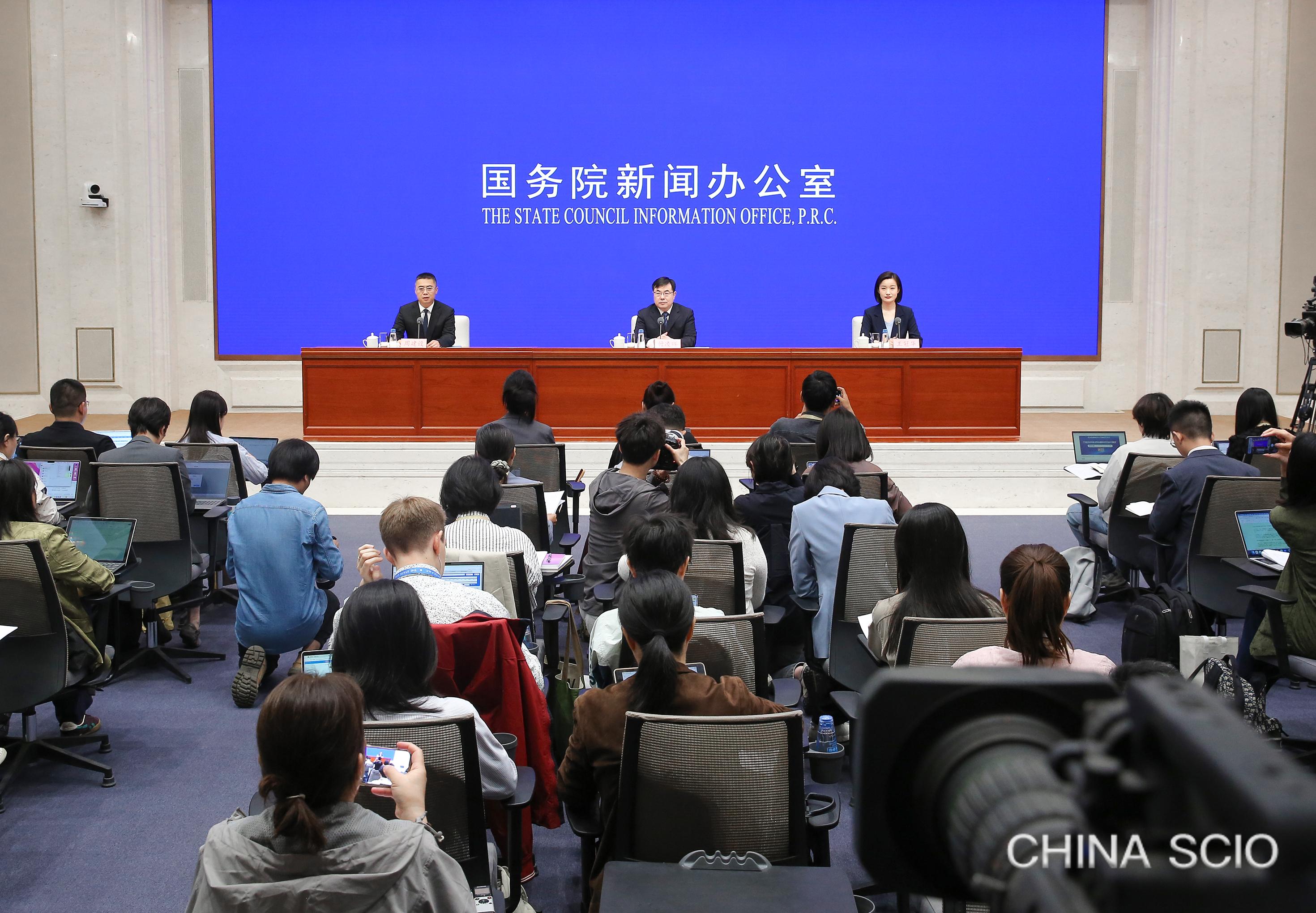
/4 Group photo
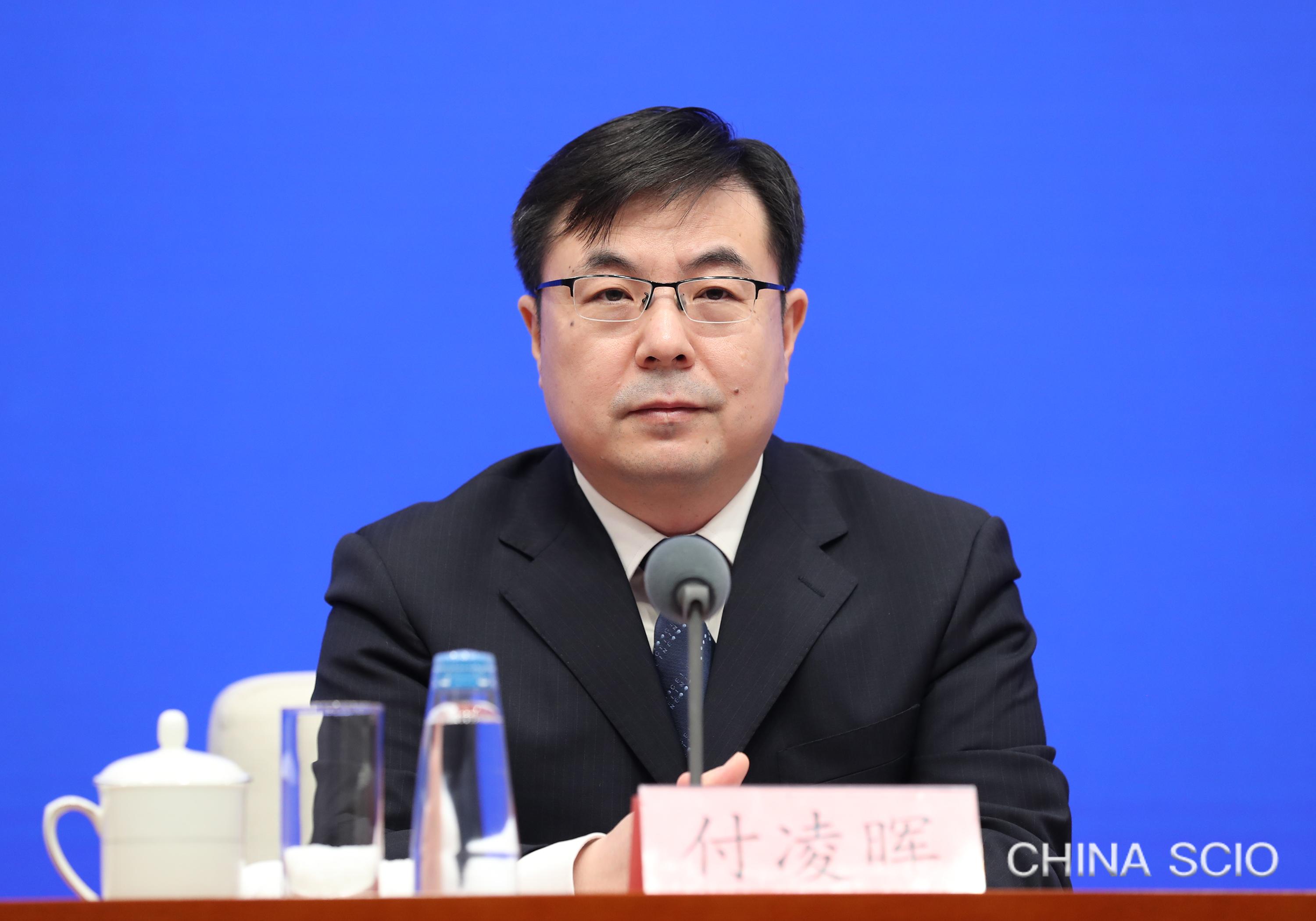
/4 Fu Linghui
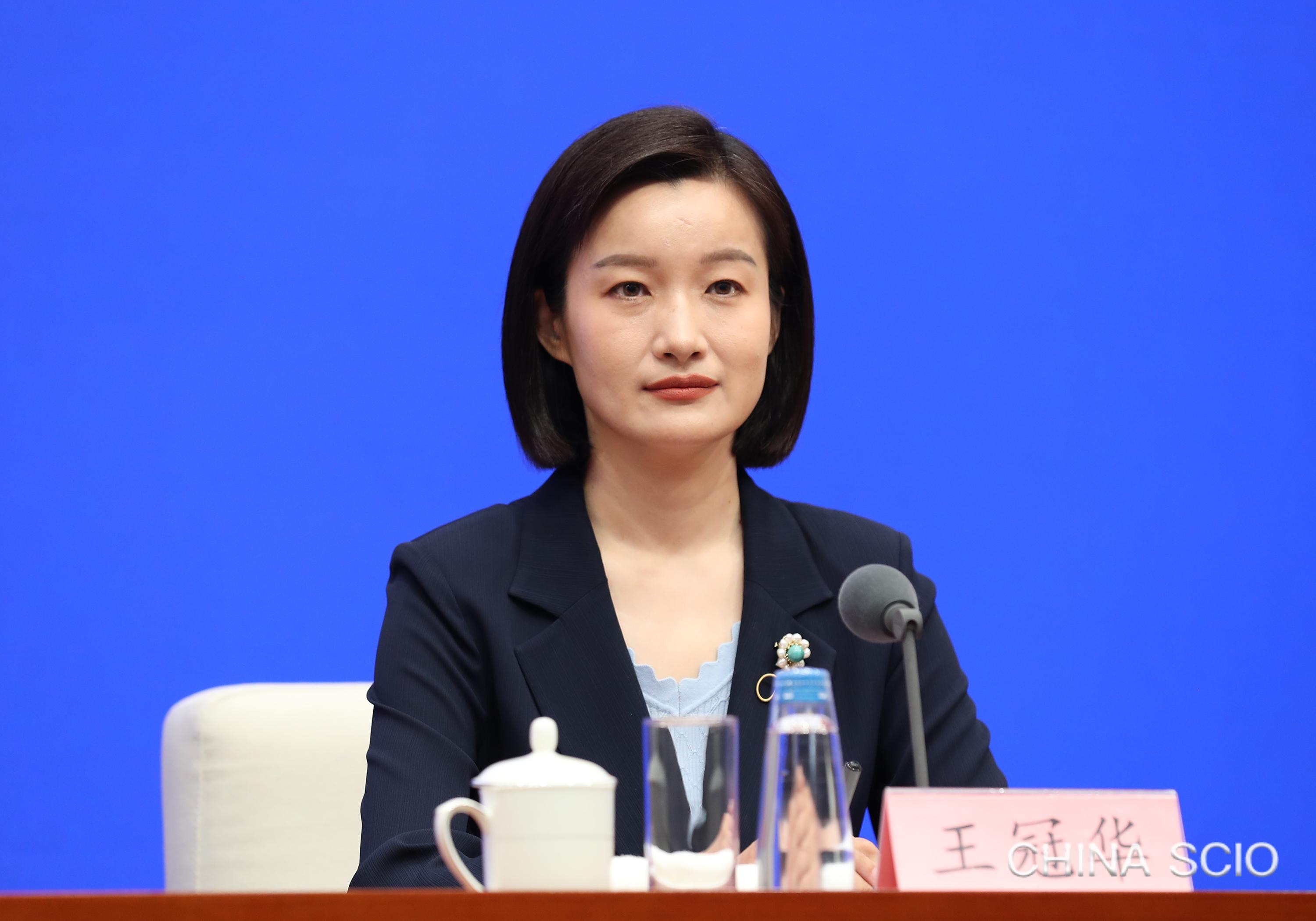
/4 Wang Guanhua
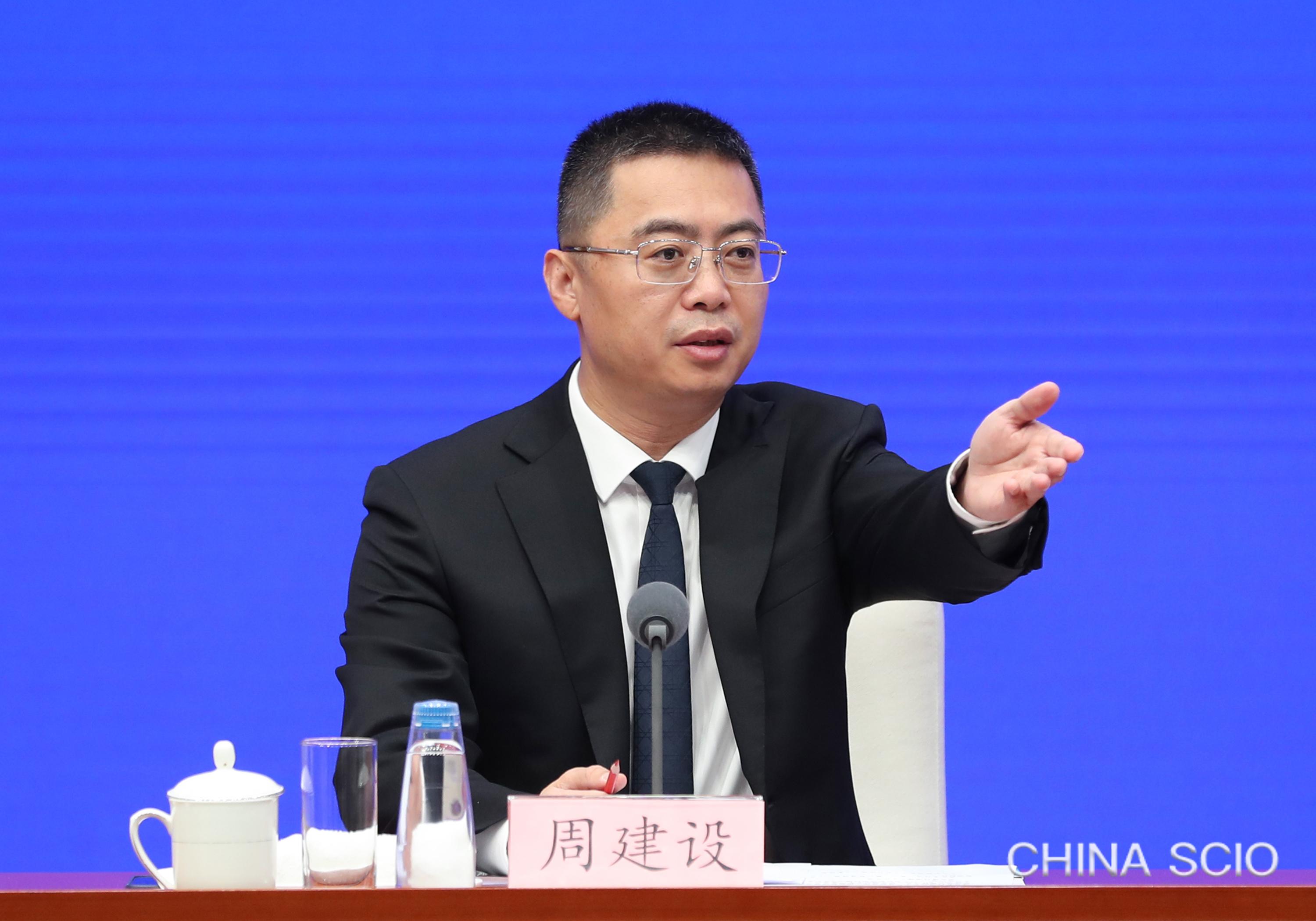
/4 Zhou Jianshe
SCIO briefing on 2026 China Internet Civilization Conference
April 29, 2026SCIO briefing about Annual Report on China's Combating of IPR Infringement and Counterfeiting (2025)
April 24, 2026SCIO briefing on China's intellectual property rights development in 2025
April 23, 2026