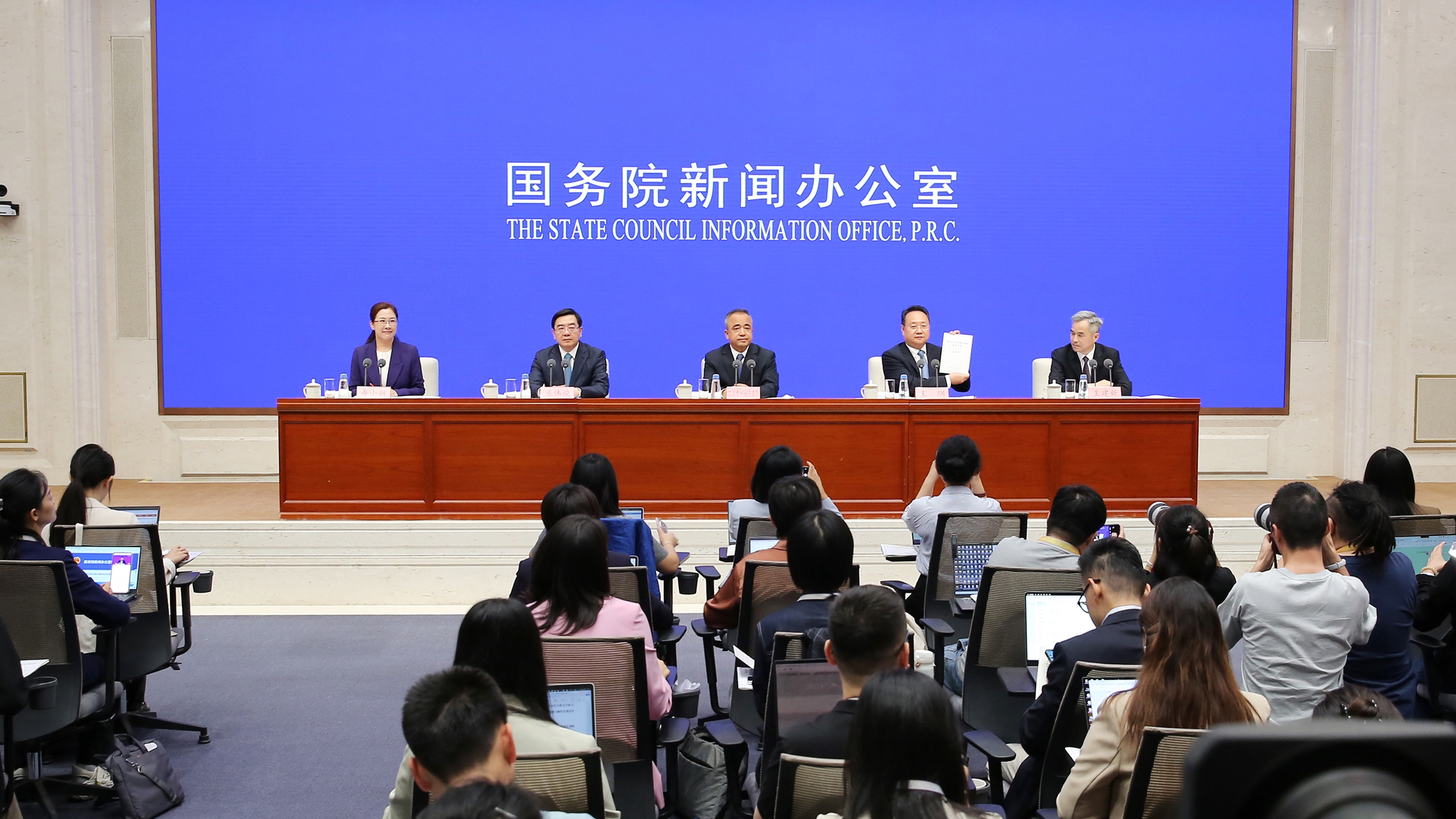

SCIO briefing on white paper 'CPC Guidelines for Governing Xinjiang in the New Era: Practice and Achievements'
Beijing | 2 p.m. Sept. 19, 2025
Speakers

Wang Gang, deputy director of the Publicity Department of the Communist Party of China (CPC) Central Committee
Erkin Tuniyaz, deputy secretary of the CPC Xinjiang Uygur Autonomous Regional Committee and chairman of Xinjiang Uygur Autonomous Region
Chen Weijun, a member of the Standing Committee of the CPC Xinjiang Uygur Autonomous Regional Committee and executive vice chairman of Xinjiang Uygur Autonomous Region
Wang Jianxin, a member of the Standing Committee of the CPC Xinjiang Uygur Autonomous Regional Committee and head of the Publicity Department of the CPC Xinjiang Uygur Autonomous Regional Committee
Chairperson
Speakers:
Mr. Wang Gang, deputy director of the Publicity Department of the Communist Party of China (CPC) Central Committee
Mr. Erkin Tuniyaz, deputy secretary of the CPC Xinjiang Uygur Autonomous Regional Committee and chairman of Xinjiang Uygur Autonomous Region
Mr. Chen Weijun, a member of the Standing Committee of the CPC Xinjiang Uygur Autonomous Regional Committee and executive vice chairman of Xinjiang Uygur Autonomous Region
Mr. Wang Jianxin, a member of the Standing Committee of the CPC Xinjiang Uygur Autonomous Regional Committee and head of the Publicity Department of the CPC Xinjiang Uygur Autonomous Regional Committee
Chairperson:
Ms. Shou Xiaoli, director general of the Press Bureau of the State Council Information Office (SCIO) and spokesperson of the SCIO
Date:
Sept. 19, 2025
Shou Xiaoli:
Ladies and gentlemen, good afternoon. Today, the State Council Information Office (SCIO) is holding this press conference to release the white paper "CPC Guidelines for Governing Xinjiang in the New Era: Practice and Achievements." We are very pleased to invite four officials to attend this press conference. They are Mr. Wang Gang, deputy director of the Publicity Department of the Communist Party of China (CPC) Central Committee; Mr. Erkin Tuniyaz, deputy secretary of the CPC Xinjiang Uygur Autonomous Regional Committee and chairman of Xinjiang Uygur Autonomous Region; Mr. Chen Weijun, a member of the Standing Committee of the CPC Xinjiang Uygur Autonomous Regional Committee and executive vice chairman of Xinjiang Uygur Autonomous Region; and Mr. Wang Jianxin, a member of the Standing Committee of the CPC Xinjiang Uygur Autonomous Regional Committee and head of the Publicity Department of the CPC Xinjiang Uygur Autonomous Regional Committee. They will provide relevant information and answer your questions.
Now, I will give the floor to Mr. Wang Gang for his introduction.
Wang Gang:
Ladies and gentlemen, friends from the media, good afternoon. Stability and prosperity in the border areas are vital to national security and strength. As a unified multiethnic nation, China's governance of its border areas is crucial to its national sovereignty and territorial integrity, as well as to building a strong nation and achieving national rejuvenation. Promoting the modernization of the system and capacity for governing border areas is an integral part of Chinese modernization. Xinjiang, located in northwestern China, is the country's largest provincial-level region by land area. It also has longer international border and borders more countries than any other Chinese provincial-level region, making it strategically crucial for border governance.
Since the establishment of the Western Regions Frontier Command by the Han dynasty in 60 B.C., China's central authorities have governed Xinjiang for more than 2,000 years. During the process, the Chinese nation has developed extensive concepts and experience in border governance. Since the founding of the CPC in 1921, generations of Chinese Communists have continued to explore and advance theoretical, practical, and institutional innovations, deepening their grasp and understanding of the dynamics of governance in Xinjiang. Since the 18th CPC National Congress, the CPC Central Committee with Comrade Xi Jinping at its core has drawn experience and lessons from past central authorities in governing Xinjiang and continued to apply and develop the Party's effective practices in this regard. This has led to the formation of the CPC's guidelines for governing Xinjiang in the new era and successfully driven progress in Xinjiang-related work.
To mark the 70th anniversary of the Xinjiang Uygur autonomous region, the SCIO has released the white paper "CPC Guidelines for Governing Xinjiang in the New Era: Practice and Achievements." This white paper systematically introduces the historical context, core principles and successful practices of the Party's governance of Xinjiang in the new era, supported by rich historical materials and detailed data. It demonstrates where the Party's guidelines for governing Xinjiang in the new era originated, how historic achievements in Xinjiang's economic and social development in the new era were made, and how the CPC continues to write new chapters in governing Xinjiang in the new era. This will help people better understand the Party's guidelines for governing Xinjiang in the new era.
The white paper contains approximately 21,000 Chinese characters and consists of a preface, main body, and conclusion. The first three chapters of the main body introduce the philosophies and experience of how central authorities have governed Xinjiang throughout history, trace the historical development of the CPC's governance of Xinjiang, and explain the rich content of the Party's guidelines for governing Xinjiang in the new era. Chapters 4 through 10 showcase the great achievements in Xinjiang's reform, development and stability under the strong leadership of the CPC Central Committee with Comrade Xi Jinping at its core and the guidance of the Party's guidelines for governing Xinjiang in the new era.
Chapter 1 discusses the philosophies and experience of central authorities in governing Xinjiang throughout history. Throughout Chinese history, central authorities have consistently upheld the concept of great unity in their governance, administering the Xinjiang region as an integral part of the country. They maintained social stability, promoted development, and facilitated ethnic interaction and religious coexistence. They also united people of all ethnic groups through the best of traditional Chinese culture. Through thousands of years of exploration and practice, they accumulated rich historical experience.
Chapter 2 highlights the glorious history of the CPC's governance of Xinjiang. During the four periods — namely the period of the New Democratic Revolution, the period of socialist revolution and construction, the period of reform, opening up, and socialist modernization, and the new era of socialism with Chinese characteristics — the CPC has united and led people of all ethnic groups in Xinjiang along a remarkable path. They went from achieving emancipation and becoming their own masters to embarking on the socialist road. They moved from embracing reform and opening up and achieving moderate prosperity in all respects to setting out on the new journey toward Chinese modernization. Together with the rest of the nation, people in Xinjiang have experienced a great transformation from standing up and growing prosperous to becoming strong.
Chapter 3 examines the new governance of Xinjiang under the CPC guidelines for governing the region in the new era. Since the 18th CPC National Congress, the CPC Central Committee with Comrade Xi Jinping at its core has coordinated the great rejuvenation of the Chinese nation and the response to the great changes unseen in a century. The CPC Central Committee has emphasized Xinjiang's important role in the work of the Party and the country, pointing out that social stability and lasting peace and security are the overall objectives of Xinjiang-related work. The CPC Central Committee established the guidelines for governing the region in the new era and systematically explained the essence, principles, and requirements of the guidelines.
Chapter 4 discusses the strengthened foundations for social stability and lasting peace and security in Xinjiang. While balancing development and security, Xinjiang has made social stability a top priority. The region has achieved progress in the fight against secession and implemented regular counterterrorism measures to ensure stability in accordance with the law. Targeted countermeasures have been carried out against foreign sanctions and interference, while notable improvements have been made in social governance. Through these efforts, the region has achieved a historic transformation from chaos to stability and ultimately to good governance.
Chapter 5 examines the deepening of unity of the Chinese nation. Xinjiang has taken solid steps to promote a stronger sense of national identity, accelerating the construction of a shared cultural home for the Chinese nation. The region has increased interaction, exchanges and integration among all ethnic groups, achieving greater ethnic unity and steady progress, ensuring that all religions in China conform to the country's realities. All ethnic groups in Xinjiang are contributing to building China into a great country and creating a better life together.
Chapter 6 addresses ongoing progress in promoting democracy and the rule of law. Xinjiang has thoroughly implemented the key concept of whole-process people's democracy, achieving remarkable achievements in this regard. The advantages of the ethnic regional autonomy system have been further demonstrated, with important advancements realized in the rule of law. Protection of human rights has been continuously enhanced, and the region has made new strides in advancing democracy and the rule of law.
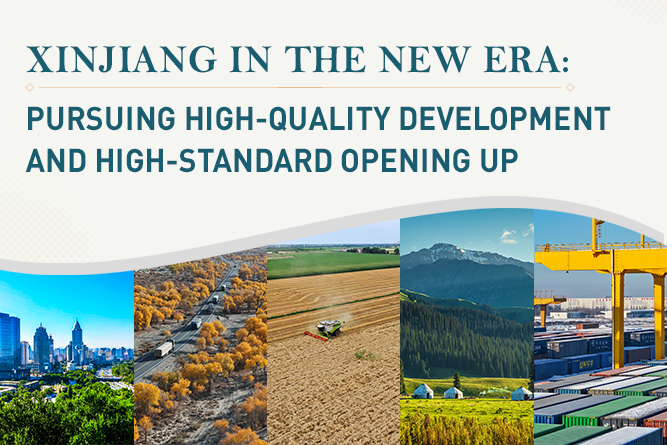
Chapter 7 covers high-quality development and high-standard opening up in the region. Xinjiang has fully applied the new development philosophy and as a result has achieved sound, rapid, and sustainable economic development, improved infrastructure, notable clustering effects in its modern industrial system, solid green and low-carbon development, and rapid construction of the core area of the Silk Road Economic Belt. Overall, Xinjiang has made great achievements in advancing Chinese modernization.
Chapter 8 highlights significant achievements in cultural development. Xinjiang has thoroughly practiced Xi Jinping Thought on Culture and effectively protected cultural heritage, while cultural and artistic creation has flourished. The public cultural service system has been improved, and the development of the cultural and tourism industries has accelerated. As a result, the aspirations of people of all ethnic groups for enriched intellectual and cultural lives are better met.
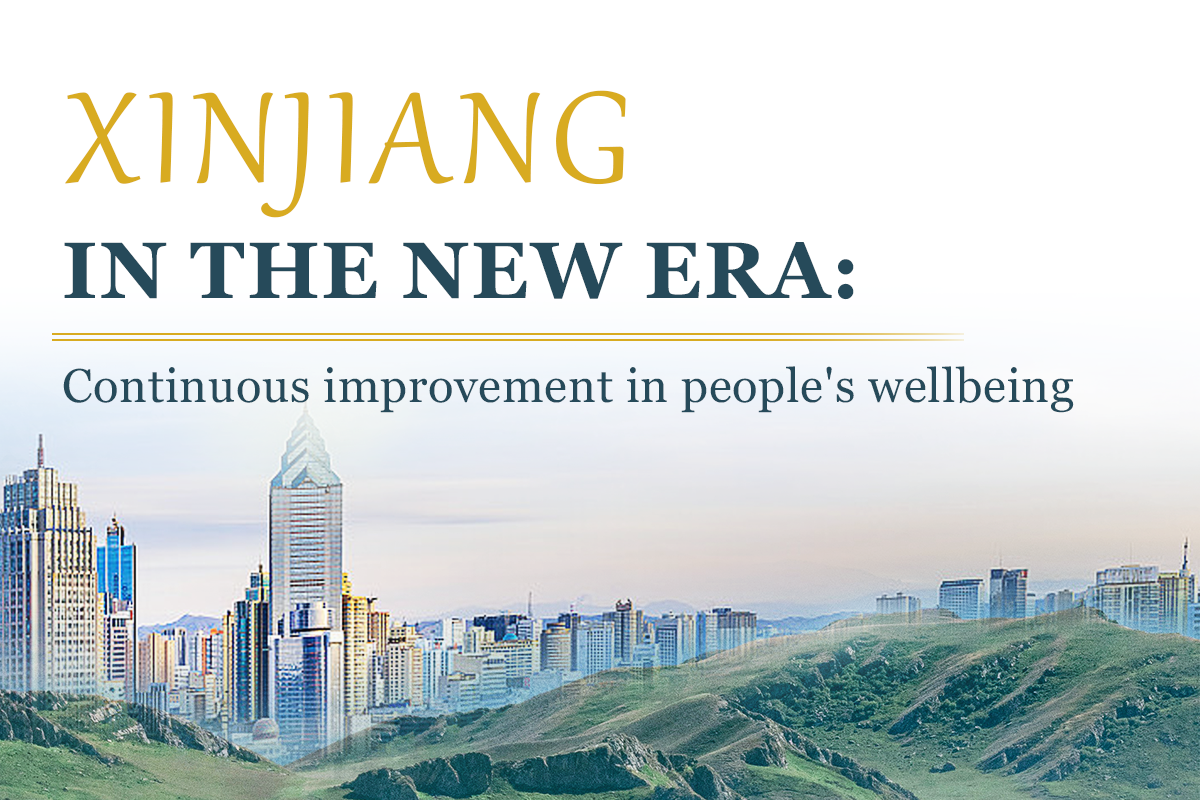
Chapter 9 examines ongoing improvements in people's well-being. Xinjiang adheres to a people-centered approach, achieving a complete victory in poverty alleviation, steadily improving employment, comprehensively developing education, enhancing the health care system, and upgrading the social security net. The fruits of development have benefited people of all ethnic groups in a more equitable way.
Chapter 10 discusses enhanced collaborative efforts for Xinjiang's development. The historic achievements and transformations in all sectors of Xinjiang's development in the new era are fundamentally due to the strong leadership of the CPC Central Committee with Comrade Xi Jinping at its core. They are also the result of generous assistance from people across the country and the united efforts of people of all ethnic groups in Xinjiang.
That's all for my introduction. Thank you.
_ueditor_page_break_tag_Shou Xiaoli:
Thank you, Mr. Wang, for the introduction. Now, I'll give the floor to Mr. Erkin Tuniyaz for his introduction.
Erkin Tuniyaz:
Ladies and gentlemen, friends from the media, good afternoon. This year marks the 70th anniversary of the Xinjiang Uygur autonomous region. At this historic moment, we are pleased to witness together with you the release of the white paper "CPC Guidelines for Governing Xinjiang in the New Era: Practice and Achievements." First, on behalf of the CPC Xinjiang Uygur Autonomous Regional Committee and the Xinjiang regional government, I extend a warm welcome to our friends from the media. Through you, I would like to express heartfelt gratitude to all sectors of society that have long cared for and supported Xinjiang's development.
You have long followed Xinjiang's development closely and are familiar with the profound economic and social changes over the past 70 years. We deeply feel that these remarkable transformations — what could be called "a miracle that changed the future through the people's undaunted spirit" — have all been made possible by the wise leadership of the CPC Central Committee. In particular, since the 18th CPC National Congress, the CPC Central Committee with Comrade Xi Jinping at its core has attached great importance to Xinjiang. General Secretary Xi Jinping has provided strategic direction and guidance, personally steering the course of its development. The CPC Central Committee convened two meetings on work related to Xinjiang. Xi has traveled multiple times to Xinjiang on inspection tours and delivered a series of important speeches and instructions, which together have established the Party's guidelines for governing Xinjiang in the new era. In providing leadership for work related to Xinjiang, it has upheld fundamental principles while breaking new ground, successfully driving progress despite complex circumstances, challenges, and risks. It is precisely under the guidance of the scientific guidelines that all undertakings in Xinjiang have undergone historic transformations and achieved historic progress, entering a period of the fastest development, greatest transformation, and most tangible benefits for people of all ethnic groups. The six-episode political documentary "Songs of Tianshan," which began airing on CCTV yesterday, vividly showcases the profound changes that have taken place in Xinjiang over the past 70 years.
We have governed Xinjiang in accordance with the law, which has ensured lasting social stability. Xinjiang has actively promoted the rule of law within government and throughout society. We have effectively protected people's legitimate rights and interests, upheld fairness and justice, and improved the business environment. We have employed law-based thinking and approaches and strengthened law-based and persistent efforts in combating terrorism and maintaining stability. As a result, the overall social situation has remained stable, grassroots governance capacity has been significantly enhanced, and public satisfaction with security has continued to rise. Today, Xinjiang is stable, harmonious, and full of vitality. In 2024 alone, Xinjiang received over 300 million tourist visits, with many praising Xinjiang as a safe, peaceful, and welcoming destination.
We have maintained stability through ethnic unity, making the cultivation of a strong sense of community for the Chinese nation the guiding principle of all our work. We comprehensively implement the Party's ethnic policies, uphold and improve the system of regional ethnic autonomy, and protect the legitimate rights and interests of people of all ethnic groups in accordance with the law. We comprehensively promote interaction, communication, and integration among all ethnic groups. Neighbors live side by side, celebrate together, and share in one another's traditions, whether it be eating sanzi (fried dough twists) at one home or mooncakes at another. We comprehensively promote and popularize the national common language and script. Standard spoken and written Chinese is promoted across the region. As a result, the public has developed a stronger awareness of using standard Chinese, which has united hearts and minds for a shared future. We fully implement the Party's basic policy on religious affairs, provide active guidance to religions so that they can adapt to socialist society, ensuring harmony and healthy inheritance. You may have noticed from short video interviews that children in Xinjiang proudly say, "I am Chinese." In August this year, 130 young people from Hotan prefecture attended the national flag-raising ceremony at Tian'anmen Square in Beijing. Many were moved to tears as they declared their love for the motherland. These are vivid examples of ethnic unity in Xinjiang, touching millions online.
We have strengthened cultural identity and bonds, working together to build a spiritual home shared by all Chinese people. Guided by Xi Jinping Thought on Socialism with Chinese Characteristics for a New Era, we draw on historical facts, archaeological finds, and cultural legacies of exchanges among ethnic groups in Xinjiang to highlight the deep roots of Chinese culture. Efforts have been made to inspire people of all ethnic groups to identify more closely with the motherland, the Chinese nation, the Chinese culture, the CPC, and socialism with Chinese characteristics. Continuous investment in infrastructure has built a five-tiered public cultural service network covering regions, prefectures, counties, townships and villages. The TV series "To the Wonder" has been loved by audiences at home and abroad, and the eight-minute brilliant performance at the Kashi sub-venue of CCTV's 2024 Spring Festival Gala captivated viewers around the world. Both showcase the vitality and flourishing of cultures of all ethnic groups in Xinjiang.
We have brought greater prosperity to Xinjiang and its people, ensuring that the benefits of development improve people's well-being and earn their support. We base our work on what the nation needs, what Xinjiang can contribute, and what the people expect. We have fully leveraged advantages in resources, geographic location, and other areas to drive rapid and high-quality growth. Since 2012, Xinjiang's GDP has grown at an average annual rate of 7.04%, surpassing the 2 trillion yuan milestone in 2024. This provides strong fiscal support for livelihood improvements. For example, in terms of infrastructure construction, Xinjiang now has 230,000 kilometers of highways, with all prefectures connected by expressways; 9,202 kilometers of railways reaching every prefecture; and 28 civil airports. Nearly 12,000 kilometers of 750-kilovolt power grids have been built, along with gigabit broadband in every county, 5G in every township, and internet access in every village, greatly facilitating people's work and daily life. In terms of ensuring people's livelihoods, total employment reached 13.91 million in 2024, up 11.6% from 2012. For the first time, every part of southern Xinjiang now has an undergraduate institution. The region has over 19,000 medical facilities. Per capita disposable income has reached 43,000 yuan in urban areas and 19,000 yuan in rural areas, making people's lives better day by day.
We have taken a long-term perspective on developing Xinjiang, strengthening the foundations for lasting peace and stability. We have upheld and strengthened the Party's overall leadership and fostered highly competent officials based on the criteria for assessing the caliber of officials in the new era. We regard strengthening grassroots work and laying solid foundations as fundamental measures for ensuring stability and security in Xinjiang. We strengthen grassroots Party organizations to maintain stability. Since 2014, we have continuously sent government officials to live and work in villages alongside local officials and residents. Together, they have developed strategies for economic growth and income generation, achieving tangible results that have been warmly welcomed by the people and reinforced the Party's governance foundation and cohesion in Xinjiang.
The achievements in all of Xinjiang's endeavors in the new era are fundamentally attributed to the strong leadership of the CPC Central Committee with Comrade Xi Jinping at its core and to the scientific guidance of Xi Jinping Thought on Socialism with Chinese Characteristics for a New Era. They are also inseparable from the dedicated support of the central Party and government departments, state-owned enterprises directly administered by the central government, and designated provinces and municipalities. As we mark the 70th anniversary of the establishment of the autonomous region, we will take this as a new starting point. We will unite the people of all ethnic groups more closely around the CPC Central Committee with Comrade Xi Jinping at its core and fully and faithfully implement the Party's guidelines for governing Xinjiang in the new era, adding Xinjiang's chapters to the annals of Chinese modernization with unparalleled confidence.
That concludes my introduction.
Shou Xiaoli:
Thank you, Mr. Erkin Tuniyaz. Now the floor is open to questions. Please identify your news outlet before asking questions.
_ueditor_page_break_tag_21st Century Business Herald:
As you mentioned earlier, in recent interview videos by various bloggers, when Xinjiang children are asked about their ethnicity, they all proudly answer "Chinese." What measures has Xinjiang taken to advance the building of a community for the Chinese nation and a common spiritual home shared by all Chinese people? Thank you.
Erkin Tuniyaz:
Thank you for your question. I will answer it. The fact that Xinjiang's children answer so firmly shows their deep sense of identity with, and pride in, being part of the Chinese nation, as well as their profound love for the motherland. Such touching stories can be seen everywhere across Xinjiang. They also fully demonstrate that Xinjiang has been an inseparable part of China since ancient times, and that recognition of the great motherland, the Chinese nation, Chinese culture, the CPC, and socialism with Chinese characteristics is deeply rooted in the hearts of young people of all ethnic groups.
Forging a stronger sense of the Chinese nation as one community is the focus of the CPC's work on ethnic affairs in the new era, and the focus of all work in ethnic minority areas. Let me share our work in the following three aspects:
First, we have always made this the focus of our work, carrying out extensive initiatives to promote ethnic unity and progress. We have launched a variety of activities under themes such as "Strengthening the Sense of the Chinese Nation as One Community, Realizing the Chinese Dream Together" and "Ethnic Unity, One Family." We have established 471 education bases for patriotism, 101 national model units, and 14 national education bases. The flowers of ethnic unity are blooming everywhere across Xinjiang. We all know the story of Kurban Tulum, the elderly villager who rode his donkey all the way to Beijing to visit Chairman Mao, a gesture of heartfelt devotion to the Party that touched people across the country. There is also Wu Dengyun, who came from Yangzhou in Jiangsu to Xinjiang at the age of 22, and for more than 60 years devoted himself selflessly, donating blood more than 30 times, even cutting 13 pieces of skin from his own body to save severely burned children from ethnic minority families. He once said, "The herdsmen in the mountains cannot be without me," and to this day, he continues to care for the health of people in the border counties. And then there is Bayika Kalidibek, whose family has defended the frontier of the Pamir Plateau for three generations over 70 years. He once said, "Without the boundary markers of our country, how could we have our cattle and sheep?" His words expressed the deepest love for the motherland. Stories like these can be found all across Xinjiang. They are vivid examples of forging a stronger sense of the Chinese nation as one community.
Second, we have continuously strengthened cultural identity and bonds in Xinjiang, adhered to the guidance of core socialist values, and vigorously carried out public education on the history of the CPC, the history of the People's Republic of China, the history of reform and opening up, the history of socialist development, and the history of the Chinese nation, ensuring that officials and people of all ethnic groups have an accurate understanding of history and continuously consolidate the intellectual foundation for building the community of the Chinese nation. We have also vigorously carried out archaeological research and the preservation and inheritance of historical and cultural heritage, and showcased the historical stories of interactions among various ethnic groups in Xinjiang, as well as related archaeological artifacts and cultural relics, such as the Han dynasty brocade arm protector embroidered with eight Chinese characters "wu xing chu dong fang li zhong guo "that translate to "five stars from the east bring blessing to China." People of all ethnic groups have gained a deeper recognition and belief in the Chinese nation from the stitches of over 2,000 years ago, feeling immensely proud to be part of the family of the Chinese nation.
Third, we have continuously broadened and deepened interactions, exchanges, and integration among various ethnic groups. Through a series of special initiatives, such as youth exchanges, ethnically integrated communities, and the fusion of culture and tourism, we have fostered a sound environment where all ethnic groups live, study, work, and enjoy life side by side, as they contribute and share benefits together. For example, in the Haldun community of Tacheng city, home to 14 ethnic groups including Han, Uygur, Kazak and Hui, over 30% of households are multi-ethnic families. Ethnic unity has become a golden brand for the area. There are many other such communities across Xinjiang, such as Liuxing sub-district in Yining city, Wangsan sub-district in Aksu city, and Tuanjie community in Korla city. Ethnic unity is the lifeline of the people of all ethnic groups in Xinjiang. Today, sharing the same land, they protect ethnic unity as they would their own eyes, cherish it as they would their own lives, and are united as closely as the seeds of a pomegranate.
That is all from me for now. Thank you.
_ueditor_page_break_tag_CCTV:
My question is, in recent years, Xinjiang's economy has continuously shown a new vibrancy and a new outlook. What are the highlights and breakthroughs in Xinjiang's pursuit of high-quality economic development? Thank you.
Erkin Tuniyaz:
I would like to invite Mr. Chen to answer your question.
Chen Weijun:
Thank you for your question. Xinjiang has firmly anchored itself around its five strategic roles in national development landscape, fully and faithfully applied the new development philosophy on all fronts, actively integrated with the new development dynamic, and advanced high-quality development centered on people's well-being. The foundation for Xinjiang's economic and social development has been strengthened, the momentum for growth has been accelerated, and the new development quality and efficiency have been substantially enhanced. Multiple indicators have achieved historic breakthroughs in terms of aggregate. Last year, Xinjiang's GDP exceeded the 2-trillion-yuan mark for the first time. The region's total import and export value reached a new high, hitting 434.16 billion yuan last year. From 2022 to 2024, for three consecutive years, the total import and export value crossed a new 100-billion-yuan milestone each year. In terms of growth rates, multiple indicators rank among the top in the country. Last year, Xinjiang's GDP increased 6.1% year on year, fixed asset investment increased 6.9% year on year, the value added of industrial enterprises above designated size increased 8% year on year, and the revenue in the general public budget increased by 10.5% year on year. In the first half of this year, the region's GDP increased 5.7% year on year, total fixed asset investment increased 13% year on year, the total import and export value increased 28% year on year, and the revenue in the general public budget increased 12% year on year. To sum up our economic development in one sentence, I would say, "Today's Xinjiang is thriving."
Let me now elaborate on three key aspects.
First, infrastructure has been comprehensively strengthened, achieving both integration and interconnection. This has greatly expanded the capacity for high-quality development. With a focus on building the 10 networks of infrastructure and driven by major projects valued in the tens and hundreds of billions of yuan, investment-driven effects have continuously materialized. The Urumqi Airport North Terminal, Barkol Airport, and Qitai Airport have been completed and put into operation, bringing the total number of civil airports in the region to 28. The Hotan-Ruoqiang Railroad has been completed and put into operation, the expressway around the Junggar Basin has been fully completed, and the expressway loop around the Tarim Basin is basically in place. A comprehensive transport system aimed at smooth travel within Xinjiang and swift access beyond is steadily advancing. The third channel that transmits locally generated electricity from Xinjiang to other parts of the country has started operation, and a fourth is under accelerated construction. A main grid structure featuring a five-ring internal supply grid and five external transmission channels has taken initial shape. A large number of infrastructure projects are advancing across the region, further boosting Xinjiang's economic development and optimizing the allocation of resources.
Second, the cluster effect of the modern industrial system is fully demonstrated, presenting a healthy pattern of a solid primary industry, an optimized secondary industry, and an expanding tertiary industry. In 2024, total food output reached 23.3 billion kilograms, hitting a new high. Xinjiang produced a surplus beyond local needs and contributed to national food supplies. More Xinjiang grain is filling the nation's bowl. The total cotton output logged 5.69 million metric tons, and the overall mechanization rate of cotton farming reached 97%. Xinjiang is accelerating efforts to build itself into a strategic base of the nation's energy resources. Six major oil and gas zones and four major petrochemical bases have been established. Last year, the oil and gas production equivalent reached 66.64 million metric tons, and raw coal output reached 540 million metric tons. As of the end of July this year, the total installed capacity of electricity in Xinjiang reached 220 million kilowatts, of which the capacity from new energy sources reached 132 million kilowatts. Policies to boost consumer spending are showing increasingly visible results, further energizing market participants. In the first half of this year, Xinjiang's retail sales of consumer goods totaled 189.36 billion yuan, a year-on-year increase of 7.5%, ranking third highest in the country in terms of growth rate. Through the vigorous implementation of the tourism-driven development strategy, tourism infrastructure has been continuously upgraded, and new business forms have continued to emerge. Xinjiang has become a popular destination for both domestic and international tourists.
Third, with the thorough implementation of strategies for driving Xinjiang's development through innovation, science and technology, and talent, the region has achieved remarkable progress in developing new productive forces. An additional 2 billion yuan in fiscal science and technology funding is allocated annually to drive innovation-led development in the region. A 10-billion-yuan talent development fund has also been established to attract urgently needed high-caliber talent, creating a welcoming environment that encourages them to stay. The Xinjiang Research Institute of Huairou Laboratory has been put into operation, and the National Innovation Center for Wind Power Generation has been officially launched. Exceeding 10,000 meters, the Tarim Oilfield's ultra-deep drilling is now the deepest in Asia. Xinjiang is leading the country in new energy development and power transmission and transformation equipment technology, and its ultra-low wind speed turbine technology has reached internationally advanced levels. Its independently developed cotton pick-and-mod machine has become the country's first, and over 95% of cotton harvesting machinery is now produced domestically. The Xinjiang-to-Chongqing Computing Resource Transfer project has been listed as a pilot for coordinated development of computing and power, and the region's first intelligent computing center has been established and put into use in Karamay.
In short, Xinjiang is in an important stage of high-quality development. High-quality development has helped strengthen unity and rallied the people's support, laying a solid foundation for social stability and lasting peace and security.
That is all from me for this question. Thank you.
_ueditor_page_break_tag_ThePaper.cn:
In recent years, Xinjiang's economy has developed rapidly. At the same time, people are paying increasing attention to matters affecting their daily lives, such as their children's schooling and their family's health care, and other issues that touch every household. How has Xinjiang ensured that its rapid economic development delivers tangible benefits to the people? Thank you.
Wang Gang:
I will answer this question. The true measure of the effective implementation of the CPC guidelines for governing Xinjiang in the new era is how they benefit the people. The Marxist view of the people holds that the people are the main actors of history, the creators of material and spiritual wealth in society, and the decisive force behind social transformation. As we all know, the fundamental purpose of the CPC is to serve the people wholeheartedly, and its aspirations and founding mission is to seek happiness for the Chinese people and rejuvenation for the Chinese nation. It is for this reason that the CPC and the people of all ethnic groups in Xinjiang have been working diligently together to bring about tangible changes in people's lives.
Bringing benefit to the people is the fundamental principle of governance. General Secretary Xi Jinping has pointed out that "the people's aspiration for a better life is our goal." Since the 18th CPC National Congress, the CPC Central Committee with Comrade Xi Jinping at its core has put forward a people-centered development philosophy, acted for the people and relied on the people in everything it has done, always putting the people first and striving for their aspirations for a better life, and ensured that the fruits of reform and development offer greater benefits to all the people in a fairer way.
The CPC guidelines for governing Xinjiang in the new era have made it clear that we must uphold the people-centered development philosophy, and advance economic and social development while improving people's well-being so that people of all ethnic groups live and work in peace and contentment. Earlier, Mr. Chen highlighted a number of economic achievements. Whether in terms of convenient transportation, expanding tourism, or increasing import and export, these achievements ultimately translate into tangible growth in income and visible changes in people's lives. Under the CPC guidelines for governing Xinjiang in the new era, Xinjiang has made it a priority to ensure that development improves people's well-being, benefits local communities, and strengthens unity. We are committed to solving the most pressing and immediate concerns of the people of all ethnic groups, ensuring that the fruits of development offer greater benefits to all ethnic groups in a fairer way. Specifically, the living conditions of people of all ethnic groups in Xinjiang have continuously improved, and their quality of life has significantly increased. I would like to illustrate this progress from three aspects.
First, in terms of poverty alleviation. Xinjiang was once one of the areas with the highest incidence and intensity of poverty in all of China. After the 18th CPC National Congress in 2012, the region prioritized the fight against poverty, pooling the best of its resources and adopting targeted measures to end poverty through hard work and perseverance. By the end of 2020, Xinjiang's impoverished rural population had all emerged from poverty. After finally eradicating absolute poverty that had once plagued Xinjiang for millennia, the region was able to achieve a moderately prosperous society in all respects, alongside the rest of the country.
Second, in terms of employment. Xinjiang prioritized expanding employment as the foundation for ensuring people's wellbeing. While vigorously promoting economic growth and increasing job opportunities, the region has continuously enhanced its institutional framework to achieve high-quality full employment and protect the rights and interests of workers. Employment rates in Xinjiang are continuing to improve, alongside ongoing enhancements in the employment structure. Meanwhile, the incomes of both urban and rural residents continue to rise steadily. Xinjiang's commitment to achieving high-quality full employment is steadily enhancing the well-being of people from all ethnic groups across both sides of the Tianshan Mountains.
Thirdly, in terms of social security. Social security is a basic institutional guarantee for safeguarding and improving people's lives, ensuring social equity and enhances their sense of wellbeing. It plays the role of a safety net for people's livelihoods, serving as an income distribution regulator, and an economic stabilizer. It is a vital component of state governance and an essential safeguard for national stability. Xinjiang has placed the improvement of its multitiered social security system in a prominent position and accelerated the development of a robust safety net to safeguard people's well-being. In Xinjiang, a social security system has been established to guarantee access to education, employment, housing, medical services, and elderly care. It has continuously made life better for people of all ethnic groups living in the region
Next, officials from Xinjiang will share the living conditions of people in the region. I would like to say that journalists should go to Xinjiang. They should go themselves and stand by the side of the local people. Microphones, eyes, ears, and keen observation will enable them to learn of people's living conditions. See how they live there, including their housing situations, diet, their sense of security, and you will gain an understanding. Only with a thorough understanding can they depict in writing a true, three-dimensional, and comprehensive Xinjiang; only with a thorough understanding can they know the real living situations of the local people. So I genuinely recommend you to go to beautiful Xinjiang. Take a look, interact with the happy people there, and then tell the world about the true Xinjiang. Thank you.
Shou Xiaoli:
Mr. Erkin Tuniyaz will share more information.
Erkin Tuniyaz:
Let me add one point. What Mr. Wang Gang just said comes from his personal experiences and feelings, because he has visited Xinjiang numerous times for inspection and research. With a deep affection for Xinjiang, he reached this conclusion through comparing the past and the present. Xinjiang has won the critical battle against poverty, lifting 3,064,900 people out of poverty. The progress and changes in Xinjiang are reflected in daily work, life and travel of local people, especially in southern Xinjiang. I myself am an official born and raised in southern Xinjiang. Comparing the past and the present, southern Xinjiang has undergone tremendous changes, which is an outstanding achievement. Those changes can be felt from the eyes, smiles, and looks of the local people. I once worked in Hotan prefecture. At that time, the streets in Hotan were full of donkey carts. Today, donkey carts belong to museums. Families get around on e-bikes, motorcycles or cars — and some families even have several cars. The sense of happiness can truly be felt among local people. Those who return to Xinjiang after several decades from their first visit, will be amazed at the changes they witness in the region. Therefore, I sincerely welcome journalists, especially those who have never been to Xinjiang before. Come and see more, take a walk and have a look around. Seeing is believing. Only after seeing it in person can they feel the charm of a beautiful Xinjiang. It is particularly worth mentioning that at the end of last year, the Ahe Highway opened to traffic. Renowned for its stunning beauty, the road has soon become as popular as the Duku Expressway. Journalists are welcome to visit both northern and southern Xinjiang, and use your pens and cameras to record and reflect a true, changing, and objective Xinjiang.
_ueditor_page_break_tag_Dazhong Daily:
I have noticed that last year, a project was completed to entirely encircle the Taklimakan Desert with a sand-blocking green belt. May I ask what achievements has Xinjiang made in recent years in preventing desertification and sandification? What are the focuses of your future efforts in ecological protection and governance? Thank you.
Erkin Tuniyaz:
Thank you for your questions. I will answer them. As everyone knows, Xinjiang covers an area of 1,664,900 square kilometers, or about one-sixth of China's total territory. It is also one of the provincial-level regions with the largest and most widely distributed area of land most severely affected by desertification and sandification. The Taklimakan Desert is an area frequently hit by intense wind and sand activities and even severe sandstorms. The harsher the conditions, the stronger the people's aspiration for a sound ecological environment. We have made decisive progress in the critical battle against desertification on the fringes of the Taklimakan Desert, completing the last 285 kilometers of the sand-blocking green belt encircling the desert in 2024. With the final stretch completed in Hotan prefecture, we have built a strong ecological barrier for people living on the edge of the desert. During an inspection tour in Hotan, I heard some local people, especially women, say they will no longer have sand-laden wind blowing into their beautiful faces. Finally, people's aspirations for a better life have been fulfilled.
The achievements of ecological governance in Xinjiang in recent years have been witnessed by all. They are mainly reflected in "dual decreases," "dual improvements," "dual growths," and "dual promotions." First, both the desertified and sandy land areas have decreased. According to the sixth national survey of desertification and sandification, the desertified land area in Xinjiang decreased by 1,955.7 square kilometers, and the sandy land area decreased by 242.8 square kilometers, marking the first turning point from an increase to a decrease in sandy area. Second, both sand control and water management have improved to spur agricultural development. The region has coordinated a four-pronged approach involving water saving, water storage, water diversion, and development of new water resources, realizing rational allocation and use of its water resources. In 2024, the irrigation water volume of forest shelterbelts in southern Xinjiang reached 2.76 billion cubic meters, and over 2 billion cubic meters of water from the Tarim River was diverted to replenish the water supply of the populus euphratica forests. As a result, a total of 150,000 mu (10,000 hectares) of degraded forest shelterbelts and 3.2 million mu of populus euphratica forests have been effectively repaired. Third, the areas of both natural oasis and artificial oasis have increased. Over the past three decades, Xinjiang's total oasis area has expanded from 99,000 square kilometers to 155,000 square kilometers, an increase of 56.6%. The forest coverage rate increased from 4.24% in 2012 to 5.07% in 2024. Fourth, we have effectively controlled wind and sand damages around the deserts in southern Xinjiang, promoting both ecological and economic benefits. With equal focus on ecological benefits and social benefits, we planted suitable economic crops in the deserts, such as Cistanche tubulosa and red dates, which have begun to produce economic returns. These efforts have achieved good results in both preventing desertification and increasing people's income.
Ecological and environmental protection has brought tangible benefits to the people of all ethnic groups in Xinjiang. This year marks the 20th anniversary of General Secretary Xi Jinping's proposal of the "two mountains" concept. We will remain committed to the principle that lucid waters and lush mountains are invaluable assets, supporting high-quality development with a high-quality ecological environment. I think our future efforts will focus on three aspects:
First, we will apply systems thinking. We will strengthen air pollution control in cities on the northern slopes of the Tianshan Mountains, including Urumqi, Changji, Shihezi and Wujiaqu, and carry out actions to prevent soil pollution at the source, amid our efforts to enhance environmental protection. Second, we will adopt comprehensive measures. We will consolidate and expand the achievements of desertification control, and increase support for ecological water use, ecological restoration, and photovoltaic project deployment to step up the battle against desertification on the fringes of the Taklimakan Desert. We will advance major projects for biodiversity conservation, leaving a more diverse ecosystem for future generations. Third, we will pursue progress while ensuring stability. We will make technological breakthroughs in the development of renewable energy, clean and efficient coal utilization, green hydrogen, and new energy storage. We will also support the application of advanced technologies in low-carbon petrochemicals, the modern coal chemical industry, and low-carbon iron and steel sector. We are striving to explore a path of energy conservation and carbon reduction that suits local conditions, and make green development the foundation of our high-quality development.
That's all for my answer. Thank you.
_ueditor_page_break_tag_China Youth Daily:
We have noticed that in recent years, educational conditions in Xinjiang have been continuously improving, with many beautiful school buildings constructed. What measures has the government taken to promote educational development in recent years, and what results have been achieved? What are your plans going forward? Thank you.
Erkin Tuniyaz:
Thanks for your questions. I'd like to invite Mr. Wang Jianxin to answer them.
Wang Jianxin:
Thank you for your questions. As this journalist just mentioned, when traveling through Xinjiang's cities and countryside, many people have a profound and distinct impression: the finest buildings in Xinjiang are schools, and the most beautiful scenery is found on campuses. Education is vital to both our nation's future and people's welfare. It serves as an important source of fulfillment and happiness for people of all ethnic groups. The Party committee and government of Xinjiang Uygur Autonomous Region are acutely aware of the great responsibility they shoulder, and persist in treating education as fundamental, essential, and long-term work that concerns lasting peace and stability. This has driven breakthrough progress in Xinjiang's education sector. Let me address this question with three points.
First, basic education has become fairer and higher in quality. Since the 18th CPC National Congress, the central government has invested a total of 47.9 billion yuan in fiscal education funds to improve conditions of elementary and secondary schools in Xinjiang. Now, Xinjiang has one kindergarten for every 106 children and one primary school for every 817 primary school students. In 2024, the completion rate of nine-year compulsory education was over 99%, and the gross enrollment rate for senior high school education was 97.74%. Xinjiang's public education services have improved significantly, effectively meeting the new expectations of people of all ethnic groups for fair and high-quality education. This fully demonstrates the CPC Central Committee's special care and concern for ethnic minority areas.
Second, higher education has greatly supported and contributed to development. Talent is key to the high-quality development of Xinjiang. To enhance talent cultivation and better adapt to industrial development, we have optimized the layout, improved quality and expanded the capacity of higher education institutions across the region. The number of higher education institutions in Xinjiang increased from 39 in 2012 to 63 in 2024, with three more added this year to reach 66. By 2024, all five prefectures and autonomous prefectures in southern Xinjiang had universities offering undergraduate programs, marking a historic breakthrough. We have established seven regional industry-education alliances, eight industry-education integration communities, and built stable partnerships with over 6,500 enterprises. Higher education's support and contribution to overall development continue to grow.
Third, vocational education has become more specialized and employment-oriented. We are accelerating the development of a modern vocational education system to continuously meet the demand for technical and skilled professionals required by high-quality development. In 2024, the number of students in vocational schools reached 575,000, up 60.69% compared to 2012. We have deepened the integration of industry and education and strengthened school-enterprise partnerships. Vocational colleges have aligned 75.4% of their programs with the region's key and advantageous modern industries. Many high-caliber technicians and skilled personnel have seamlessly transitioned from academia to industry, fulfilling their potential in various fields.
The success of educational development largely depends on having high-quality, professional teaching staff. In recent years, we have recruited high-level talent to strengthen our teaching staff and intensified training for existing teachers, comprehensively improving their capabilities. Nearly 20,000 outstanding teachers from across the country have come to Xinjiang, including teachers of an educational support program, retired teachers and volunteers participating in the "Go West" program. More and more teachers in Xinjiang hold doctoral and master's degrees. They bring fresh perspectives and vitality, empowering children of all ethnic groups in Xinjiang to achieve their life dreams. We believe that Xinjiang's education has a promising future, and Xinjiang's development also has a promising future. Thank you.
_ueditor_page_break_tag_Guangming Daily:
Stability is the foundation of development. How will Xinjiang maintain lasting social stability? Thank you.
Erkin Tuniyaz:
Thanks for your question. I will answer it.
Today's Xinjiang is characterized by lasting social stability, steady and high-quality economic growth, and continuously enhanced public welfare. It is a region of ethnic unity and progress, as well as religious harmony where people enjoy peace and contentment in life and work. People's sense of gain, happiness and security is unprecedented. The 26 million people of all ethnic groups in Xinjiang deeply understand that this situation has not come easily. These are the results we have achieved by fully, accurately, and faithfully implementing the Party's guidelines for governing Xinjiang in the new era, especially by upholding the overall goal of social stability and lasting peace and security in the region in advancing all our work.
First, we have always adhered to governing Xinjiang in accordance with the law, continuously strengthening the legal foundation for long-term stability and security. Xinjiang's stability is built under the rule of law. We have implemented the requirements of comprehensive law-based governance in all undertakings, using the "needle" of the rule of law to accurately guide the "thousand threads" of reform, development and stability, effectively ensuring social stability and harmony. We have highlighted the role of the rule of law in maintaining social stability, and safeguarding ethnic unity and religious harmony, and resolutely advance the enforcement of regular counterterrorism measures to ensure stability in accordance with the law. We have accelerated the building of a law-based government. By the end of 2024, the People's Congress of Xinjiang Uygur Autonomous Region and its Standing Committee had approved 874 local regulations, resolutions and decisions with regulatory functions or on major issues, and special ordinances. Among them, currently in effect are 175 local regulations and 56 resolutions and decisions with regulatory functions or on major issues. Local legislation provides guarantees for people of all ethnic groups to handle affairs in accordance with the law, seek law-based solutions in case of trouble, and solve problems and settle disputes in accordance with the law, thereby improving overall social governance through sound laws and good governance. Since 2022, Xinjiang has taken the lead nationwide in holding dedicated meetings at the autonomous region level to hear reports on advancing the rule of law. For four consecutive years, leading Party and government officials at the county level and above have delivered a report on their performance in fulfilling the primary responsibility for advancing the rule of law every year. We have also carried out regular legal education and publicity activities, delivering legal knowledge to thousands of households to help people of all ethnic groups raise awareness of the rule of law in their daily lives.
Second, we have always adhered to promoting stability through development, continuously strengthening the material foundation for long-term stability and security. We have fully and faithfully applied the new development philosophy, and strive to serve and contribute to the new development pattern in line with Xinjiang's strategic positioning in the country. We have coordinated development and security, openness and security, and accelerated the transformation of our resource endowments, geographic advantages, and industrial foundation into development advantages. The vast areas both north and south of the Tianshan Mountains take on a completely new look every year. Last year, a number of Xinjiang's economic indicators ranked among the fastest-rising nationwide, as Mr. Chen mentioned previously. Xinjiang's stable social environment, favorable business environment, and sound industrial system have attracted a large number of well-known domestic and foreign enterprises to invest and start businesses in the region. Since 2012, Xinjiang has attracted a cumulative total of 6.6 trillion yuan in investment from outside the region. 223 countries and regions around the world have trade relations with Xinjiang. In 2024 alone, 516 delegations with over 10,600 visitors came to Xinjiang for visits, while the region attracted 5.148 million foreign tourists. Xinjiang has transformed from a relatively closed inland region into a gateway for opening up to the west.
Meanwhile, we have always put people's well-being first and rallied their support, underpinning long-term peace and security. The fundamental guarantee for lasting peace and security in Xinjiang lies in rallying the people's support. Over the years, we have allocated more than 70% of public budget expenditures to ensure and improve people's livelihoods. We have eradicated absolute poverty as scheduled. We have advanced comprehensive rural revitalization and consolidated the achievements of poverty elimination. We have vigorously improved urban and rural infrastructure and basic public services and worked to meet the people's basic living needs. In summary, the people of all ethnic groups cherish the current promising situation from the bottom of their hearts, and we have united a strong force to maintain social stability. Those who seek to undermine such a happy life will be firmly rejected by the people of all ethnic groups in Xinjiang. That's all from me. Thank you.
_ueditor_page_break_tag_Lianhe Zaobao:
Over the past few years, the U.S. has added more than 140 Chinese companies to the entity list under its Xinjiang-related legislation. What is the impact of this on Xinjiang's economy and employment? How does the government of Xinjiang Uygur Autonomous Region help local enterprises respond to this? Thank you.
Erkin Tuniyaz:
Thank you for your questions. I'd like to invite Mr. Chen to answer them.
Chen Weijun:
Thank you for your questions. We have repeatedly emphasized on many occasions and through various channels that there is absolutely no "forced labor" in any form whatsoever. Workers of all ethnic groups choose to work out of their aspirations and pursuits for a better life. Their employment is voluntary and of their own free will, and their various labor rights and interests are fully protected. In recent years, the U.S. has imposed sanctions on Xinjiang-related enterprises and individuals on the account of so-called "forced labor," interfering in our internal affairs. In essence, it is engaging in political manipulation and economic bullying under the guise of human rights protection. In the short term, U.S. sanctions do have certain adverse impacts on Xinjiang's economic development. For example, some enterprises face obstacles in product exports, suffer damage to their interests, and experience declining production capacity. Employment opportunities for workers of all ethnic groups, including Uygurs, decrease to some extent. Therefore, the unjustified U.S. sanctions are violating the employment rights of workers of all ethnic groups in Xinjiang under the guise of human rights protection. If there is any forcing, it is the U.S. that is doing it by forcing unemployment. In the long run, Xinjiang is a frontier for China's opening up to the west. It is backed by our huge domestic market of 1.4 billion people and faces the vast international markets of Asia, Europe and Africa. In recent years, Xinjiang's distinctive and competitive industries have developed rapidly, opening up has continued to deepen, and it now trades with more than 220 countries and regions. An increasing number of "Made in Xinjiang" products are being sold globally and are deeply favored by consumers in various countries. We have the resolve as embodied in the line "remaining strong and resilient in the face of all winds," and even more the courage expressed in "not fearing the floating clouds blocking our vision." U.S. sanctions can neither hinder Xinjiang's development nor stop the growth and expansion of enterprises and industries.
At present, the country has promulgated relevant laws, regulations, and departmental rules, taking countermeasures against the unjustified sanctions imposed by the U.S. In 2024, the Standing Committee of the People's Congress of Xinjiang Uygur Autonomous Region adopted a resolution opposing U.S. sanctions on Xinjiang and supporting the development of sanctioned enterprises and related industries, fighting back against unilateral sanctions by the U.S. On the one hand, we will actively provide services to sanctioned businesses and support them in employing legal tools to safeguard their legitimate rights and interests in accordance with the law. On the other hand, we will encourage enterprises to increase investment in science and technology, improve product quality, enhance market competitiveness, and explore broader international markets. We will work to help enterprises and industries overcome current difficulties, and emerge stronger and more mature. These efforts will create more job opportunities for workers of all ethnic groups.
Facing the current situation, what do I want to say in the end? I want to say that if you want to know the true face of Xinjiang, the answer lies in the facts. Therefore, Xinjiang is open and welcoming. We are willing to provide the greatest convenience for friends at home and abroad to visit and exchange views, allowing everyone to experience the real Xinjiang and embrace beautiful Xinjiang. That's all from me.
_ueditor_page_break_tag_Global Times:
Just now, the speaker mentioned Xinjiang's beauty multiple times, as well as its booming tourism sector. I also noticed a figure in the white paper that Xinjiang received more than 300 million tourists in 2024. Why has Xinjiang become a dream destination for more and more people in recent years? Thank you.
Erkin Tuniyaz:
Thank you for your question. I'd like to invite Mr. Wang Jianxin to answer it.
Wang Jianxin:
Thank you for your question. There is a widely popular song that goes: "Our Xinjiang is a wonderful place, with beautiful scenery on both sides of the Tianshan Mountains." As this journalist mentioned, many people regard beautiful Xinjiang as their dream destination. Xinjiang boasts unique natural landscapes, including Tianchi Lake in the Tianshan Mountains, Kanas Lake, Nalati Grassland, and the poplar trees along the Tarim River — all of which captivate visitors. Xinjiang also possesses profound historical heritage and rich cultural resources, with world-renowned historical and cultural sites including the ruins of Jiaohe, the ruins of Beiting City, the Kizil Grottoes, and the ruins of the Subashi Buddhist Temple. Xinjiang's vast and magnificent scenery, together with its diverse yet harmonious culture, gives it a natural "radiance" of its own. Last year, Xinjiang received a total of 302 million domestic and international tourist visits, up 14% year on year. This year, its popularity has continued, welcoming 230 million tourists from January to August. Xinjiang's appeal, influence and reputation are all on the rise. I'll sum it up in a few keywords.
The first keyword is "boom." By this, I mean the cultural boom, museum boom, intangible cultural heritage (ICH) boom, and cultural activity boom, which have been frequently covered in media reports about Xinjiang tourism over the past two years. During this summer vacation, Xinjiang Museum received an average of 15,000 visitors daily. The newly built Museum of the Western Regions Frontier Command and the Qiuci Museum this year have gained great popularity and quickly become popular destinations for visitors. From July to August this year, the 6th China Xinjiang International Dance Festival attracted over 60,000 audience members to theaters. During the Xinjiang ICH Week, the venue was packed with visitors, and ICH products such as clay pottery, mulberry-bark paper, and Atlas silk proved extremely popular.
The second keyword is "hot," meaning that the tourism industry is a hot sector. From the famous Dushanzi-Kuqa Highway to the newly opened Altay-Hemu Highway this year, as well as the highway around the Bosten Lake, cars on road trips flow continuously. From the picturesque Salimu Lake to the culturally rich Ancient City of Kashi, tourists are everywhere. During July and August this year, the International Grand Bazaar in Urumqi received an average of over 200,000 visitors daily for 30 consecutive days. Xinjiang is equally enchanting in winter. Places like Altay and Ili are covered in thick blankets of snow, where skiers soar through the air and carve on the slopes. Xinjiang tourism sees busy off-seasons and even busier peak seasons.
The third keyword is "integration," which refers to the integration of culture and tourism. The 2024 CCTV Spring Festival Gala's Kashi venue featured spectacular and stunning performances that amazed the world, bringing the city of Kashi into the spotlight. The TV series "To the Wonder" captivated audiences with its beautiful natural scenery and romantic love story, becoming popular both domestically and internationally, turning Altay into a wonderful destination for countless tourists. "Film and TV tourism," "music tourism," and "performance tourism" have become new trends in Xinjiang, enriching the region's tourism with deeper cultural significance and contemporary appeal.
The fourth character is "mi," which means "close" bonds. As we travel across the vast land of Xinjiang, it is common to see people of all ethnic groups living side by side as neighbors. Whether in bustling urban communities or in tranquil rural villages, we can see people of all ethnic groups closely united, much like the seeds of a pomegranate. In the Qiuci Alley of Kuqa city and on the Liuxing street in Yining city, tourists from all over the country gather together. They sing, dance, and rejoice together which is in fact the most beautiful scene in all of Xinjiang.
The fifth character is "run," which means "nourishing" people's hearts. In recent years, we have held events such as the China Xinjiang Folk Art Season, Conference on Reading, establishing demonstration sites that showcase Chinese cultural symbols and the collective images of the Chinese nation. These efforts serve as an exhibition of Chinese culture, enrich the local cultural life, and nourish the hearts of the people. We have also held diverse public cultural and sports activities, such as the village gala, Village Super League, and Village Basketball Association known as "Cun BA." In 2024, over 10,000 village evening gala events were held across the region, both injecting vitality and increasing the popularity of the villages.
Just as Mr. Erkin mentioned: If one were to describe the Altay-Hemu highway in just one word, it would be "beautiful." In two words: "incredibly beautiful." And in three: "truly incredibly beautiful." Honestly, that's exactly how all of Xinjiang could be described. Xinjiang is a great place. Beautiful Xinjiang welcomes you. I sincerely invite all our journalist friends and tourists from around the world to visit beautiful Xinjiang where you will experience its beauty and embark on a journey through stunning landscapes and truly brilliant culture. That's all from me for this question. Thank you.
_ueditor_page_break_tag_Phoenix TV:
In recent years, Xinjiang has integrated its regional opening up strategy into the country's overall plan of opening up to the west, and accelerated the development of the core area of the Silk Road Economic Belt. What measures has Xinjiang taken in terms of its opening up strategy? Thank you.
Erkin Tuniyaz:
Thank you for your question. I'd like to invite Mr. Chen to answer it.
Chen Weijun:
Thank you for your question. Xinjiang has remained firmly committed to the opening up strategy. In recent years, the country has advanced its strategy of opening up to the west and developed the core area of the Silk Road Economic Belt. As such, Xinjiang has been giving full play to its advantages in terms of policies, geographical location and development. This transformation has turned the region from a relatively isolated inland area into a frontier of opening up, making it a critical gateway for the country's opening up to the west. Located at the core area of the Eurasian continent, Xinjiang looks out onto the wider world from its vantage point. With multiple ports linking eight neighboring countries, Xinjiang's crucial location on the Silk Road Economic Belt makes it a vital bridge connecting Asia and Europe. This is a reality that defines the region. Today, Xinjiang is blessed with both timing and geographical advantages. People of all ethnic groups are embracing the world with great enthusiasm and looking toward the future with optimism.
From a policy perspective, the CPC Central Committee and the State Council have delineated Xinjiang's five strategic roles in national development, including a golden channel across the Eurasian continent and a gateway for opening up to the west, as well as a strategic fulcrum of the new development dynamic. The country has approved the establishment of the China (Xinjiang) Pilot Free Trade Zone, setting up 56 national-level key open platforms and industrial development platforms across 14 categories in Xinjiang, providing a series of special preferential policy support. Geographically, Xinjiang stands at the intersection of the New Eurasian Land Bridge, China-Mongolia-Russia Economic Corridor, China-Central Asia-West Asia Economic Corridor, and China-Pakistan Economic Corridor. It shares borders with eight countries, and has 19 open ports currently, serving as an important window for China's opening up to the west and a key international golden passage to Central Asia, South Asia, West Asia, and Europe. From the perspective of industries, in recent years, Xinjiang has focused on the target of meeting national needs and utilizing local resources. It has leveraged its abundant energy, mineral, and agricultural resources to build a modern industrial system that reflects its unique strengths at a faster pace. The region boasts vast potential for development in modern agriculture, commercial logistics, advanced manufacturing, new energy, green computing, and cultural tourism. Xinjiang's potential for cooperation with Central Asian, Middle Eastern, and European countries in industrial and supply chains is immense.
We are actively integrating into the country's overall plan of opening up to the west, leveraging the unique location advantages of the Belt and Road core area to accelerate the construction of "One Port, Two Zones, Five Centers, and One Port Economic Belt," opening our doors wider. We are steadily expanding institutional opening up. A series of preferential policies have been introduced to support the stable development of foreign trade development, and as many as 129 pilot reform tasks of the Pilot Free Trade Zone have been fully launched, with over 80 already implemented and achieving phased results. For example, the clearance time for agricultural and sideline products at border ports with Kazakhstan, Tajikistan, and Kyrgyzstan has been reduced from five days to just one day. We are also committed to enhancing the efficiency of the "golden channel across the Eurasian continent." There are 119 bilateral transport routes and 10 multilateral road freight routes. A total of 16,400 freight trains traveled through Xinjiang on the China-Europe Railway Express in 2024, marking the fifth consecutive year that the number of trains on the line had exceeded 10,000. The increasingly developed transportation network of roads, railways, and flights connects Xinjiang closely with the global market. We continue to expand our circle of trade partners. We have hosted high-quality economic and trade events, establishing trade relations with more than 220 countries and regions worldwide. Last year the 8th China-Eurasia Expo was held in Xinjiang, resulting in signed agreements totaling 610 billion yuan. Through unremitting efforts, Xinjiang's opening up has demonstrated strong momentum. As Mr. Erkin mentioned previously, Xinjiang's total import and export value has increased from 158.96 billion yuan in 2012 to 434.16 billion yuan last year, creating new development opportunities for many countries and regions around the world. From the bustling Alashankou Port and Khorgos Port to the China-Europe Railway Express connecting Central Asia and Europe, a more open, confident, and dynamic Xinjiang is opening its arms to welcome global partners to share development opportunities and write a new chapter of win-win cooperation on the Silk Road Economic Belt.
That's all from me.
Shou Xiaoli:
Due to time constraints, we'll take one last question.
_ueditor_page_break_tag_Xinhua News Agency:
The white paper, titled "CPC Guidelines for Governing Xinjiang in the New Era: Practice and Achievements," released today elaborates on the profound implications and great significance of the CPC guidelines for governing Xinjiang in the new era from both historical and national perspectives. What do these guidelines mean for people of all ethnic groups? Thank you.
Wang Gang:
Thank you for the question, I believe your question aptly brings together all the key points that the four of us have just shared. Under the guidance of the CPC's guidelines for governing Xinjiang in the new era, the development of the entire region has been implemented concretely — across every inch of land, in every household, and in the lives of every individual. What does this mean for the people? It means that, in the new era and under the leadership of the CPC Central Committee, more than 26 million people living on Xinjiang's vast land of over1.66 million square kilometers are unified, striving and experiencing a growing sense of fulfillment, happiness, and security. This sense of fulfillment comes not only from increased economic income and material wealth but also from spiritual enrichment. Therefore, I'm confident that Xinjiang's future will be even better than its present, that the lives of its people will be better than they are today, and that everyone in Xinjiang will live with even greater contentment.
Thank you for your synthesizing question — it brings our focus back to what matters most. I believe the CPC Xinjiang Uygur Autonomous Regional Committee and the Xinjiang regional government will continue striving tirelessly toward the future the people desire. Thank you.
Shou Xiaoli:
Thanks to all the speakers and friends from the media. That's all for today's press conference. We have also arranged for several experts involved in the drafting of the white paper to be available after the press conference. Feel free to direct further questions to them. Goodbye.
Translated and edited by Liu Sitong, Cui Can, Zhang Jiaqi, Li Xiao, Lin Liyao, Zhang Tingting, Gong Yingchun, He Shan, Wang Qian, Li Huiru, Wang Wei, Zhang Junmian, Yuan Fang, Zhou Jing, Jay Birbeck and Tudor Bentley Finneran. In case of any discrepancy between the English and Chinese texts, the Chinese version is deemed to prevail.

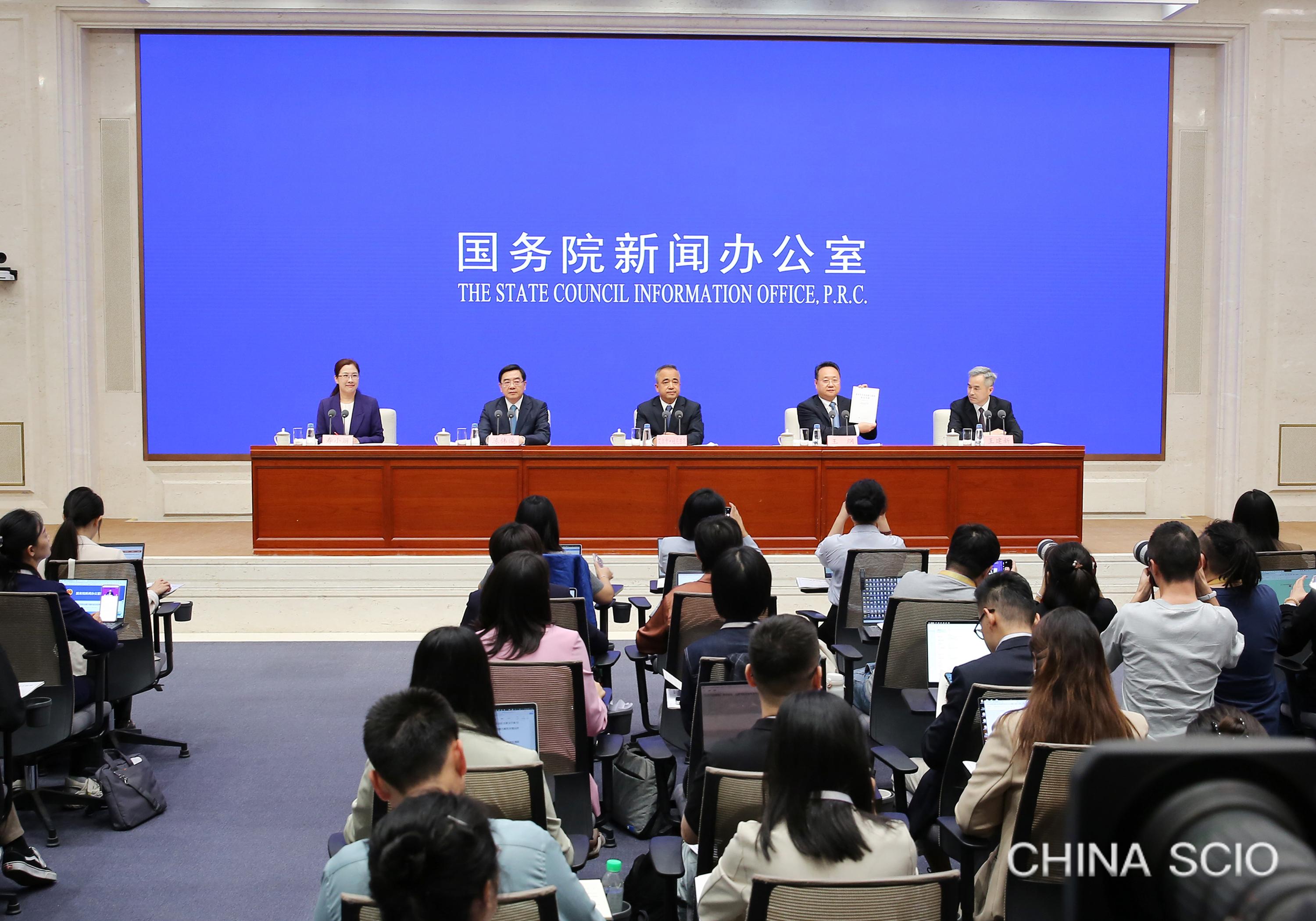
/6 Group photo
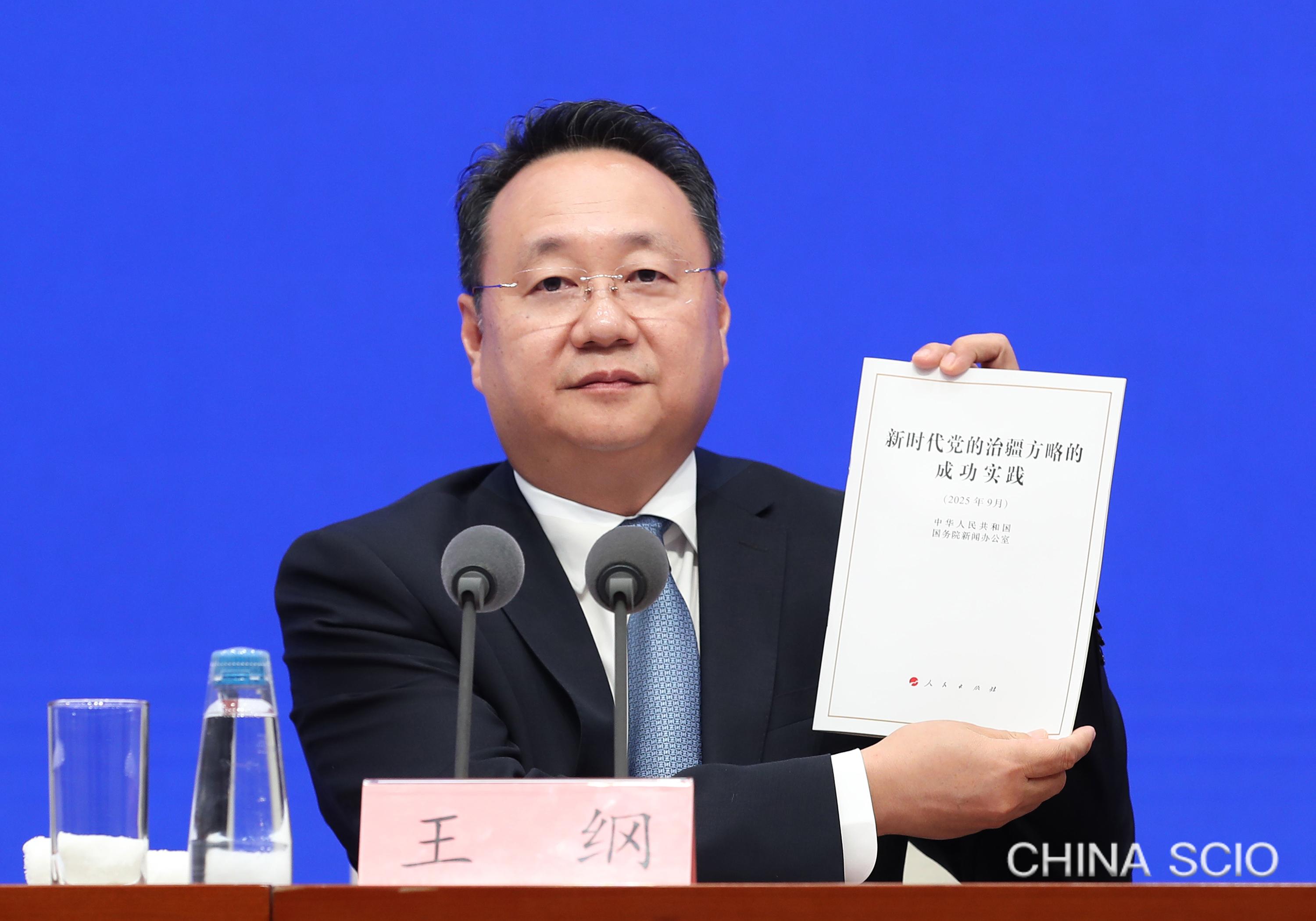
/6 Wang Gang
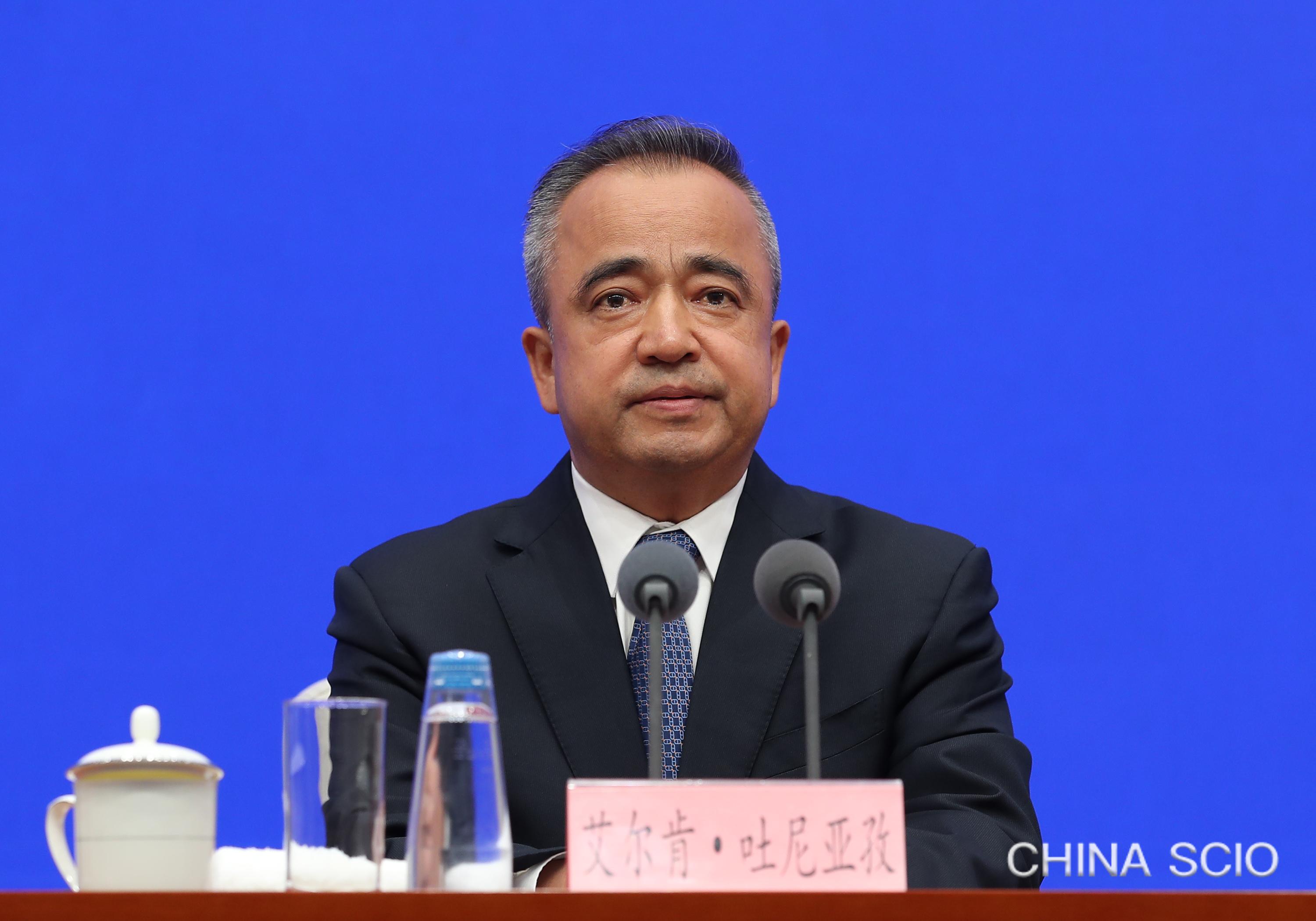
/6 Erkin Tuniyaz
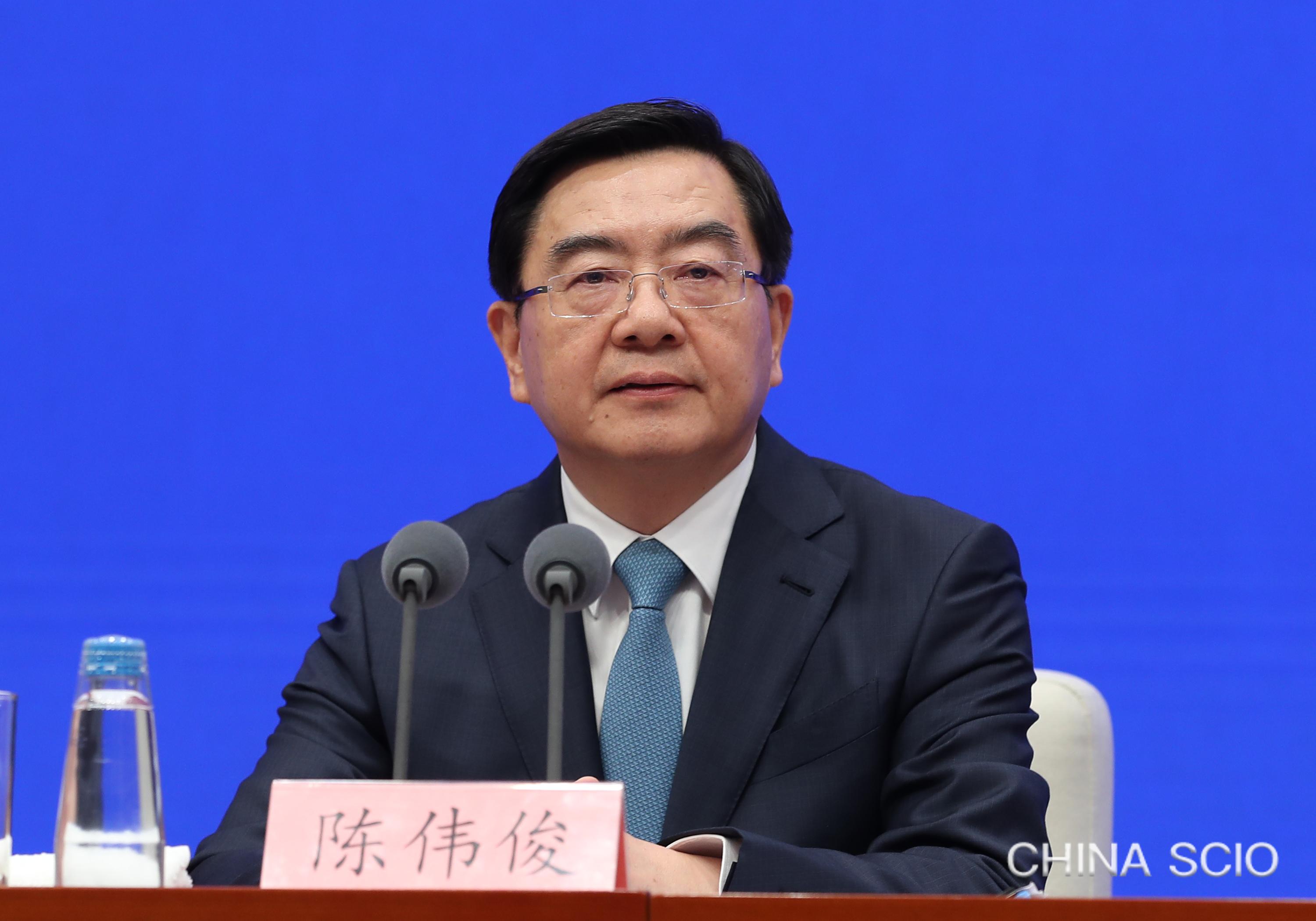
/6 Chen Weijun
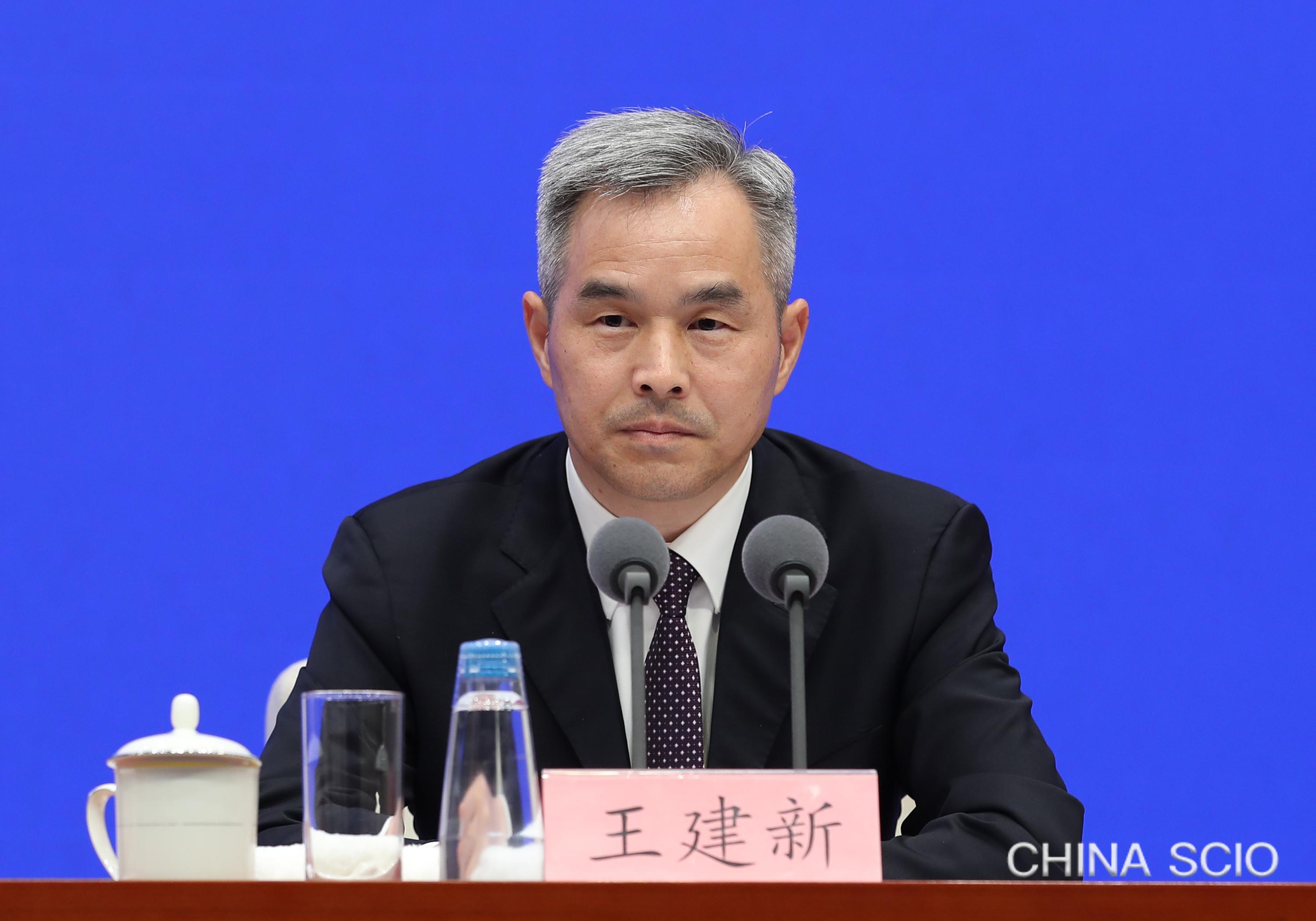
/6 Wang Jianxin
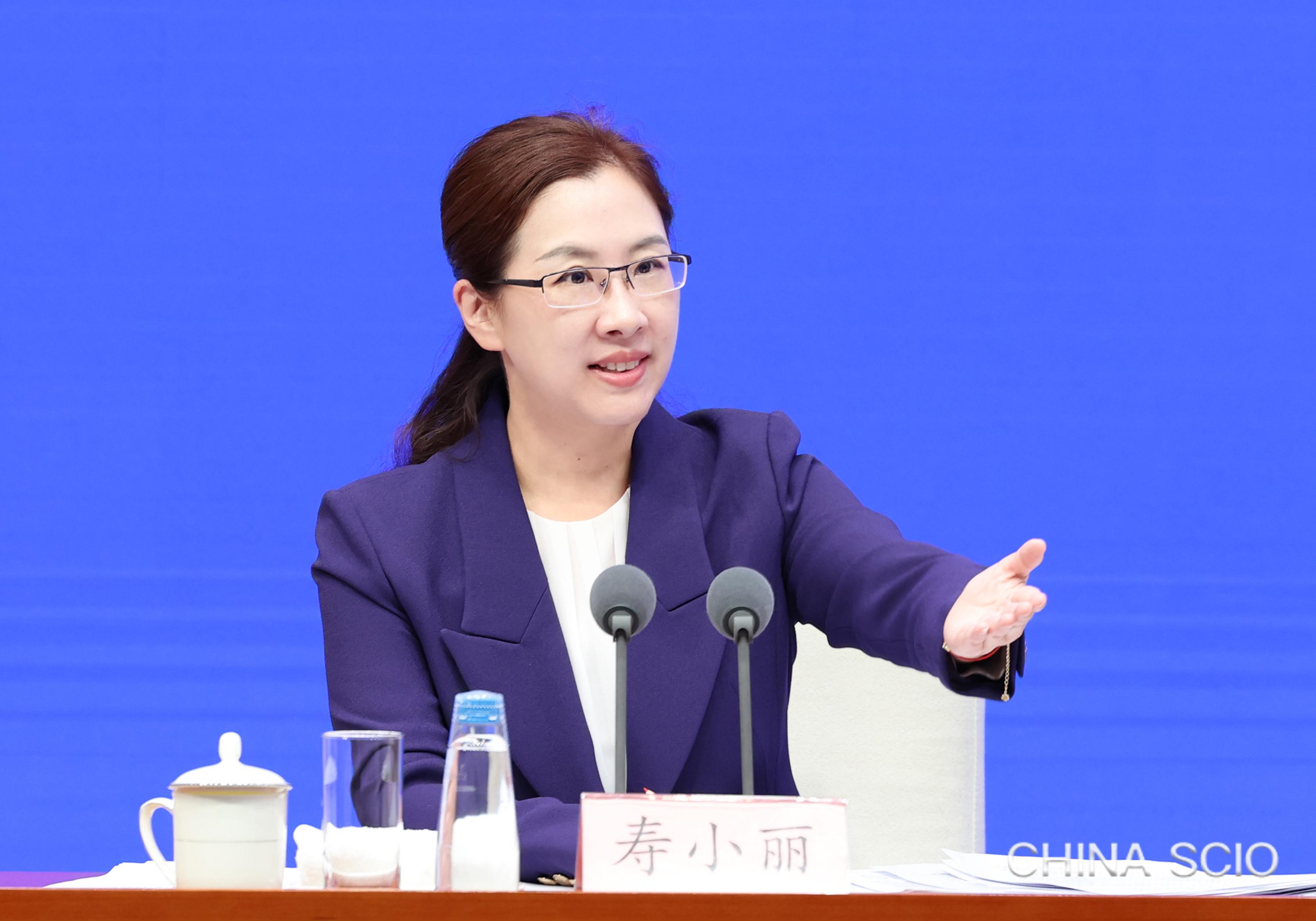
/6 Shou Xiaoli
SCIO briefing on science, technology and innovation achievements in the 14th Five-Year Plan period
September 18, 2025SCIO briefing on measures to expand service consumption
September 17, 2025