China Daily | October 21, 2026


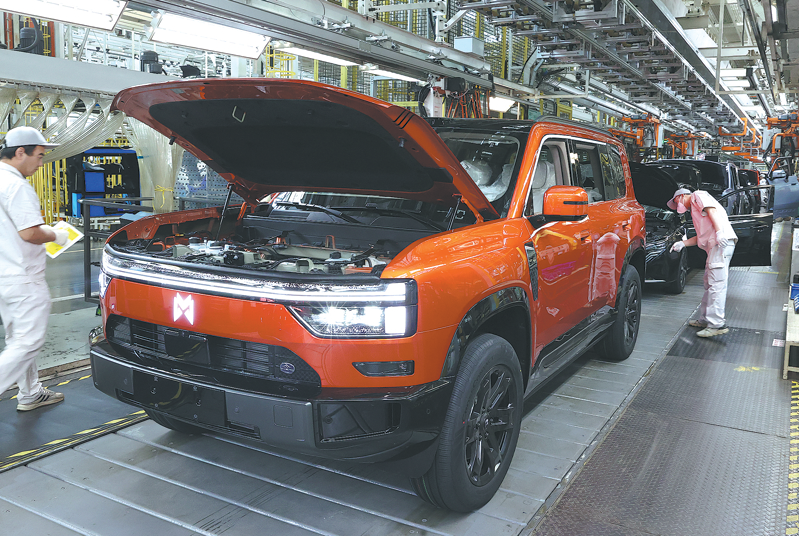
China is drafting a new policy for next-generation smart manufacturing to accelerate the integration of artificial intelligence into the industrial base, a senior industry official said on Tuesday, as the country reported solid industrial growth and an electronics manufacturing boom driven in large part by AI.
Speaking at a State Council Information Office news conference in Beijing, Wang Weiming, chief engineer of the Ministry of Industry and Information Technology, said the ministry is researching and drafting policy measures for next-gen smart manufacturing, adding that the push will leverage China's twin advantages of vibrant AI innovation and rich manufacturing scenarios.
He said the MIIT will cultivate smart factories in tiers. Basic and advanced-level smart factories will be encouraged to deepen digital and networked foundations and apply AI across research and development, production, operations and after-sales services. Excellent and leading-level factories will be supported in exploring next-gen smart manufacturing system architectures and future production models to guide the industry.
Meanwhile, the ministry will promote smart equipment. Companies will be supported in developing intelligent industrial machine tools, robots, testing equipment and control systems with adaptive machining, flexible operations and online inspection capabilities to meet high-precision, high-reliability production needs. Smart construction machinery, agricultural equipment and medical devices will also be advanced, Wang added.
The MIIT will also accelerate breakthroughs and application of smart technologies. Enterprises will be encouraged to build high-quality industrial datasets, develop vertical large language models and industry-specific models, and explore industrial intelligent operating systems, aligning data, models, software and equipment.
The AI push comes against a backdrop of resilient industrial growth. Wang said China's industrial output grew 5.3 percent year-on-year in the first three quarters, with industry contributing about 35 percent of economic growth.
Electronics manufacturing has been the standout performer. Xie Cun, MIIT spokesperson and director of the information and communications administration bureau, said the sector's value-added output grew 15.8 percent over the period, 10.3 percentage points higher than overall industrial growth.
Electronics manufacturing revenue in January-August reached 12.8 trillion yuan ($1.92 trillion), up 20.1 percent year-on-year, while profits totaled 847.5 billion yuan, up 109.9 percent and accounting for 62 percent of the profit growth of all industrial enterprises above designated size.
AI is the main driver. More than 20 AI-powered smartphones and computers were launched in the third quarter, with flagship products now capable of autonomous on-device task execution — shifting AI terminals from "passive response" to "active service", Xie said.
He added that more than 100 AI terminal products now meet level-3 assistant-level capability requirements under national intelligence grading standards, covering handsets, computers, televisions, glasses, automotive cockpits and earphones. Beidou independent positioning chips are also expanding, with several cities achieving 100 percent adoption in shared bikes, taxis, official vehicles, agricultural machinery and law enforcement equipment.
Fixed-asset investment in electronics manufacturing rose 9.6 percent in the first three quarters, with capital flowing toward high-end products. Investment in printed circuit boards reached about 169.1 billion yuan in the first half, more than four times the year-earlier level, driven by AI computing servers and data centers.
Samantha Zhu, chairperson of Accenture China, said China is emerging as a critical testing ground for AI. The fast-evolving technology is no longer just a tool. It's becoming a versatile, cross-scenario capability permeating every facet of enterprise operations.