China SCIO | January 14, 2026



China plans to expand its waste-free city initiative to around 200 cities during the 15th Five-Year Plan period (2026-2030), as it steps up efforts to strengthen solid waste management nationwide, a senior environment official said on Tuesday.
Li Gao, vice minister of ecology and environment, made the remarks at a policy briefing on the Action Plan for Comprehensive Treatment of Solid Waste.
According to a guideline on building a beautiful China, 60% of Chinese cities are expected to participate in waste-free city construction by 2027, and the country aims to implement the initiative nationwide by 2035.
Aligning the recently released action plan with the guideline, the Ministry of Ecology and Environment aims to increase the number of participating cities from 113 cities and eight designated areas during the 14th Five-Year Plan period (2021-2025) to about 200 cities in the next five years.
Efforts will be coordinated in major economic clusters, including the Beijing-Tianjin-Hebei region, the Yangtze River Delta, the Guangdong-Hong Kong-Macao Greater Bay Area, the cities in the middle reaches of the Yangtze River, and the Chengdu-Chongqing economic zone, Li said.
Progress made during the 14th Five-Year Plan period has laid the groundwork for the expansion. From 2021 to 2025, more than 3,000 solid waste treatment projects were implemented nationwide, with total investment reaching approximately 560 billion yuan (US$80.26 billion).
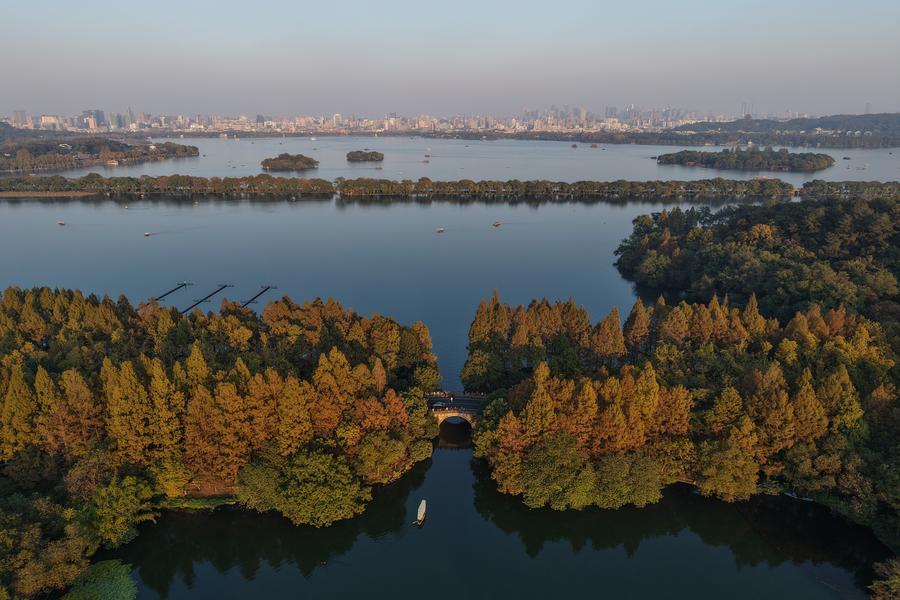
An aerial drone photo shows the West Lake scenic area in Hangzhou, eastern China's Zhejiang province, Nov. 21, 2025. [Photo/Xinhua]
High-profile events such as the Hangzhou Asian Games and the National Games held in Guangzhou, both organized under waste-free principles, received wide public recognition. In addition, nearly 44,000 waste-free units have been established in government institutions, enterprises, and schools across China, Li said.
Recently, Hangzhou was recognized as one of the "20 Cities Towards Zero Waste" under the United Nations Secretary-General's Advisory Board on Zero Waste, according to the Hangzhou Municipal Ecology and Environment Bureau. The city's achievement will be showcased as a model case in March as a reference for global efforts.
Looking ahead, the ministry will step up evaluation of waste-free city construction, identify weak links in solid waste management, and promote more tangible results. Provinces with pilot zones for the Beautiful China Initiative and those with suitable conditions will be encouraged to complete waste-free city goals, Li added.
Achieving these targets requires stronger regulatory oversight, the vice minister said. The ministry will improve planning, set clearer targets and tasks, roll out new treatment projects, and establish accountability and evaluation mechanisms to ensure concrete progress.
In terms of laws and regulations, China will implement the ecological environment code, which is currently under deliberations, and accelerate revisions to the regulations on hazardous waste operation permits.
Furthermore, the country will establish an integrated and sector-specific standard system to control toxic and hazardous substances in solid waste, aiming to reduce environmental risks at the source.
The ministry will also strengthen technological support by backing research projects on solid waste management and the integrated treatment of heavy metals, Li said.

