Xinhua | January 9, 2026


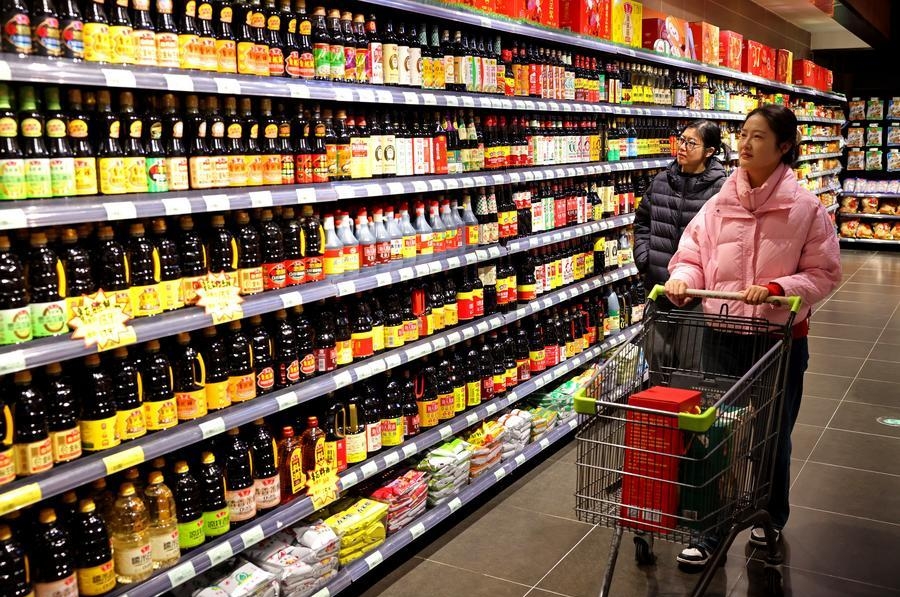

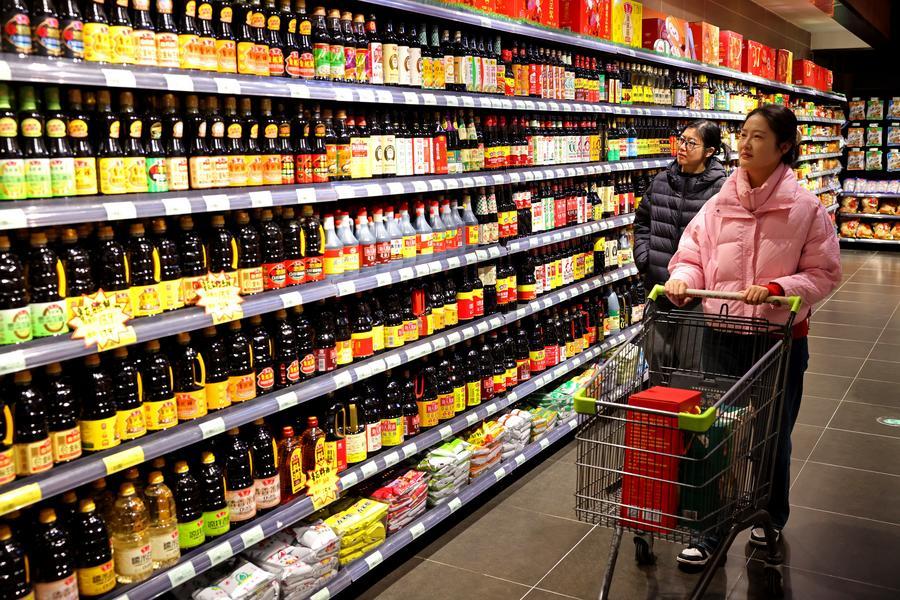
Customers select products at a supermarket in Zaozhuang City, east China's Shandong Province, Dec. 10, 2025. (Photo by Sun Zhongzhe/Xinhua)
China's inflation ticked up in the final month of 2025, and the decline in producer prices further narrowed as government policies aimed at boosting domestic demand continued to make a positive impact on the economy.
With the New Year's spending boost, China's consumer price index (CPI), a main gauge of inflation, rose 0.8 percent year on year in December, data from the National Bureau of Statistics (NBS) showed Friday.
"The CPI increase in December expanded by 0.1 percentage points compared to the previous month, reaching the highest level since March 2023," NBS statistician Dong Lijuan said, attributing the widened price increase primarily to the expansion in food price growth. In December, food prices gained 1.1 percent year on year.
The core CPI, which excludes food and energy prices, was up 1.2 percent from a year ago last month, the data showed.
In December, the CPI in urban regions rose 0.9 percent, beating a milder 0.6 percent increase in rural regions. Non-food prices also registered more moderate growth than food prices, rising 0.8 percent year on year.
In 2025, the CPI remained flat compared to last year, according to NBS data. Among its main targets for development in 2025, the Chinese government aimed for a CPI increase of around 2 percent as it sought to balance supply and demand through a combination of policies and reform measures, while maintaining the general price level within an appropriate range.
On a monthly basis, the CPI also rose 0.2 percent in December, reversing a 0.1-percent decrease in November. This shift in price changes has been primarily driven by rising prices of industrial consumer goods excluding energy, which grew by 0.6 percent in the month.
"As the effects of policies to boost consumption continued to take effect, coupled with the New Year's Day, residents' demand for shopping and entertainment increased, leading to price increases in communication devices, maternal and infant products, durable recreational goods, and household appliances, with growth rates ranging between 1.4 percent and 3 percent on a month-on-month basis," Dong said.
Friday's data also showed the producer price index (PPI), which measures costs for goods at the factory gate, fell 1.9 percent year on year in December, narrowing from a 2.2 percent decline in the previous month. For the full year of 2025, the PPI declined 2.6 percent.
However, on a month-on-month basis, the PPI rose 0.2 percent in December, accelerating from a 0.1-percent increase in the previous month. This also marked the third straight month of PPI growth.
Dong said that improved supply-demand dynamics have driven price increases in some industries in December, while improved production management in key industries and comprehensive efforts to regulate market competition have led to price increases in sectors such as coal mining and processing, lithium-ion battery manufacturing, cement manufacturing, and new energy vehicle manufacturing.
Rising international non-ferrous metal prices also spurred price increases in related domestic sectors, such as non-ferrous metal mining, smelting and rolling, last month. However, declining international crude oil prices led to domestic petroleum extraction and refined petroleum product manufacturing prices falling by 2.3 percent and 0.9 percent, respectively, Dong said.

