Xinhua | August 6, 2026


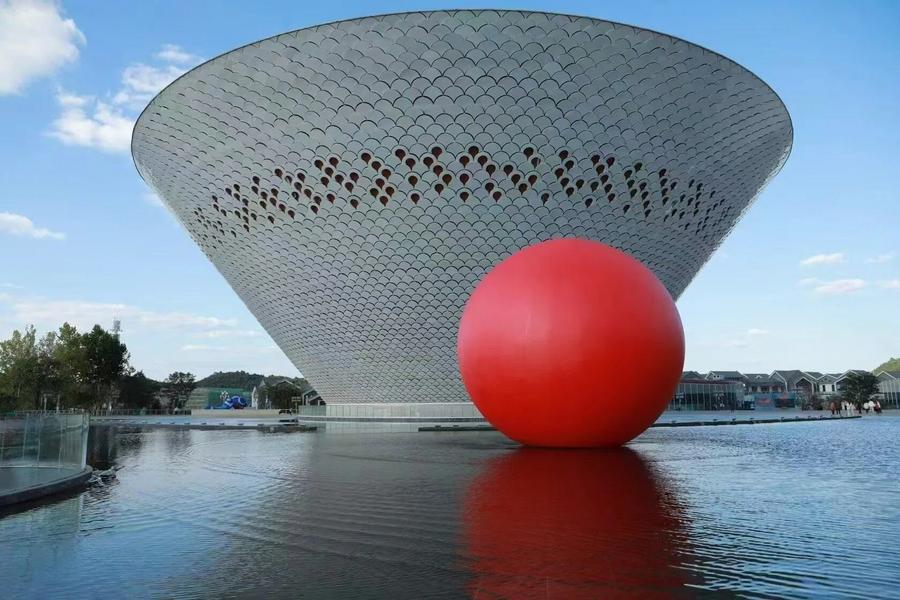
This photo taken on May 8, 2026 shows a bowl-shaped building in Jingdezhen, east China's Jiangxi Province. (Xinhua)
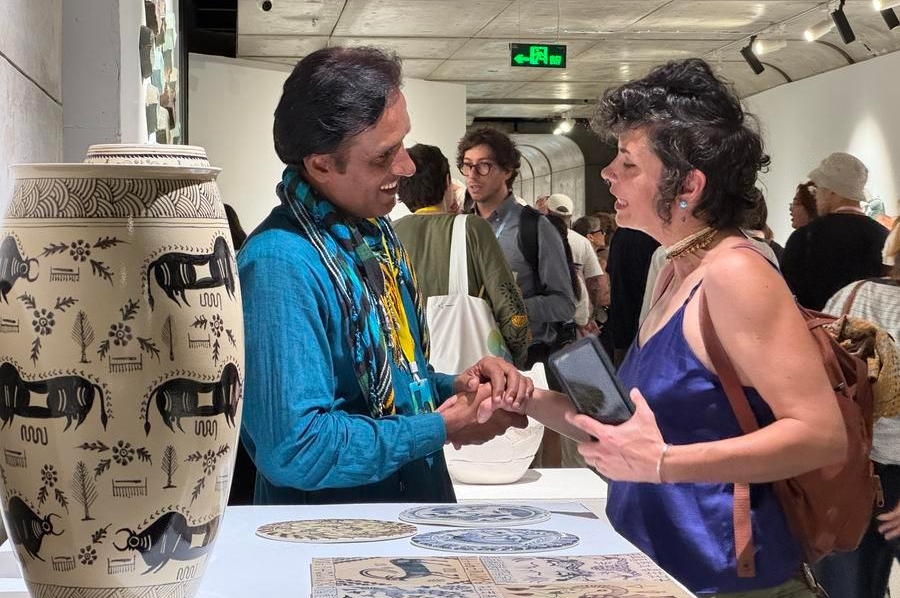
Tracing a creative arc from "socarrat," an ancient Arab ceramic-making technique flourishing in Valencia, Spain, to Jingdezhen's classic Chinese techniques, Spanish artist Xavier Monsalvatje has been reinterpreting modernity from these centuries-old legacies.
"In almost all my projects, I've always wanted to use traditional ceramic techniques and bring them to a more contemporary discourse," said Monsalvatje. The artist's cobalt blue artwork has become a standout attraction at the ongoing International Academy of Ceramics (IAC) Member Exhibition in Jingdezhen, China's renowned "porcelain capital."
Recently, the city in east China's Jiangxi Province gained further recognition after the United Nations Educational, Scientific and Cultural Organization (UNESCO) added Jingdezhen Handicraft Porcelain Industry Sites to the World Heritage List on July 25. It brings the total number of World Heritage sites in China to 61.
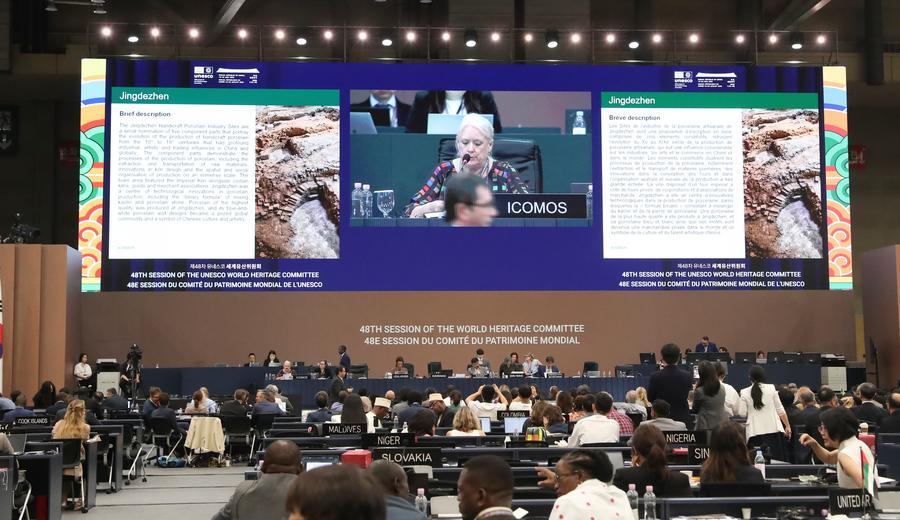
This photo taken on July 25, 2026 shows a scene during the 48th session of the World Heritage Committee in Busan, South Korea. (Xinhua/Yao Qilin)
For over a millennium, the reach of Jingdezhen porcelain extended across the globe, taking in Asia, Africa, and Europe. Today, that enduring allure draws more than 5,000 ceramic enthusiasts from around the world to the city at peak seasons.
The city has long been fertile ground for ceramic artists worldwide in their quest for creative innovation. Michael May, a 38-year-old American artist, is using 3D printers to "print" ceramics, leveraging the city's wealth of related equipment and technologies. Fellow U.S. artist Matt Watterson, meanwhile, incorporates Jingdezhen's ancient ceramic fragments into his own creations.
Russian-British artist Svetlana K-Liée also said her work evolved over three years in Jingdezhen, where she kept trying new techniques such as wood kilns and combining glass with ceramics.
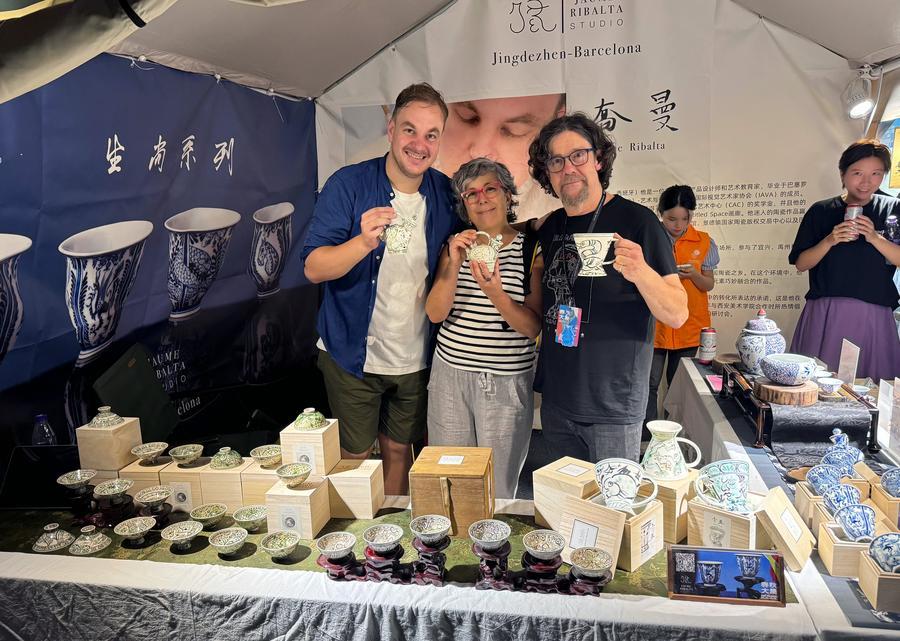
This file photo shows Jaume Ribalta (1st L) and his friends displaying porcelain works at a fair in Jingdezhen City, east China's Jiangxi Province, in October 2024. (Xinhua)
Another Spanish artist, Jaume Ribalta, opened his own studio in Jingdezhen, where he explored fusing his native Barcelona's black-and-white ceramic motifs with the city's time-honored techniques.
He marveled at the intricate specialization of Jingdezhen's ceramic production. "Yet the real value here lies in the openness -- every stage of the craft is accessible to outsiders," Ribalta said.
Oriol Calvo Vergés, president of the IAC, highlighted Jingdezhen as an exceptional place to preserve depth of tradition, while opening new creative pathways for artists.
"Here, inheritance is visible everywhere: in the kilns, in the workshops, in the hands of craftspeople, in museums, in historic sites, in porcelain itself. But innovation is also present everywhere: in universities, research centers, contemporary exhibitions, residencies, new creative districts and international projects," said the president.
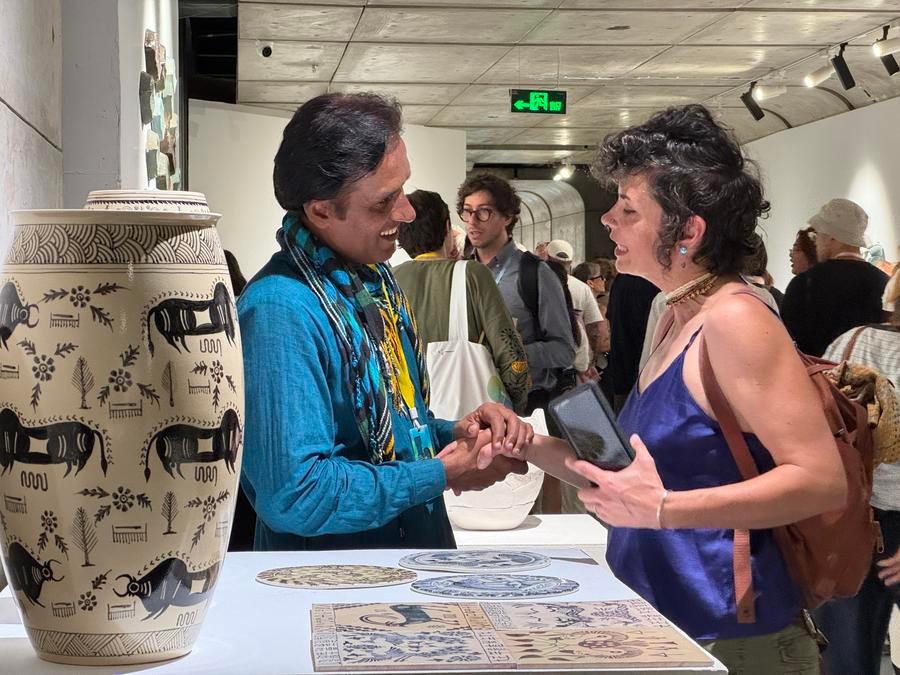
Foreign artists are seen during the 2026 Congress of the International Academy of Ceramics in Jingdezhen, east China's Jiangxi Province. (Photo by Liu Bin/Xinhua)
Spanish artist Anca Ion is trying to push the boundaries of traditional ceramics in Jingdezhen. Through investigating the parameters of fusion between ceramics and glass at high temperatures, the artist believes she can create brand-new ceramics.
Jingdezhen is more than a porcelain production hub, and it is also a melting pot where diverse cultures converge and interweave, said Bai Guanghua, associate researcher with the Jingdezhen Imperial Kiln Institute.
As a still-thriving "porcelain capital," the city is home to more than 3,200 inheritors of intangible cultural heritage in ceramic craftsmanship. It has also been named in the UNESCO Creative Cities Network as a City of Crafts and Folk Art.
In recent decades, China has demonstrated to the world that ceramics are far more than a heritage to be preserved, and can also serve as a powerful engine for urban renewal, education, tourism, innovation, artistic creation and international dialogue, Vergés noted.
Ribalta has settled in Jingdezhen. "I have always dreamed of coming to Jingdezhen. As an artist, I expect myself to continue to grow in my artistic career," he said. "Now I am personally exploring the origin of those blue-and-white porcelains that once crossed the ocean to my hometown."
"Jingdezhen is not only a part of Chinese history but also that of world history. And to me, it is also my home," he added.