Xinhua | July 7, 2026


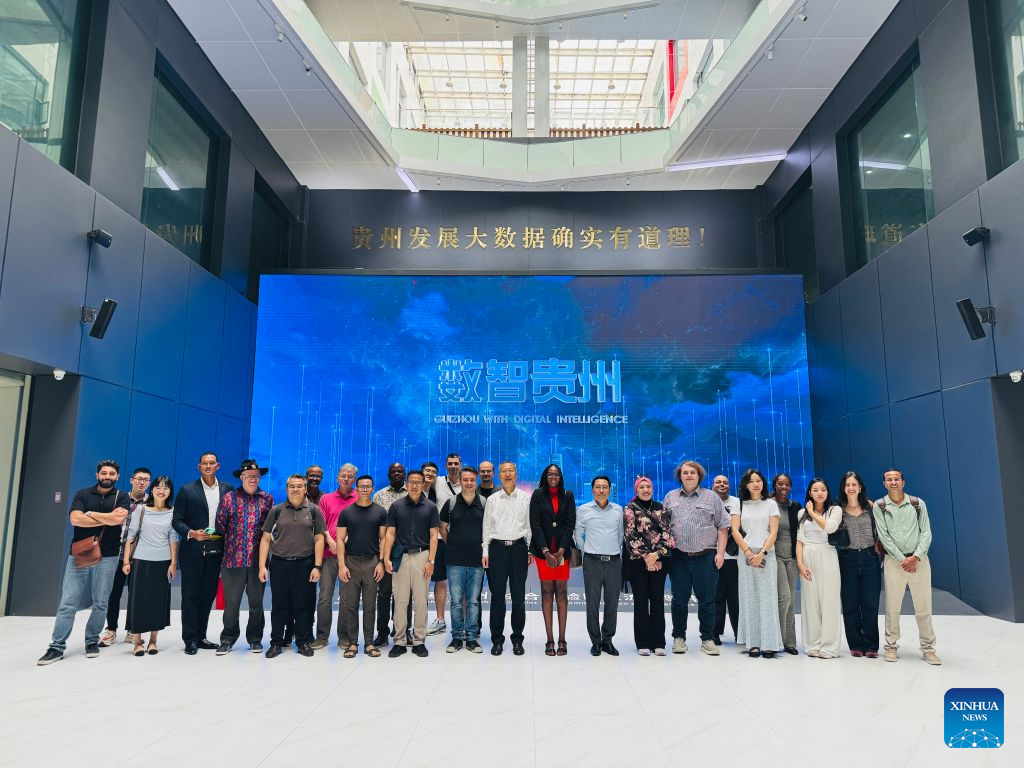
A delegation of political party and media representatives from 21 countries poses for group photos while visiting the National Big Data (Guizhou) Comprehensive Pilot Zone Exhibition Center in Guiyang, southwest China's Guizhou Province, July 3, 2026. (Xinhua/Zhou Xuanni)
At the invitation of the International Department of the Central Committee of the Communist Party of China (IDCPC), a delegation of political party and media representatives from 21 countries paid a four-day visit to Guiyang, Guizhou Province in southwest China from July 3 to 6.
During the tour, the delegates visited Guiyang's fast-growing big-data industry, witnessed live artificial intelligence applications, and experienced autonomous driving vehicles firsthand. The trip gave them an up-close look at Guizhou's notable progress in poverty alleviation and its profound urban-rural transformation.
One highlight of the trip was the futuristic, high-tech autonomous shuttle nicknamed the "Potato Bus", which runs along Guiyang's scenic "Wonder Loop" sightseeing route. It immediately caught the eye of delegation leader Francesco Maringio, a member of the Central Committee and head of the Asia Desk, International Department of the Italian Communist Party (PCI).
Aboard the vehicle, Maringio closely examined its start-up procedures, emergency braking system and automatic operation mechanism. He was amazed throughout the ride and took a lot of photos and videos of the autonomous drive.
"This is not my first visit to China. I have traveled between Italy and China since 2008. My stays here are often lengthy, not just one-week short trips. I have even resided in Beijing for as long as a month at a time. I am well aware that China has achieved remarkable development, with its major cities outpacing their counterparts in many other countries," Francesco said.
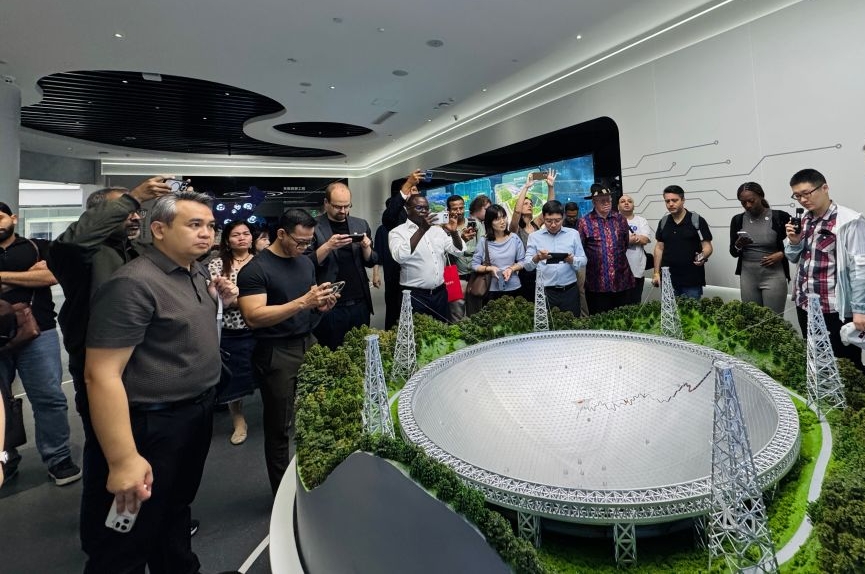
This was Maringio's first trip to Guizhou. He was impressed by the province's development model displayed at the National Big Data (Guizhou) Comprehensive Pilot Zone Exhibition Center. He was particularly struck by how big data is helping improve the lives of local people.
"It was also my first time riding an autonomous vehicle, and this cutting-edge technology struck me as truly extraordinary." In Francesco's view, the ultimate goal of China's emerging technology industrial development is to deliver a better life for the people.
"Technological development fuels economic growth, raises incomes and substantially improves people's livelihoods on a large scale. It frees people from tedious routine tasks, giving them more time to enjoy life, while also protecting urban ecological environments and public health," Francesco explained.
Commenting on Guizhou's dramatic leap from a once deeply impoverished region to a national digital industry hub, Francesco noted that Guizhou's development approach is pragmatic, always rooted in people's livelihoods and anchored to its original aspirations.
Italy and Guizhou have launched multiple cooperative projects. The autonomous shuttle bus that Francesco rode has been put into large-scale commercial operation in Turin, Italy. Speaking about existing bilateral cooperation and future prospects, Francesco remained highly optimistic.
"European countries including Italy have vast potential for cooperation with Guizhou. Faced with complex global challenges, strengthened multilateral cooperation is the only way to weather difficulties amid a volatile international landscape," Francesco added.
The autonomous driving experience also won high praise from Vincent Cziesla, head of the Editorial Department of Our Time, the official newspaper of the German Communist Party. He shared his excitement after the ride.
"This was an entirely new experience for me. I was curious about its technological design at first. The vehicle features abundant high-tech applications and a unique interior layout, with passengers sitting facing forward or backward. It runs fully driverless, delivering a thrilling yet reliably safe journey. The panoramic windows allow passengers to enjoy full surrounding views," Vincent said.
"It is incredible. Decades ago, Guizhou was isolated by mountains and underdeveloped infrastructure, making it hard to reach. Today, it boasts world-leading future-oriented intelligent mobility. Its development speed is truly astonishing," he said.
"Global geopolitics remains highly complex. Germany needs to adjust its development orientation and pursue peaceful coexistence and mutually beneficial cooperation. We hope to see such positive changes, which Germany must actively strive for, as China has proven its development path is sound and viable," Vincent added.
Currently, AI and big-data analytics are widely used to improve Guizhou's industrial, agricultural, transport and cultural tourist sectors. Paul Ilado, editorial director of Kenya's Radio Africa Group, who focuses on agricultural development, lingered for a long time in front of Guizhou's smart agricultural big data display screen, observing real-time footage and operational data of local livestock farms.
"It is truly eye-opening. We had only read about such technologies in books before. Experiencing them on site makes abstract data concrete, allowing us to see their practical functions in daily life. Data supports daily operations and helps us make more scientific decisions," Paul remarked.