Xinhua | September 3, 2026


Road access to the mudslide-hit Gyirong Port in southwest China's Xizang Autonomous Region was basically restored on Wednesday morning, facilitating the entry of more rescuers and machinery to assist in a large-scale search for the hundreds of people still missing.
The road became accessible again after days of round-the-clock repair work, allowing more rescue teams, relief supplies and large equipment into the disaster zone.
A fast-moving chain mudslide, triggered by a high-altitude glacier collapse in Nepal, struck Gyirong Port on the China-Nepal border in Xizang on Aug. 26. Twenty-one people have been confirmed dead and 541 others remain missing, according to the regional government's latest update.
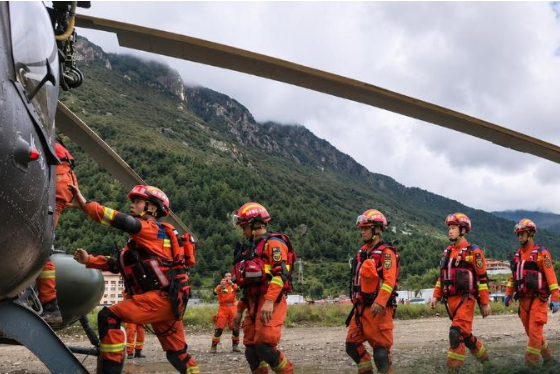
China has sent more than 2,300 emergency personnel into a multipronged rescue mission at the devastated port. Rescuers have described the mission as highly challenging due to cut-off road access, adverse weather and high risks of secondary disasters.
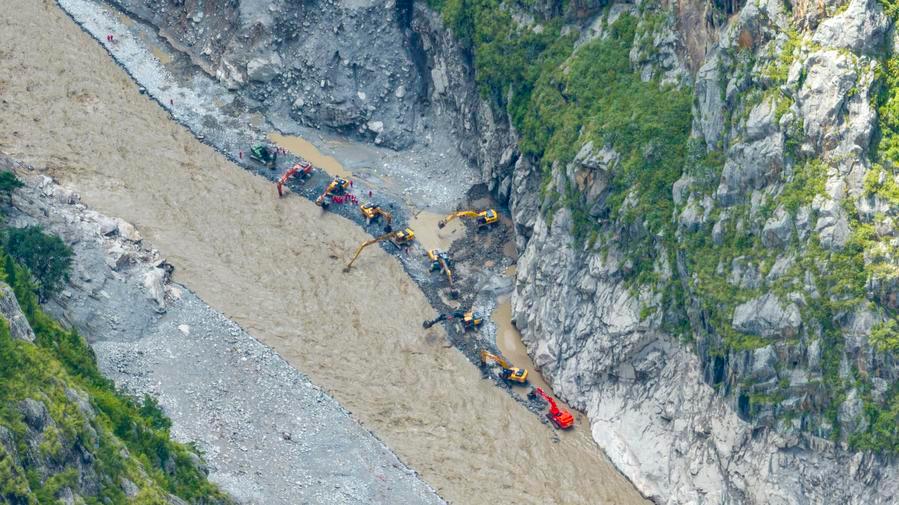
An aerial drone photo shows a road clearing and restoring operation underway in a section of the G216 national highway from Gyirong Town to Gyirong Port in southwest China's Xizang Autonomous Region, Aug. 30, 2026. (Xinhua/Jigme Dorje)
TRUDGING TO BORDER GATE
The mudslide destroyed a section of G216, a key national highway leading into the port, while strong winds and turbulence made it difficult for helicopters to airdrop rescuers at the badly-hit border gate. To reach the site, rescuers had to trek through thick mud for several kilometers carrying heavy loads.
On the morning of Aug. 26 immediately after the disaster, firefighters in the town of Gyirong were mobilized to head for the port area more than 20 kilometers away.
Their vehicle came to a halt about six kilometers from the destination. "The road was damaged and blocked," said firefighter Cering Ngoezhub, who saw excavators, car wrecks, clothing fragments and construction boards floating in the river nearby.
Another rescuer, Nyima Gyaincain, waded through the muddy water carrying equipment weighing over 20 kilograms. "The mud was up to my calves," he said. "Every time I pulled my legs out, it was like a tug-of-war with the mud. After walking just a few dozen meters, my legs were already aching and trembling."
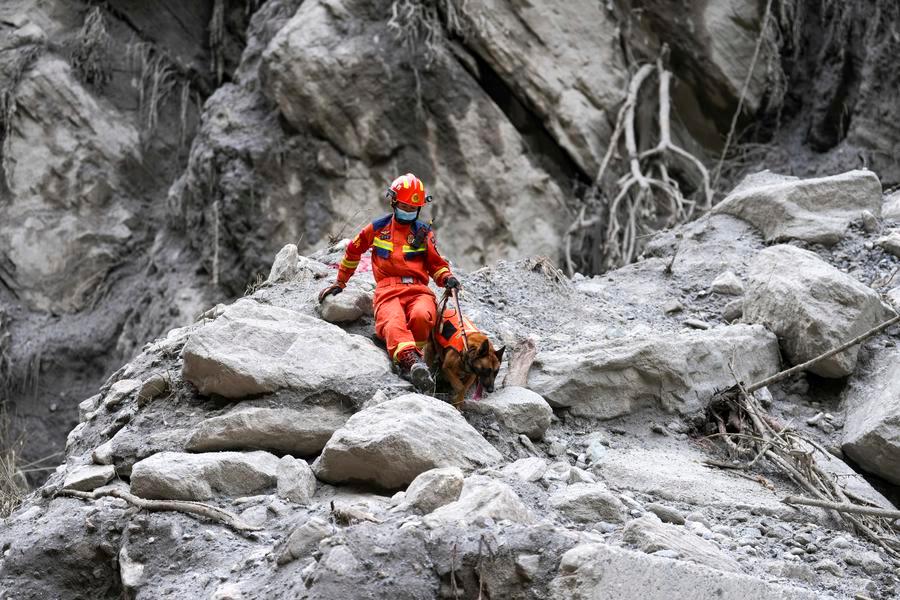
A rescuer and his sniffer dog search for the missing at the mudslide-hit area in Gyirong County, southwest China's Xizang Autonomous Region, Aug. 30, 2026. (Xinhua/Jigme Dorje)
The first team of 141 rescuers, as well as a high-altitude helicopter, arrived at the port on Thursday morning. On Friday, two teams, comprising 21 people and a search dog, became the first professional rescue teams to reach the core rescue zone at the border gate.
Huo Jianxin, who led one of the teams, said they trudged between a cliff face prone to sudden landslides and a steep valley. "Our guide told us that they hadn't trekked through this primeval jungle for 20 years," Huo recalled.
They relied on ropes to pass steep cliffs. "We carried loads weighing over 10 kilograms. On the descent, we had to press ourselves tightly against the mountainside and slowly slide down, relying on the friction between our bodies and the slope surface."
Guo Xiqing, another team member, said that while the straight-line distance was only six kilometers, they traversed more than 20 kilometers of mountains, descending over 500 meters on ropes in total.
"I have never encountered a disaster situation so complex and ever-changing," said the veteran rescuer, who has been engaged in rescue work for nearly 20 years.
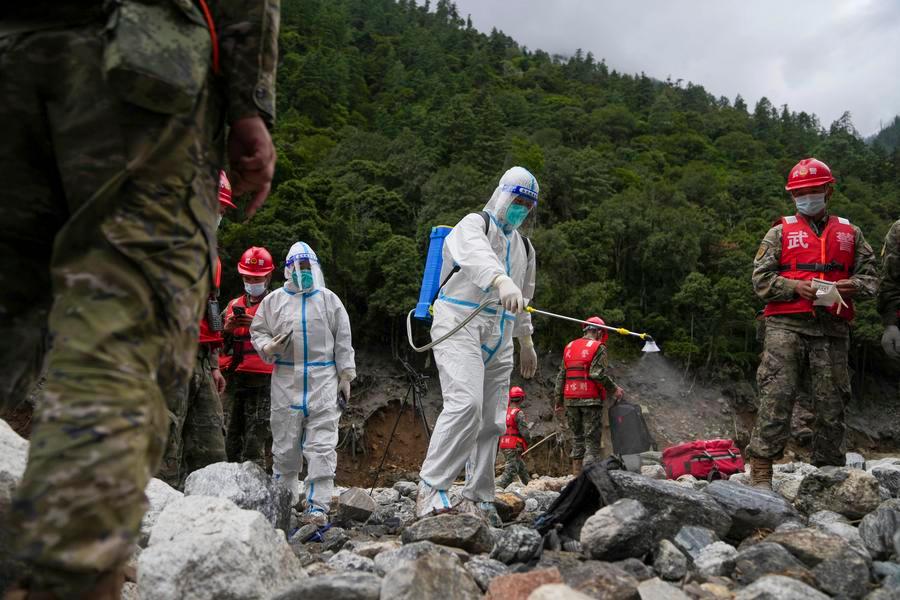
Workers conduct disinfection operations at the mudslide-hit area in Gyirong County, southwest China's Xizang Autonomous Region, Aug. 30, 2026. (Xinhua/Jigme Dorje)
Search and rescue operations began immediately upon their arrival at the border gate, with the objective of locating survivors and remains of the deceased from the surface and within the crevices of the debris, paving the way for subsequent deep dredging and recovery efforts.
A total of 27 buildings were flattened within the port's core area, which spanned approximately 0.7 square kilometers. A three-dimensional search and rescue tactic was adopted, combining ground operations, waterway searches, and aerial reconnaissance and delivery, supported by Beidou navigation terminals, drones, life detectors, and search and rescue dogs.
"Is anybody here?" the team members shouted every few meters, their voices reverberating over the ruins.
"Due to the interference from mud and standing water caused by the mudslide, life detectors couldn't function properly," said Guo. "Rescuers sometimes had to rely on visual searches, lining up in a row and conducting thorough manual inspections. After a while, the upstream area was on the verge of collapsing again, and we had no choice but to move to higher ground."
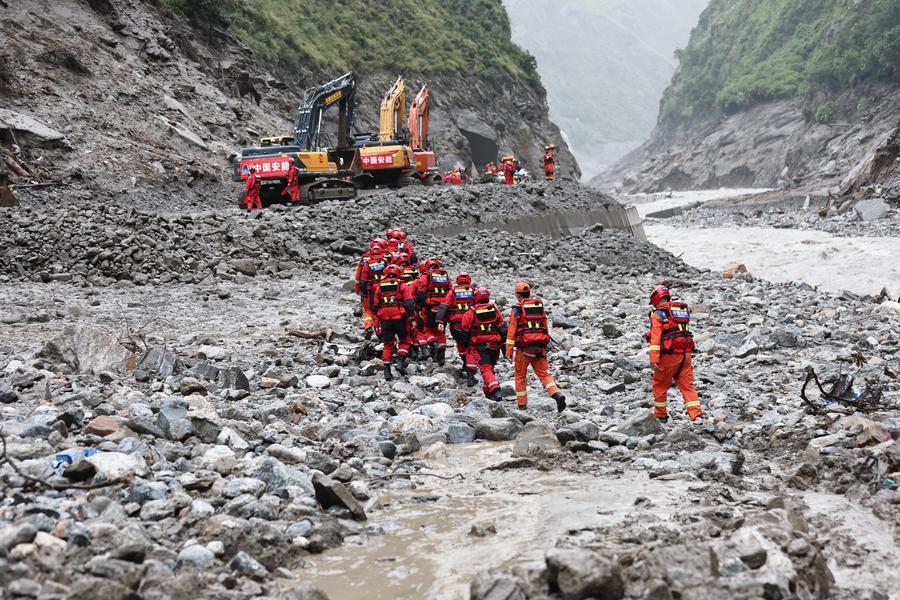
This photo shows search and rescue operations underway at the mudslide-hit area in Gyirong County, southwest China's Xizang Autonomous Region, on Aug. 29, 2026. (Xinhua/Jiang Fan)
RESTORING VITAL ARTERY
Repair of the G216 national highway was another priority, with road access essential for vehicles and large equipment to enter the core rescue area.
Operations had been hampered by extremely limited working space, difficulties in transporting large rocks needed to rebuild the roadbed, strong river currents that could wash away road-filling materials, and risks from rain, rockfalls and landslides.
"Conditions vary from one section of the road to another," said Zhou Gang from China Anneng, a state-owned engineering and rescue enterprise, which deployed personnel and equipment to repair the road. Some parts of the roadbed were severely damaged, buried in mud or submerged in water.
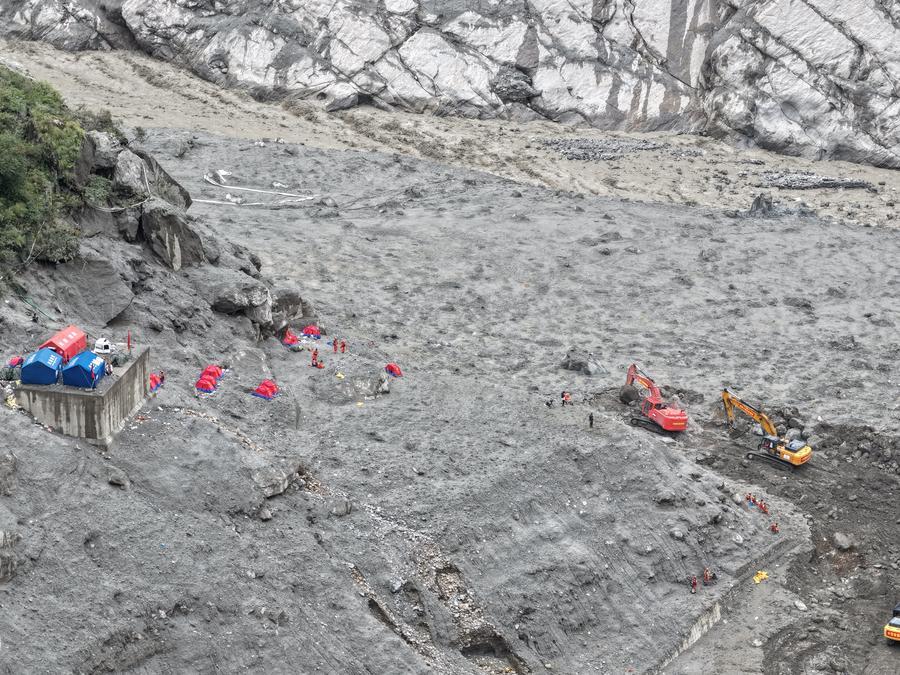
An aerial drone photo shows road clearance and repair operations underway at the core area of the mudslide-hit Gyirong Port in southwest China's Xizang Autonomous Region, Sept. 2, 2026. (Xinhua/Jiang Fan)
The work zone lay in a narrow mountain gorge, with steep mountainsides on one side and the fast-flowing river on the other. The confined space made it difficult for multiple pieces of heavy machinery to operate simultaneously or maneuver around one another, Zhou added. In sections where the roadbed had been washed away, excavators also risked becoming bogged down in the mud.
The river was flowing at 6 to 7 meters per second and was about 1.5 meters at its deepest point, with strong currents capable of washing away ordinary rocks used to rebuild the roadbed. Supplying heavier rocks posed another challenge: with the road steep, narrow and running alongside cliffs, transporting the material from 40 kilometers away took about three hours.
Crews adapted their methods to conditions. Along narrow sections, multiple excavators worked in relay, lining up one behind another to dig and pass debris from one machine to the next.
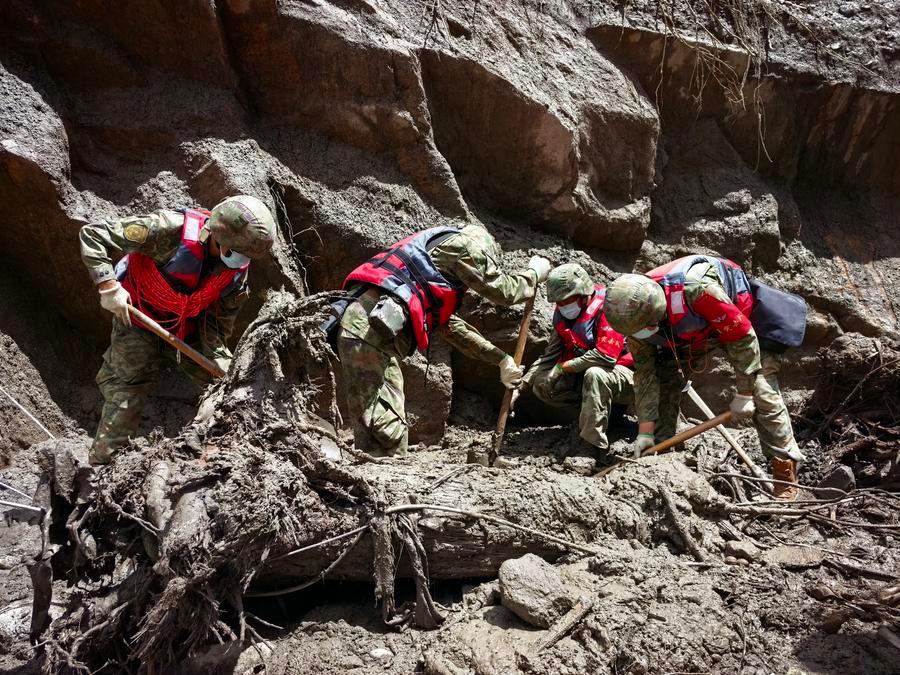
Rescuers from the Chinese People's Liberation Army work in a mudslide-hit area near Gyirong Port in Gyirong County, in Xigaze, southwest China's Xizang Autonomous Region, Aug. 28, 2026. (Photo by Liu Yuqin/Xinhua)
They also used the river itself to separate usable material from the debris. Excavators agitated mixtures of mud, sand and rocks in the water, allowing the current to wash away fine mud while leaving behind sand and rocks that could be used to rebuild the roadbed -- a method rarely used in conventional road repairs.
In sections with the strongest currents, excavators pushed into the water to open the way, while crews built diversion structures and placed rock-filled steel cages to stabilize the roadbed, advancing section by section.
To guard against potential hazards as the work progressed, China Anneng used AI-enabled laser video monitoring systems to monitor surrounding mountainsides around the clock.
CONTINUING RELIEF EFFORTS
China has employed multiple technologies, including satellite remote sensing, radar, drones and 3D laser scanners, to monitor secondary geological hazards such as landslides and barrier lakes.
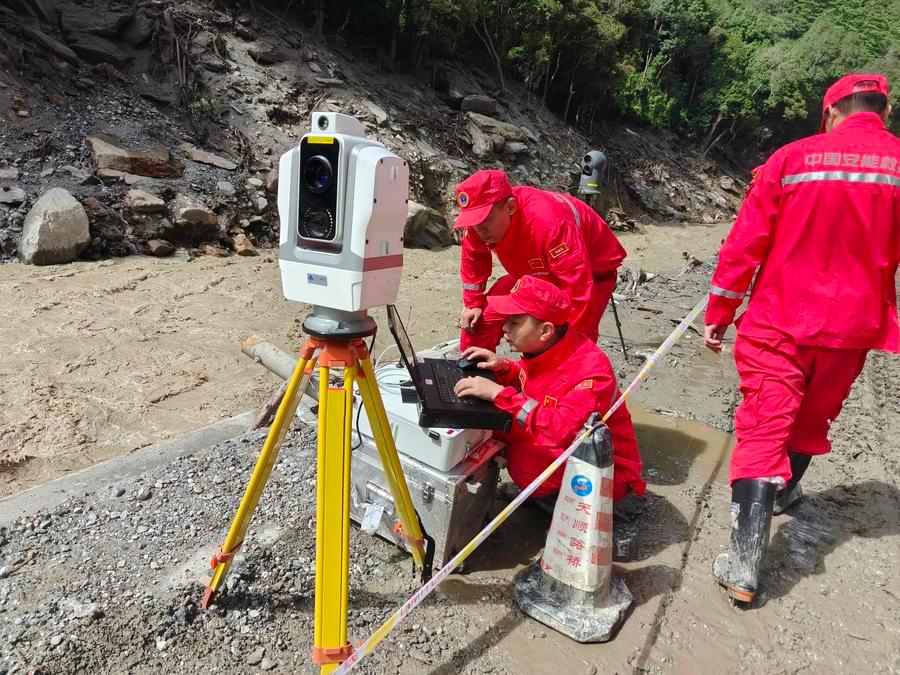
Rescuers use a laser-based AI monitoring device to dynamically monitor risks such as landslides and falling rocks at the mudslide-hit area in Gyirong County, southwest China's Xizang Autonomous Region, Aug. 30, 2026. (Xinhua/Jigme Dorje)
The barrier lake above Gyirong Port was fully drained, with water now flowing through the river channel, according to an assessment by a team of experts on Tuesday.
But the danger has not passed. Conditions in the downstream river channel still need to be closely monitored, said Ding Haitao, a senior engineer at the Institute of Mountain Hazards and Environment under the Chinese Academy of Sciences.
Frontline support has also been intensified. The People's Liberation Army Xizang Military Command has delivered food, medicine and rescue equipment to the core disaster area by helicopter, while city and county-level support teams in Xigaze have assisted more than 4,300 disaster-affected residents and rescue workers.
An epidemic prevention team also rushed to the frontline, carrying out environmental disinfection, food and water quality testing, emergency vaccinations, and routine medical rounds for injuries and illnesses, while medical personnel at resettlement sites provide regular psychological counseling for rescuers and the disaster-affected residents.
As of 5 p.m. Tuesday, telecom operators in Xizang had restored one base station and added 12 emergency base stations in disaster-hit areas, ensuring uninterrupted communications for emergency command, rescue operations and supply coordination.
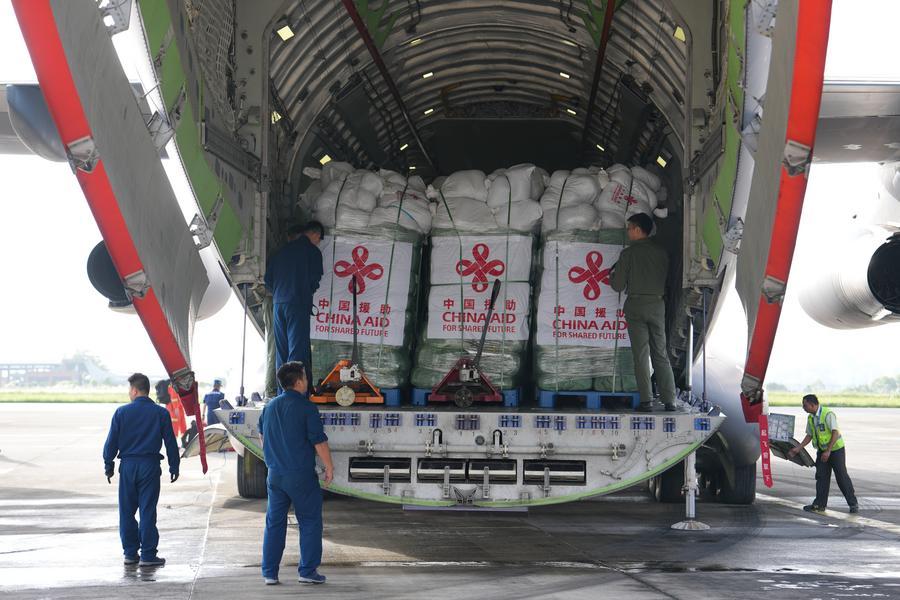
Staff members prepare to unload Chinese relief supplies at Tribhuvan International Airport in Kathmandu, Nepal, Aug. 30, 2026. (Xinhua/Zhang Ping)
While urgently carrying out rescue and relief efforts at home, China also immediately reached out to Nepal to support its emergency response and disaster relief, said Chinese foreign ministry spokesperson Guo Jiakun at a news briefing on Monday.
China has provided Nepal with emergency cash assistance, humanitarian aid and expert support. On Sunday, the first batch of 50 tonnes of relief supplies arrived in Kathmandu, while rescue teams composed of Chinese tunnel rescue experts rushed to disaster-stricken areas.
A second round of assistance followed on Tuesday, including water purification and lighting equipment, genetic testing devices and drones, along with a team of Chinese DNA experts to support victim identification efforts.
"China will stand firmly together with Nepal and jointly overcome the difficulties as part of our efforts to carry forward the traditional friendship as neighboring countries," Guo stated at a daily news briefing on Tuesday.
He told another regular press briefing that China is preparing a third batch of emergency relief supplies, including Bailey bridges, epidemic prevention materials and emergency communications equipment. China is ready to send a second group of DNA identification experts based on Nepal's needs, Guo added.