Xinhua | May 25, 2026


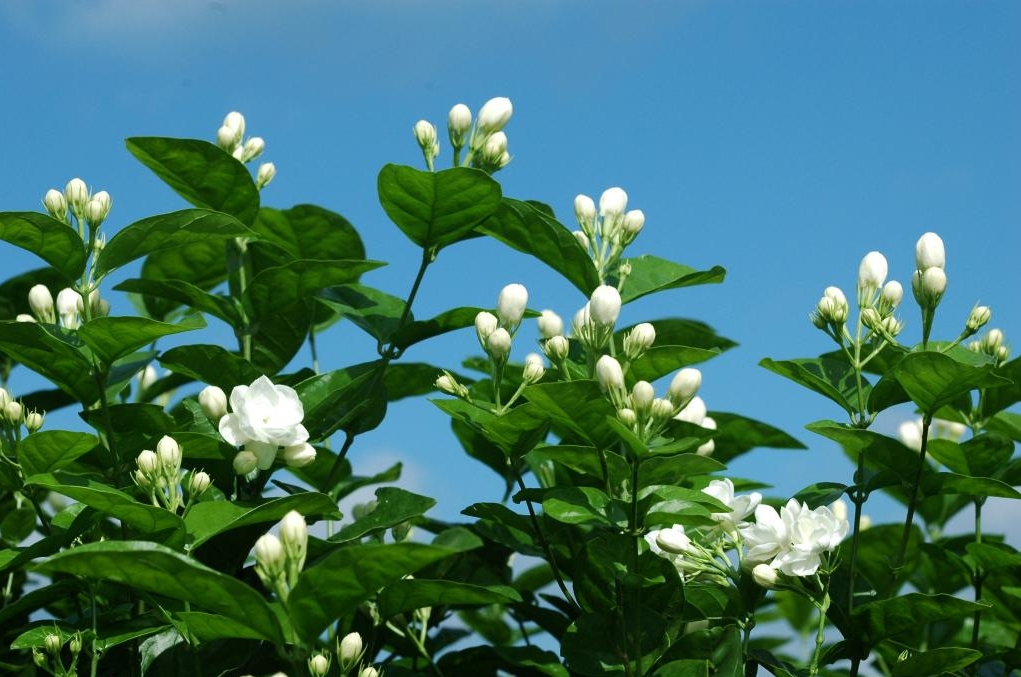
Surrounded by waves of verdant green and limestone gray, a scene not often encountered in the Karst landscape, the air in Hengzhou, a county-level city in south China's Guangxi Zhuang Autonomous Region, is thick with a peculiar floral sweetness.
This is the scent of jasmine harvest season, a biological window measured in hours and not days, that drives the fortunes of a regional economy undergoing fast industrial transformations.
Official figures show Guangxi's annual tea output stands about 140,000 tonnes, with the value of the whole industrial chain exceeding 70 billion yuan (10.24 billion U.S. dollars).
Hengzhou supplies more than 60 percent of the world's jasmine flowers and over 80 percent of China's total. Roughly 340,000 people work in Hengzhou's jasmine sector alone.
Traditionally, farmers head into the fields around midday, when the sun is fiercest and the blossoms are under maximum thermal stress.
"The volatility of essential oils peaks in the heat," said Lei Shuiping, a third-generation jasmine farmer. "It releases the aromatic compounds that global buyers pay a premium for."
It is estimated that the combined brand value of Hengzhou's jasmine and jasmine tea will reach 23.53 billion yuan in 2026, a year-on-year increase of 863 million yuan.
Though the picking remains labor-intensive, everything that follows has been transformed by technology.
A 10,000-mu (approximately 667-hectare) plantation now functions as a "digital greenhouse," studded with sensor networks and AI-powered image recognition.
The "Smart Planting System," as local officials refer to it, has extended the flowering window by four to six weeks, cut water and fertilizer use by around 30 percent, and halved labor costs per mu by predicting peak bloom times and flagging pest outbreaks in real time.
These tech upgrades have added an average of 3,600 yuan to farmers' annual income per mu, according to local agricultural data.
Lu Yuan, who works at a local university, nowadays drinks two or three cups of tea-based beverages a day, drifting away from iced coffee.
"Cold-brew tea gives me the same ritual," she said. "Coffee hasn't quite disappeared from my life, but it's just become optional."
Such consumer pivot has broadened the global footprint of Guangxi tea. Mixue Ice Cream & Tea, a Chinese company that built its brand selling flavored teas, has opened more than 4,000 stores overseas, while Chagee, another Chinese tea brand, has set up shops in over 200 locations outside China, with long lines reported outside new stores in places including Kuala Lumpur and New York.
Hengzhou jasmine forms the scented base for many of their best-selling drinks.
The same modernization drive is boosting Guangxi's traditional dark teas. In nearby Cangwu County in Wuzhou City, producers have given a 1,500-year-old fermented variety, known as Liubao, a contemporary makeover.
"With ecological gardens and digital systems, managing the plantation is so much easier now," said Huang Shangyong, a tea farmer in Wuzhou.
A blockchain traceability system now logs every stage of production, while AI-equipped drones can flag disease outbreaks up to 14 days before they would otherwise be visible to naked eyes, said Liang Jinzhao, a local agriculture official. Each batch of export goods carries its own identity card, in the form of a QR code, allowing buyers around the world to trace a consignment back to a specific plot.
Guangxi's tea modernization was part of the country's broader rural revitalization strategy.
The frequent use of AI, from pest-detection algorithms to yield-forecasting models, has turned the region into a new frontier in the modernizing of China's traditional farming, while also preserving its cultural identity.
In 2025, Guangxi ports handled 16,000 tonnes of tea export and import, worth nearly 300 million yuan, placing the southern region in the first place nationally.
Both Liubao and jasmine have extended their global reach via trade and networking platforms like the annual China-ASEAN Expo in Nanning, according to the Guangxi International Expositions Bureau.
As Chinese consumer brands rapidly dot storefronts overseas, they are carrying Guangxi's signature offerings with them and making Guangxi a major link in the world's tea boom.