Xinhua | May 9, 2026


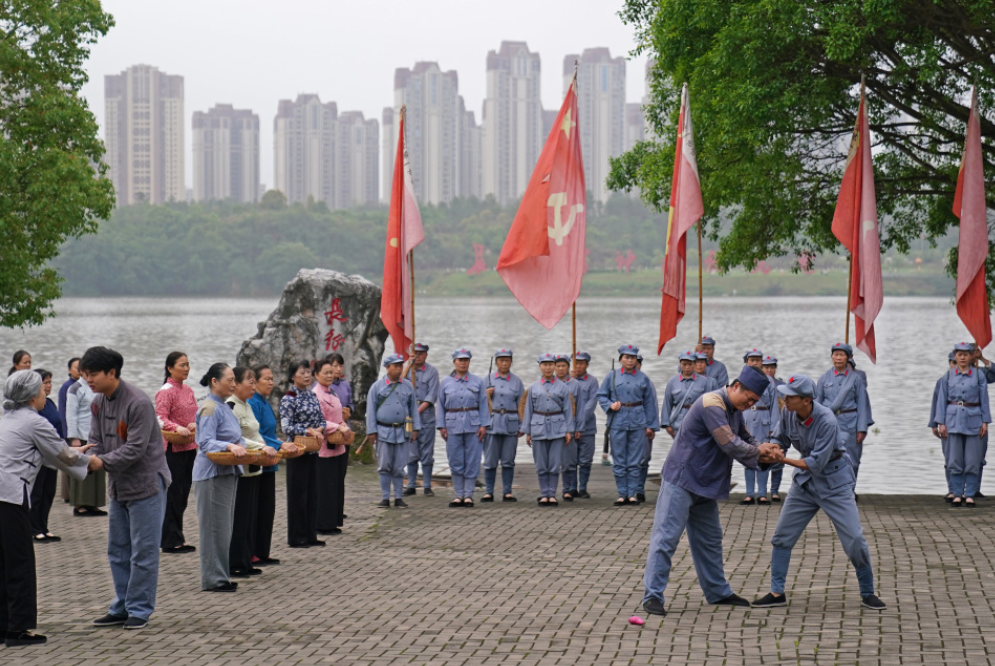
On the banks of the Yudu River in east China's Jiangxi Province, actors dressed as Red Army soldiers step onto a floating bridge. Villagers press straw sandals and boiled eggs into their arms. An elderly woman, played by a local resident, holds a soldier's hand, unwilling to let go.
The farewell is staged now, but it is rooted in a departure that still weighs heavily on this county. The short outdoor performance, titled "Farewell," brings more than 150 volunteers onto the square, many of them descendants of Red Army soldiers. It recreates the autumn of 1934, when local residents in Yudu County saw off troops led by the Communist Party of China as they set out on the Long March.
Before the departure, people in Yudu made some 200,000 pairs of straw sandals for the soldiers. They also dismantled doors, tables and even coffin planks to build makeshift bridges, according to local historians.
"We want more people to understand what happened here. It wasn't easy," said 63-year-old Lin Jinfeng, who plays a wife saying goodbye to her husband in the performance. She has taken part in the production for three years. Her own grandfather left from a river crossing in Yudu with the Red Army and never came back.
It was from Yudu that more than 80,000 Red Army soldiers began the Long March, the roughly 12,500-kilometer trek later described by American journalist Harrison Salisbury as "a great human epic." After two years of hardship, the troops reached northern China, completing a strategic shift that would help shape China's modern history.
This year marks the 90th anniversary of the victory of the Long March. As one of its important starting points, Yudu has become more than a place of remembrance. For many visitors, it is a place to measure their own lives against a history of endurance.
Chen Jianguo, who runs a textile enterprise in Quanzhou, east China's Fujian Province, came to Yudu with his son.
"The textile industry has reached a point where transformation is unavoidable," Chen said. "The pressure is heavy. Sometimes I can't sleep at night."
But standing in Yudu, he said, changed the scale of those worries. "When I think of the Red Army setting out from here, not knowing whether they would return or how far they could go, what do my difficulties amount to?"
His son, Chen Yuxuan, is in his first year of high school. Chen said the boy had grown up in comfortable conditions and could easily become discouraged by small setbacks. "I wanted him to see what real difficulty looks like," he said.
That lesson, he added, could not be taught in a classroom.
"Reading about the Long March in books is completely different from standing by the Yudu River and watching the performance," Chen Yuxuan said. "I used to think that 'not fearing difficulties' was just a slogan, but now I realize that it really takes courage."
During the May Day holiday this year, Yudu received 855,900 tourist visits and generated 690 million yuan (about 101 million U.S. dollars) in tourism revenue, up 10.27 percent and 10.93 percent year-on-year, respectively. The memorial park marking the starting point of the Central Red Army's Long March received more than 200,000 visits during the holiday.
Since 2024, the county has introduced immersive programs that allow visitors to step into recreated departure scenes. More than 70,000 people have taken part so far, many of them young people. Yudu has also trained more than 2,200 youth guides, known locally as "Little Red Star" docents, to tell Long March stories from a younger generation's perspective.
The Long March remains one of China's most powerful symbols of hardship and resolve. A familiar saying goes, "When the going gets tough, remember the Long March." Mao Zedong's line, "Of the trying long march, the Red Army makes light, thousands of rivers and mountains are barriers slight," is still widely quoted.
The history has also drawn foreign visitors. Australian scholar Mark Linton came to Yudu last October, retracing part of the route taken by the Central Red Army. He spent a morning at one of the river crossings, studying the remains of the site and speaking with descendants of Red Army soldiers.
"You stand here and imagine tens of thousands crossing this river into the unknown," he said. "That kind of determination is striking."
Linton said he planned to include the trip in a book he is writing on international perspectives of the Long March.
For many visitors, Yudu is not only a place to look back. It is also a place to see how a once-poor revolutionary base area has changed.
The county, long held back by weak infrastructure and limited industry, was lifted out of poverty in 2020 during China's nationwide poverty alleviation campaign. Since then, government support for old revolutionary base areas has helped develop local agriculture, tourism and rural industries.
In Tantou Village, about 11 km from the county seat, a once-impoverished community has become a popular stop for visitors. The muddy roads and dilapidated houses of the past have given way to clean lanes, renovated homes, and roadside stalls selling selenium-rich vegetables grown by local farmers. Per capita income exceeded 20,000 yuan last year, nearly five times the level of a decade earlier.
During the three-day Qingming Festival in early April and the May Day holiday, villager Liu Changfa said his farmhouse restaurant serves seven to eight tables a day.
"Our predecessors set out so that future generations could live better lives," Liu said. "Now that we have better lives, we still have to keep moving forward."