China Daily | May 7, 2026


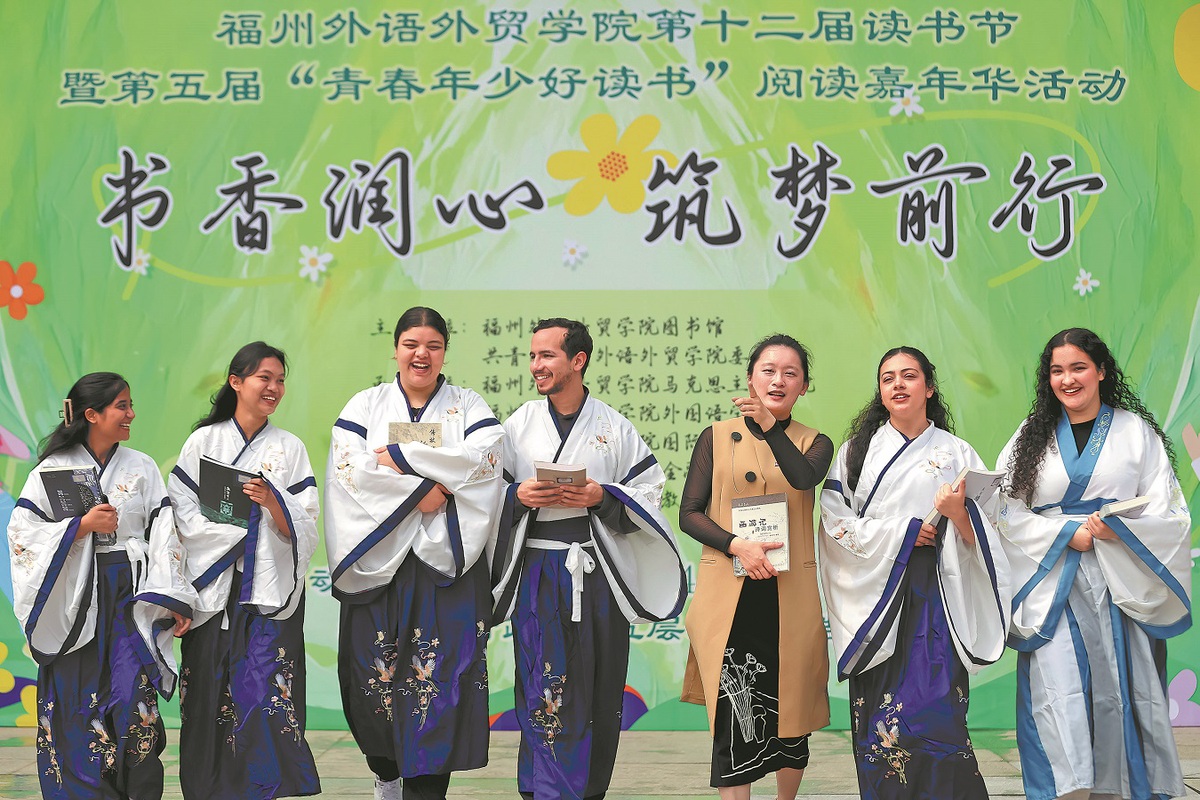
International students at Fuzhou University of International Studies and Trade in Fuzhou, Fujian province, learn about traditional Chinese culture from ancient classics under the guidance of a teacher on April 22. XIE GUIMING/FOR CHINA DAILY
The 15th Five-Year Plan (2026-30) prioritizes the expansion of high-level opening-up of education and strengthening of the "Study in China" brand, and education officials and university leaders are confident that China is on track to become one of the world's most attractive destinations for international students.
Wang Daquan, head of the Chinese Service Center for Scholarly Exchange under the Ministry of Education, said, "We have confidence in that goal, and we will continue to make efforts to achieve it."
Citing data collected by the center over the past three years, Wang pointed to the steady rise in the number of applicants, greater diversity in the countries of origin of students, a significant increase in the number of self-funded students, and a marked rise in the number of degree-seeking candidates at the undergraduate, postgraduate and doctoral levels.
He attributed this upward trajectory to several distinct advantages, including the strong cost-effectiveness of China's higher education system, with tuition fees in the country being among the lowest globally.
He also highlighted China's stable policies, safe environment, and rapid development. The expanding global footprint of Chinese enterprises and the Belt and Road Initiative are creating new career opportunities for graduates in their home countries and elsewhere, he added.
According to the latest data from the Ministry of Education, 380,000 international students from 191 countries and regions were studying in China as of the 2024-25 academic year.
Asian students made up the largest share at 61.1 percent, followed by those from Africa at 16.2 percent and from Europe at 15.6 percent. The number of degree-seeking students stood at 205,000, with postgraduates representing 35 percent of that figure. Engineering ranked first among the chosen fields of study, with 27.8 percent of students opting for it.
The Beijing International Studies University exemplifies the shift from scale expansion to high-quality development at the institutional level.
Zheng Chengjun, vice-president of the university, said that as of March 2026, the university's international student population stood at 1,024 — a remarkable 70.6 percent increase year-on-year.
There has been notable growth in the number of students coming from Belt and Road partner countries and the Regional Comprehensive Economic Partnership member states. Leading the enrollment figures are students from Saudi Arabia (177), Morocco (100) and Russia (54), followed by South Korea, Kazakhstan and Vietnam.
Zheng said the university aims to attract more postgraduate students during the 15th Five-Year Plan period."International students act as a crucial link for trade, tourism and diplomatic relations between China and the world," he said.
By organizing international cultural festivals and improving campus facilities, the university ensures that international students find a true sense of belonging, he said.
Zhao Zhongxiu, president of the University of International Business and Economics, said the university has 70 years of experience in international education and has trained tens of thousands of students from over 170 countries and regions.
He said that deepening educational cooperation is a vital response to global uncertainties. Education cooperation can build cultural identity and people-to-people bonds, helping to forge a community with a shared future for humanity, he said.
In the economic sphere, international students boost two-way trade promotion, play a role in China's outward direct investment and contribute to building home-country human capital. In the field of science and technology, international cooperation in education serves as a major vehicle for talent flow and innovation, enabling global knowledge sharing and collaborative research, he said.
Zhang Hao, a professor at the Beijing Language and Culture University, emphasized that international students are the most powerful medium for telling the story of the real China when they return home.
To attract more students, Zhang urged Chinese universities to strive to reach high global rankings and work for the development of benchmark programs such as high-speed rail, electric vehicles and new energy.
Angelina Sanzharovskaya from Kazakhstan, a master's student majoring in Russian Interpretation at BISU, said: "The best thing about being a student here is the opportunities the university provides. Through various events, I've visited different cities and learned about the immense diversity of Chinese culture."
El Batoul Nejjaoui from Morocco, a postgraduate student at the same university with nearly 10 years of experience in living and working in China, said that as China plays an increasingly important role globally, she wants an on-the-ground understanding of its economy and urban development.

