China SCIO | April 23, 2026


Inside the electric power robotics laboratory of Guangdong Power Grid, a subsidiary of China Southern Power Grid (CSG), the de-icing robot Qingling moves steadily along transmission lines, removing ice with its high-frequency vibrating de-icing head.
The robot was deployed during a severe cold wave in 2026, when snow and ice blanketed transmission lines in the mountainous areas of Shaoguan, Guangdong province. Equipped with intelligent sensing modules and high-definition monitoring systems, it enables operation and maintenance personnel to monitor on-site conditions in real time and carry out remote de-icing operations.
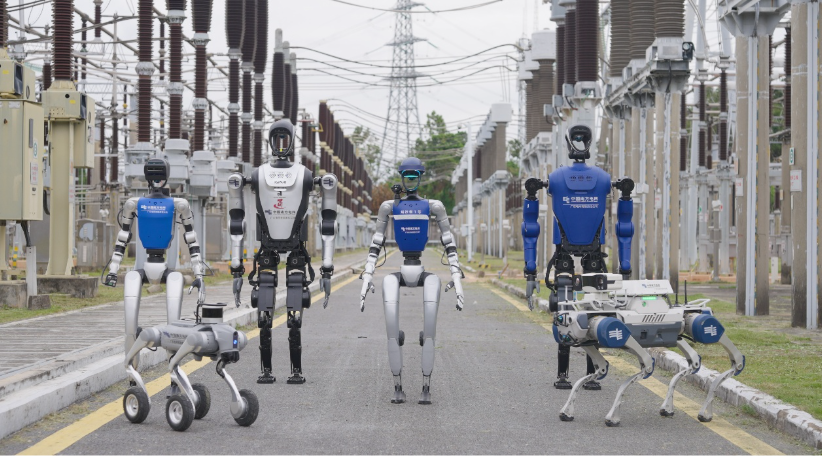
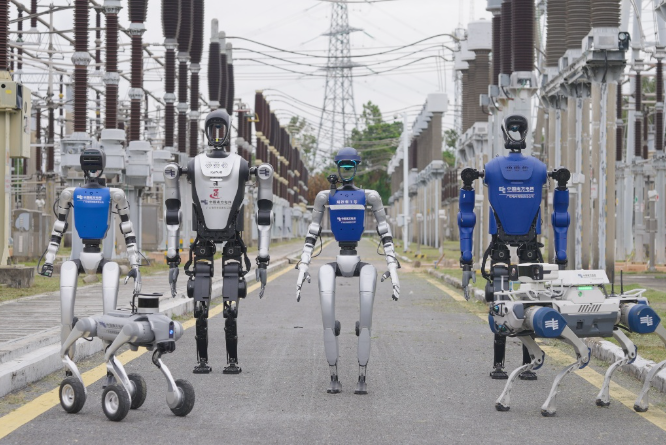
Robots developed by Guangdong Power Grid carry out inspection and maintenance at a substation in Guangzhou, Guangdong province during the 15th National Games of China. [Photo provided by Guangdong Power Grid]
This was not possible before such robotics technology was developed. In 2008, when a severe ice and snow disaster struck southern China, de-icing operations relied entirely on manual labor.
"Back then, we carried generators on our shoulders, climbed transmission towers, and chipped away ice for more than 10 hours at a time," recalled Yu Sheng, head of the cable team at the Power Transmission Station of the Shaoguan Power Supply Bureau under CSG.
"It was bitterly cold and extremely dangerous," Yu said.
Now with intelligent de-icing technology, Qingling can move autonomously along transmission lines and operate normally at temperatures as low as minus 15 degrees Celsius, eliminating the need for high-risk manual ice removal on towers.
Qingling is not the only product for electrical operations developed by the laboratory, which focuses on core robotics technology research, data collection on electrical operation behaviors, the training of embodied models for electrical operations, and integrated testing of robotic systems.
Due to the highly specialized operating environment, electrician robots require strong stability and high precision. Off-the-shelf general-purpose robots are generally unable to meet the industry's specific needs, making it necessary to develop specialized models.
"In Guangdong, power grid facilities are widely distributed across urban areas, mountainous regions, and even underground and underwater environments," said Chen Jiaxin, a member of the volunteer docent team of the company.
"Carrying out power system construction and equipment maintenance requires climbing mountains and transmission towers, entering tunnels, and even working underwater, which are both physically demanding and hazardous," she added. "The development of these products is aimed at reducing operational risks and improving work efficiency."
Other products of the company include power inspection drones, cable tunnel inspection robots, and submarine cable laying robots, which have been deployed at scale.
The company's breakthroughs not only demonstrate its expertise in the research and deployment of electrician robotics, but also reflect Guangdong province's broader efforts to build a global hub for the robotics industry.
"As one of China's leading manufacturing provinces, Guangdong has taken a forward-looking approach to developing the robotics industry," said Zeng Jinze, director general of the Department of Industry and Information Technology of Guangdong Province, at a press conference on April 15.
"This is not only a strategic response to the global wave of technological revolution and industrial transformation, but also a necessary path to leveraging our own strengths, overcoming development bottlenecks, and building competitive advantages for the future," Zeng said.
To boost the development of the robotics industry, Guangdong will support breakthroughs in key and core technologies, with a focus on developing a number of flagship products with strong core competitiveness and accelerating their large-scale production, according to Zeng.
In addition, Guangdong aims to broaden the application scenarios for robotic products. The province will establish two-way lists aligning application demand with product supply, develop a number of demonstration scenarios, and accelerate the deployment of embodied intelligent robots in areas such as manufacturing, commercial services, healthcare, and eldercare, Zeng added.
With a commitment to open cooperation, Guangdong Power Grid is working to transform China's innovations in power artificial intelligence into global public goods, said Lai Yingdong, general manager of the Emerging & International Businesses Department of the company.
In March this year, a project team from CSG traveled to Chile and reached an agreement with local partners on a project for intelligent substation inspection. It is expected that in the second half of the year, the company's self-developed quadruped inspection robot will be deployed at remote substations in Chile.
The quadruped robot Feiyun, equipped with multimodal sensing, all-terrain adaptive mobility, and high-precision intelligent recognition algorithms, is capable of conducting comprehensive, blind-spot-free autonomous inspections of power equipment, according to Guangdong Power Grid.
"We offer not just a quadruped robot, but a comprehensive suite of intelligent inspection solutions and operation and maintenance services," Lai said.