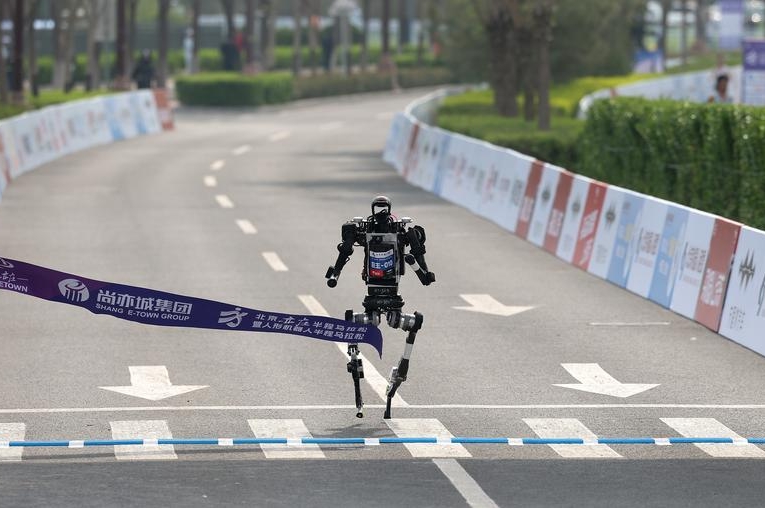
Xinhua | April 20, 2026


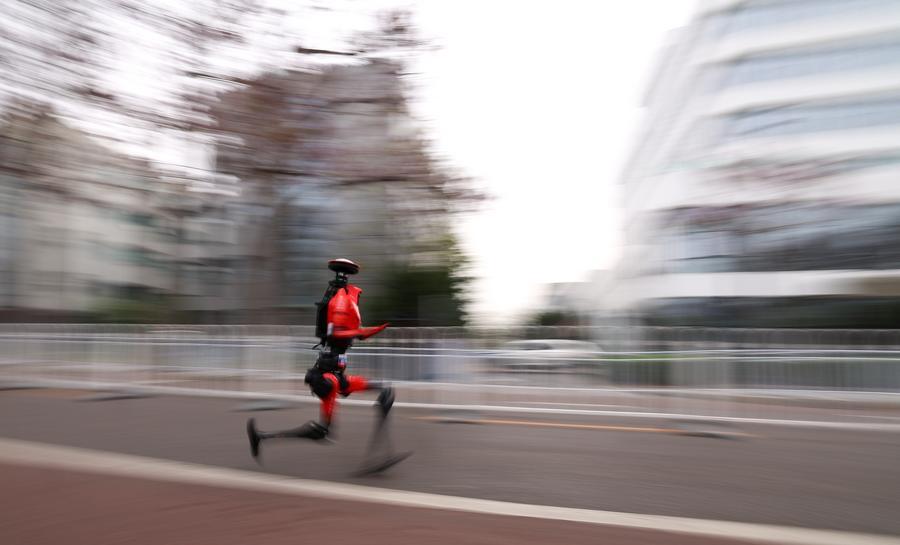
Humanoid robot "Flash" of Qitiandasheng Team in the autonomous category runs during the Beijing E-Town half-marathon and humanoid robots half-marathon in the Beijing Economic-Technological Development Area in southeast Beijing, China, April 19, 2026. (Xinhua/Luo Yuan)
On a crisp Sunday morning, the starting gun rang out at an innovation zone on the southeastern outskirts of Beijing. More than 100 humanoid robotic runners clattered across the starting line, their servos humming with a staccato whir.
The novelty had worn thinner than it had been the previous April, when the first annual humanoid robot half marathon drew large crowds. This time, however, the machines had more to prove than just putting on a show.
Over the past year, Chinese robots have wowed global audiences with dynamic feats of speed and agility, including sprinting, martial arts and gala dancing. Once the cheers died down, a key question emerged in the era of embodied intelligence: how can these machines move beyond being seen as just remote-controlled toys for tech enthusiasts?
The event organizer's new rules for the 2026 edition of the 21.1-kilometer race in Beijing made this clear: robots unable to navigate on their own were not barred from competing, but their finishing time would be multiplied by 1.2. This rule was meant to push the entire field toward genuine autonomy in motion. As a result, close to 40 percent of the competing robots took on the challenge of running the race entirely on their own.
For Chinese engineers, the priority is sharper perception and a smarter brain, not just stronger muscles. Progress depends on advanced AI at the core, rather than only on more stable frames, tougher joints or better batteries.
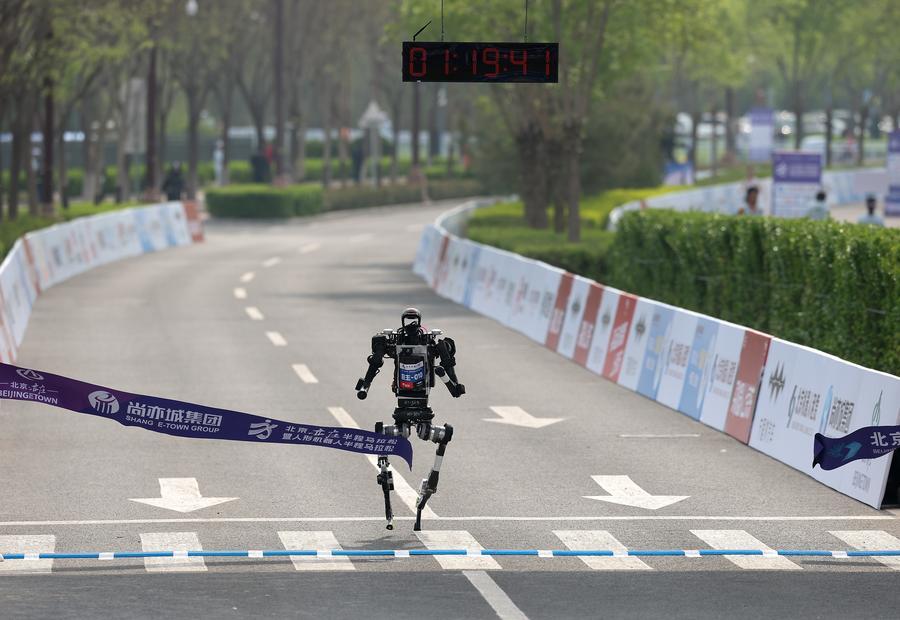
Humanoid robot "Unitree H1" of Hang S Sai Team in the autonomous category crosses the finish line during the Beijing E-Town half-marathon and humanoid robots half-marathon in the Beijing Economic-Technological Development Area in southeast Beijing, China, April 19, 2026. (Xinhua/Zhang Chenlin)
Unlike last year's varied designs, this year's competitors focused on a few standard robotic platforms. Many teams used robots such as Unitree, Tien Kung with a UBTECH background, or a model from Huawei's spin-off, Honor. The real contest was in the software: a head-to-head race to develop the best optimization algorithms for this identical hardware.
Leading the pack was a mecha warrior-like Honor robot with a red-and-black metallic finish. It moved with a unique gait, its legs in an inward-pointing V shape, while its upper body swayed from side to side with each stride.
In contrast, Tien Kung's running form was more similar to that of a professional long-distance runner, featuring a high arm carriage and an upright posture.
Honor proved to be the day's top performer. While one of these models was the first to cross the line with an operator trailing in a golf cart, the true self-navigating champion was another machine, also from Honor.
Finishing in a blistering 50 minutes 26 seconds, the winning robot shattered the human world record, lopping off more than six minutes from the best human time. "In our training, we emulated top human runners," said Du Xiaodi, an engineer at Honor, standing next to the 1.69-meter-tall champion, after the award ceremony.
The runner-up and third place prizes also both went to autonomous Honor robots. Carried by its momentum, an Honor humanoid could not stop in time and hit the safety barrier, drawing a mix of cheers and gasps from the audience.
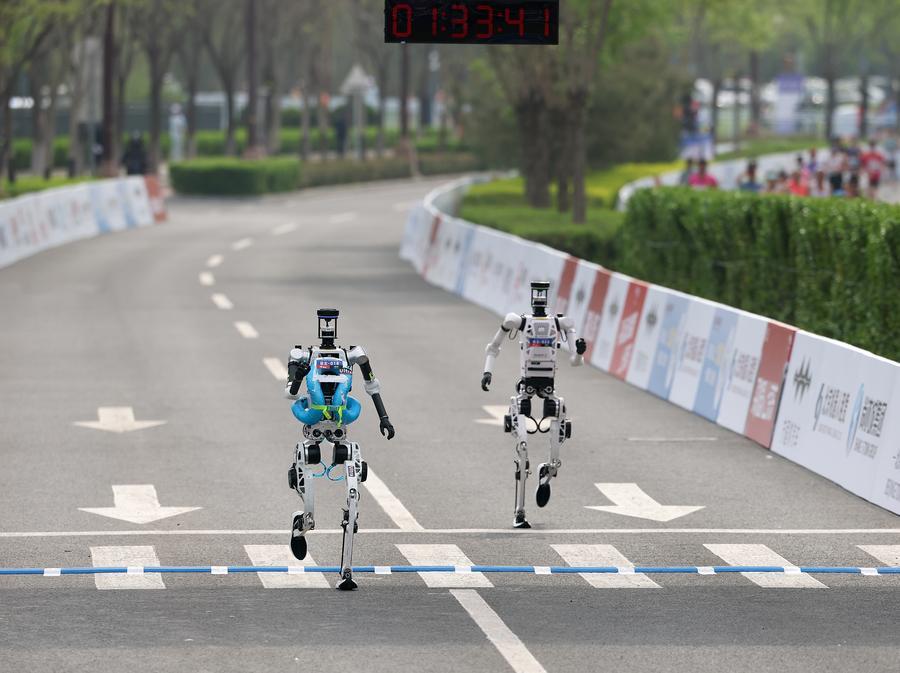
Humanoid robot "Tiangong 1.0 Ultra" (L) of Tianxiao Team in the autonomous category runs during the Beijing E-Town half-marathon and humanoid robots half-marathon in the Beijing Economic-Technological Development Area in southeast Beijing, China, April 19, 2026. (Xinhua/Zhang Chenlin)
A Tien Kung Ultra robot, fitted with blue protective guards, did not make the top 3 place but still caught the eye by executing a slick S-curve to edge out its closest rival by a narrow margin in a dramatic final 50 meters, finishing in 1 hour and 15 minutes.
This marked a stunning improvement for the defending champion as the model only posted a time of 2 hours and 40 minutes in winning the 2025 race. This progress highlights the huge leap in China's humanoid robotics technology in just one year.
Zhao Wen, a control algorithm engineer behind Tien Kung, attributed this progress to smarter embodied AI. "With major upgrades to running control algorithms, communication and perception systems, the 'big brain' and 'small brain' have integrated to enable dynamic, intelligent adjustment of stride frequency and length," Zhao explained.
"Last year, robots struggled just to stand up. This year, they are all stable and racing," noted the leader of the Paris-Saclay University team. The 2026 event in China's capital featured global participants, with engineers from Germany, France, Portugal and Brazil.
Global interest in Chinese robotics was also in the spotlight in February this year, when German Chancellor Friedrich Merz watched humanoid robots perform various tasks at Unitree Robotics during his trip to China.
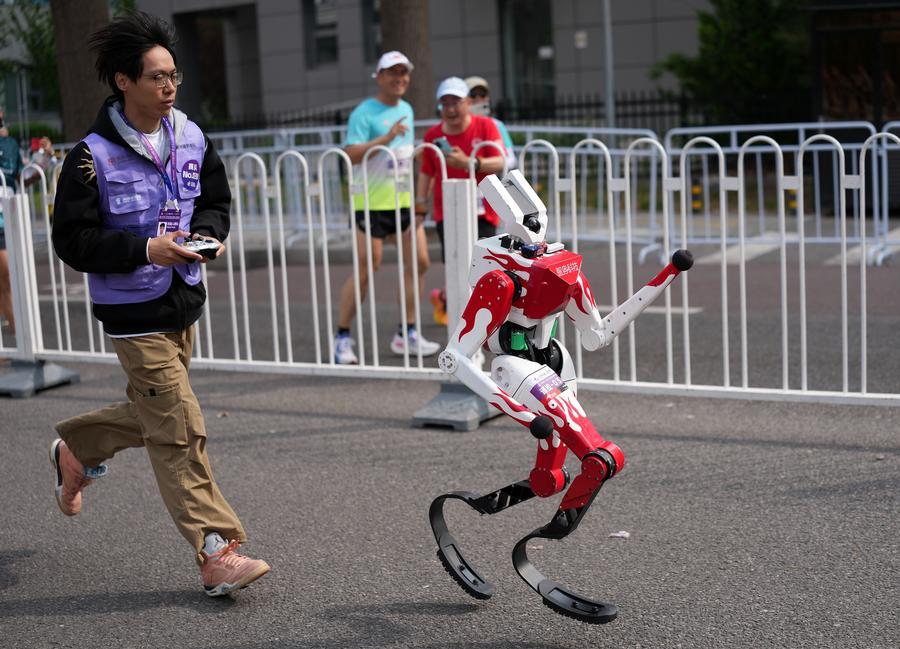
Humanoid robot "X1" (R, front) of Pofengzhe Team in the remote-controlled category runs during the Beijing E-Town half-marathon and humanoid robots half-marathon in the Beijing Economic-Technological Development Area in southeast Beijing, China, April 19, 2026. (Xinhua/Luo Yuan)
Sunday's half-marathon course put robotic systems to a tough test with a variety of challenges. It included over 10 terrain types with slopes reaching 8 percent incline and 100 meters of total climb, putting power control and energy efficiency to the test.
Also, narrowed paths and a traffic island obstacle simulated urban complexities, and a series of 22 turns, including near-90-degree angles, required centimeter-level precision and balance.
"Autonomously navigating a track with this level of mobility is a major test of a robot's agility," said Zhao Mingguo, an automation researcher at Tsinghua University in Beijing.
The race is over, but the real-world journey has just begun. There is growing agreement that the goal of robotics should not be to simply replace human labor, but to take on tasks that people are unwilling to do, especially dangerous work in remote areas or high-risk rescue scenarios.
While AgiBot, another leading Chinese robotics firm, skipped this long-distance race, it showcased its precision in a factory setting this week. It live-streamed its robots working an eight-hour shift on a tablet assembly line. This demonstration is part of China's broader push to integrate AI with manufacturing.
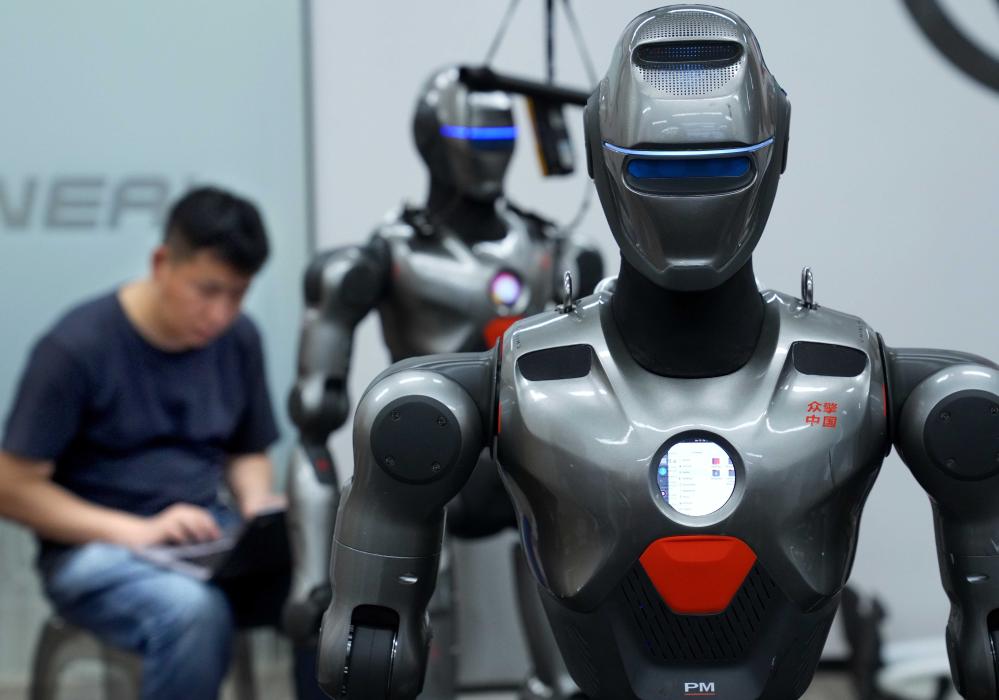
A staff member debugs a humanoid robot at a robot company in Shenzhen, south China's Guangdong Province, June 25, 2025. (Xinhua/Li An)
Shenzhen, a technology hub in southern China, is also using humanoid robots in diverse roles -- from directing traffic on the streets to handling household chores.
Positioned as a future industry in China's five-year plan, embodied intelligence is set for a new growth drive. One forecast points to a humanoid robot market worth around 870 billion yuan (approximately 127.6 billion U.S. dollars) in China by 2030.
"Humanoid robots don't run just for the sake of running," said Liang Liang, deputy secretary-general of the Chinese Institute of Electronics. The race's goal is to identify outstanding engineering teams, spark tech competition, and thereby bridge the gap to market for such technology, Liang explained.