Xinhua | March 31, 2026


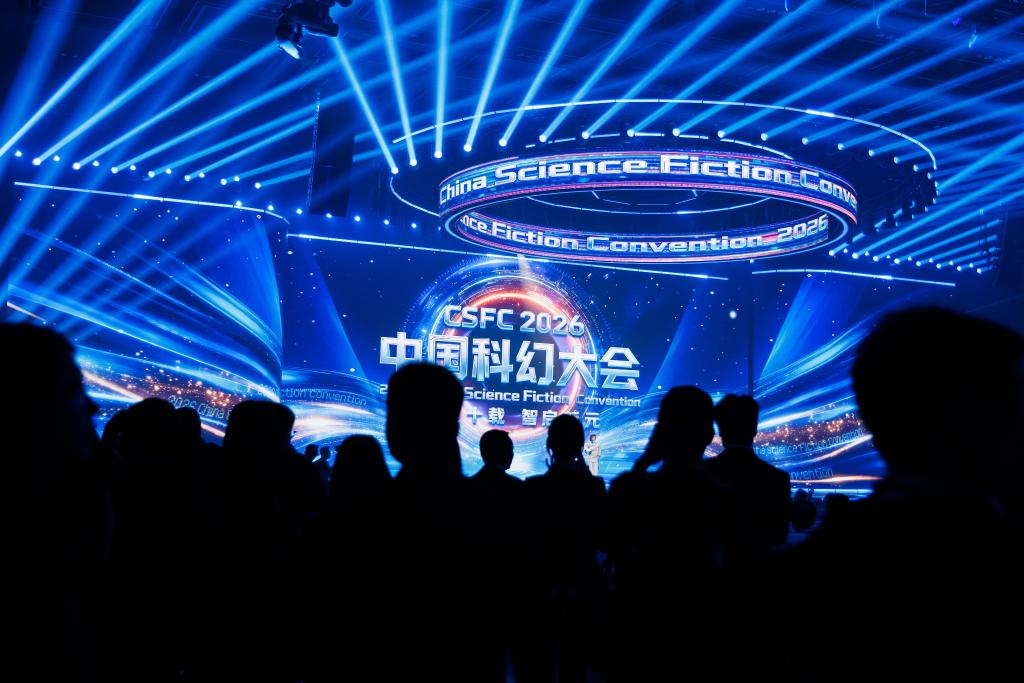
This photo taken on March 27, 2026 shows the opening ceremony of China Science Fiction Convention 2026 in Beijing, capital of China. (Xinhua/Jin Liwang)
"100 Percent Mission Completed!" Nine-year-old Yang Yiran's eyes lit up as he guided a simulator onto Mars, while children and parents leaned over consoles, waiting for their turn at the International Sci-Fi and Future Tech Expo, a highlight of the 2026 China Science Fiction Convention held in Beijing from this past Friday to Sunday.
The moment echoed a story seven decades old. In the first sci-fi work of the People's Republic of China, "From Earth to Mars," three teenagers rocketed to the red planet.
When it was published in 1954, Beijing was immediately swept up in a "Mars fever." With no modern planetarium yet in the capital, children flocked to the 15th-century Ancient Observatory, lining up for hours just to catch a glimpse of the real Mars in the night sky.
"Today, kids can simulate that journey themselves," said Zhu Zihao, a junior at Beihang University's School of Astronautics and one of the simulation designers.
The game pays homage to Tianwen-1, China's first Mars probe launched in 2020. "Imagination meets reality," Zhu said, smiling.
"The development of contemporary sci-fi is closely linked to China's modernization," said Hugo Award-winning writer Liu Cixin at the convention's opening ceremony. "It is this grand process that has made China a country brimming with a sense of the future."
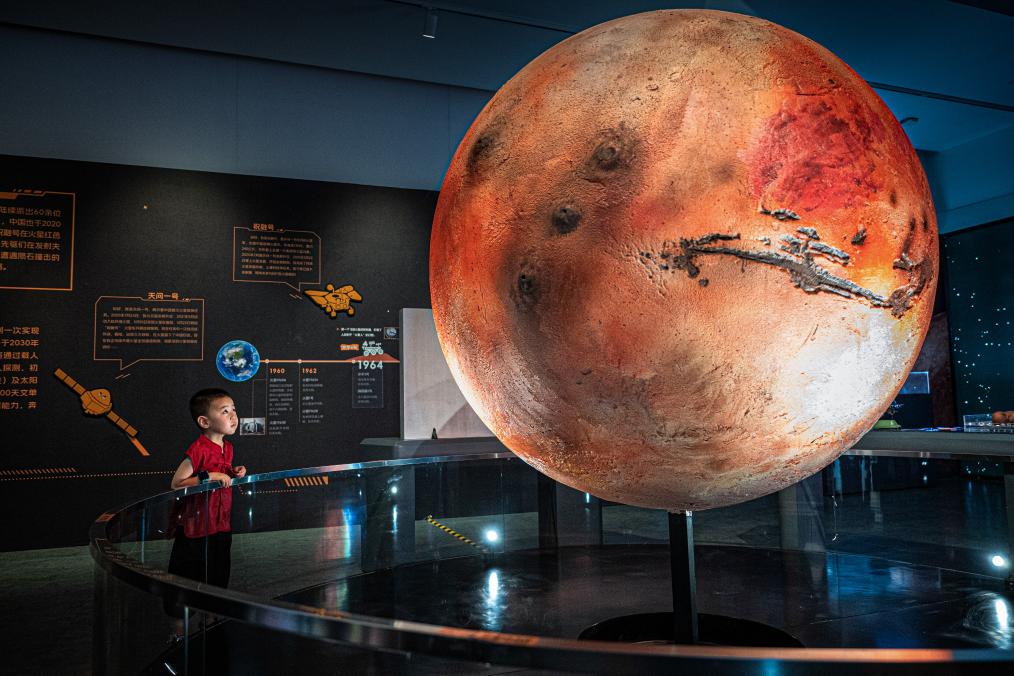
A boy visits a science fiction-themed planetary science experience exhibition at China Building Science Museum in Wuhan, central China's Hubei Province, July 18, 2025. (Xinhua/Xiao Yijiu)
In the early 20th century, intellectuals translated Western sci-fi into Chinese, hoping to inspire national strength and public enlightenment in a country mired in poverty and chaos.
Decades later, as reform and opening up continued to reshape the nation and science was declared the "primary productive force," renowned Chinese scholar Guo Moruo argued: "Scientific creativity depends on imagination."
By 2010, Liu's "The Three-Body Problem," which later won the prestigious Hugo Award, was fully published. Its arrival coincided with China's rise as the world's second-largest economy.
"Science fiction is a barometer of a nation's development," Liu later reflected. "Only a modernized country can cultivate a thriving sci-fi culture."
As China continues to strengthen its industrial capabilities, sci-fi cinema is becoming a new frontier for this interplay between imagination and modernization.
In 2025, China's sci-fi industry generated a total revenue of 126.1 billion yuan (approximately 18.2 billion U.S. dollars), and the sci-fi film sector brought in 8.16 billion yuan, a 21.6-percent increase from the previous year.
"The Wandering Earth," adapted from one of Liu's short stories, premiered in 2019, the same year China announced a complete, modern industrial system recognized by the UN. Its sequel, "The Wandering Earth 2," followed in 2023, with these two movies grossing nearly 9 billion yuan combined, according to Maoyan, a Chinese movie-ticketing and film data platform.
"'The Wandering Earth 2' reflects China's industrial achievements," said Liang Wenjie, a physicist and scientific advisor of the film. "Its metallic, industrial aesthetic resonates with audiences, linking fiction to reality."

A child rides sled pulled by a robotic dog on the frozen surface of the Songhua River in Harbin, northeast China's Heilongjiang Province, Jan. 11, 2026. (Xinhua/Wang Jianwei)
During the convention, sci-fi writers, technologists, and scholars highlighted that fiction and daily life are increasingly intertwined as these tech-savvy applications enter ordinary routines.
Earlier this month, the world's second-largest economy unveiled its latest development blueprint for the next five years. Futuristic technologies once confined to imagination, such as artificial intelligence (AI), brain-computer interface, and embodied intelligence, are found on the priority list.
Rising sci-fi writer Gu Shi sometimes revises manuscripts because reality catches up with her ideas.
Veteran author Han Song, active for four decades, now experiments with AI tools to turn stories into short videos, sharing AI-generated sci-fi clips of his own dreams on social media.
"Future technologies are developing faster and with more uncertainty than ever," said 1980-born sci-fi writer Bao Shu.
"Perhaps sci-fi can provide guidance -- and even predictions about how the Chinese society could evolve and adapt," he smiled and said.

