Xinhua | February 12, 2026


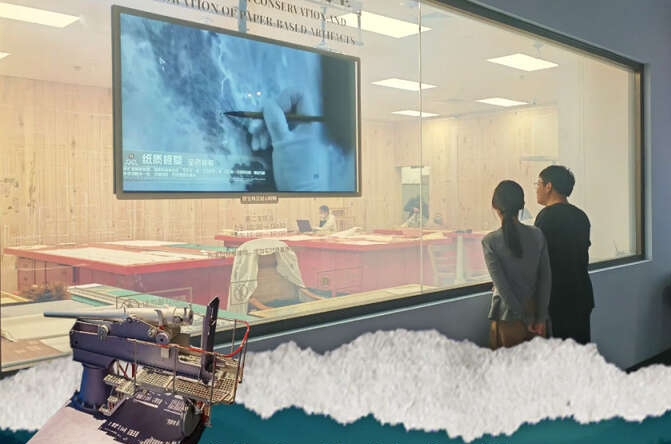

Inside the Museum of Guangxi Zhuang Autonomous Region in south China, a unique transformation is capturing the hearts of visitors. It is not just the shimmering gold or ancient bronze that draws the crowds, but the quiet, meticulous journey of a relic traveling from "broken" to "perfect."
By literally breaking down walls to install transparent glass windows, the museum has turned its private restoration laboratories into a public stage, allowing the "slow time" of cultural heritage conservation to be seen and appreciated.
"This used to be a solid wall. Now, it is a bridge connecting history with the public," said Jing Hui, director of the museum's cultural relic conservation center. Jing added that the decision to "break the wall" was born from a desire to foster a deeper understanding of the labor-intensive nature of preservation.
For restorers, the transition from the secluded "backstage" to the public eye was initially daunting. Chen Qi, a professional restorer at the center, admitted to feeling nervous about potential misunderstandings.
"We worried people might wonder why we aren't wearing gloves, or think we are idling when we sit still for a long time," Chen said.
He further explained that some delicate tasks require the tactile sensitivity of bare skin, and that "staring" is often a crucial moment of mentally connecting with the original creator to ensure perfect color matching.
Through the window, the craft's complexity is revealed. The lab equipment resembles a blend of various professions: a carpenter's saw, a painter's palette, an ultrasonic cleaner from a dentist's office and even a surgeon's scalpel.
"Tools from all walks of life find a use here," Chen noted. He described restoration as a multidisciplinary blend of science and history that ultimately relies on the "touch" of expert craftsmanship.
The center also highlights the fusion of modern science and traditional craftsmanship. "Modern technology has upgraded restoration from an experience-based craft to a data-based science," Jing noted.
However, Jing added that technology cannot replace the "warmth of the fingertips," as the final, subtle transition of a glaze still relies on a master's artistic intuition.
In interactive zones, visitors can also touch the rough texture of Song Dynasty (960-1279) ceramic shards through specialized openings in the glass, and virtually assemble relic fragments on digital screens, further experiencing the precision required in a restorer's daily work.
Yang Qingping, the museum's deputy curator, believes the ultimate goal of the open-door policy is to build an emotional connection. It is about understanding a legacy.
As visitors left the hall, many stopped to leave messages. One visitor wrote: "Restorers are the 'relic doctors' in white coats, guarding the roots of our civilization with their hearts."
The courage to "break the wall" has paid off. By revealing the silence and persistence behind the scenes, the Guangxi Museum has allowed the public to encounter history not as a static display, but as a living, breathing process of rebirth.

