Xinhua | December 16, 2025



The cold is sharp enough to sting the lungs in December's Lhasa before sunrise. 19-year-old runner Sonam Gyaltsen squinted toward the eastern horizon, then put on sunglasses and started his morning training, unaware that the quiet routine would mark the final chapter of one journey and the beginning of another.
The next day, Sonam left the Qinghai-Xizang Plateau for the first time to compete at China's National Games for Persons with Disabilities and the National Special Olympic Games.
Born with low vision and a learning disability, Sonam was about to run on a national stage that once felt impossibly far away.
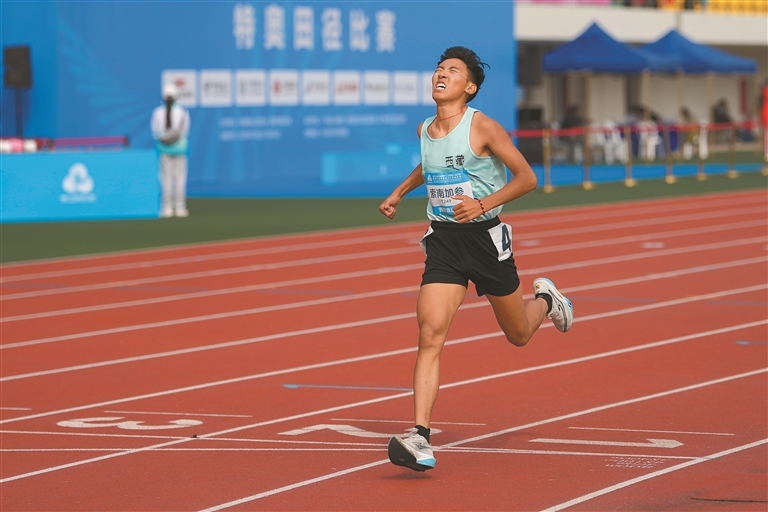
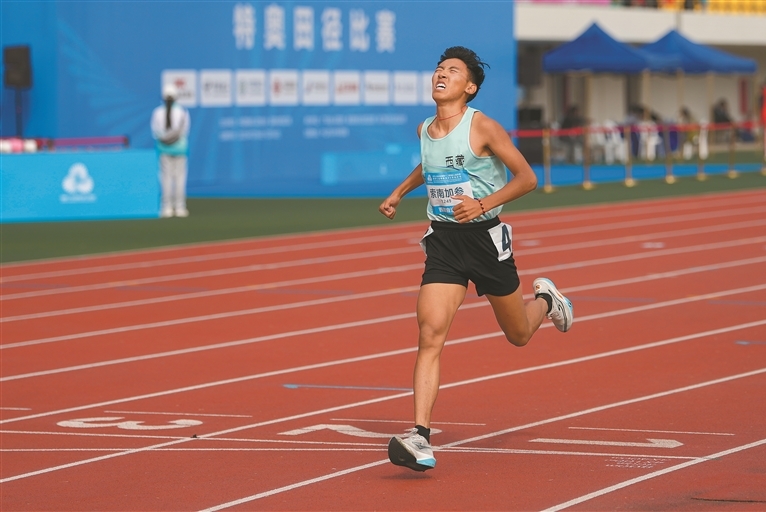
Sonam Gyaltsen crosses the finish line first in the men's 800 meters for athletes aged 16 to 21 at China's 12th National Games for Persons with Disabilities and the 9th National Special Olympic Games in Zhongshan, southern China's Guangdong province, Dec. 11, 2025. [Photo/Xinhua]
FROM THE PLATEAU'S SHADOWS
For Sonam, light has always been complicated. He grew up in Nagqu, deep in the Changtang plateau of Xizang Autonomous Region, where the average altitude exceeds 4,500 meters and sunlight is both abundant and unforgiving.
"As a child, everyone at school called me 'Wuba'," Sonam said softly, using the Tibetan word for owl. Like an owl, his vision was worse during the day and slightly better at night.
At the Nagqu Special Education School, physical education teacher Thubten Kelsang noticed something others overlooked. Despite his limited eyesight, Sonam had long, powerful limbs and a natural sense of rhythm.
"He couldn't see well," Thubten recalled, "but you could tell the track was where he belonged."
Convincing Sonam's family was far more difficult. His father, Tsering Dorje, worried about injuries and doubted whether athletics could ever be realistic for a child with disabilities.
"My son can't even herd cattle properly," he said at the time. "If a yak runs off, he mistakes it for a truck." Shaped by his own upbringing in the 1980s, the father doubted whether sports could offer a real future for a child with disabilities - at that time, disability sports in Xizang were still in their infancy, focused mainly on basic rehabilitation rather than competition.
It took repeated home visits and quiet persistence from the coach before the family finally agreed to let Sonam try.
LEARNING TO RUN WITH CONFIDENCE
The first months of training were filled with hesitation. Sonam ran with his eyes half-closed, unsure of the space ahead, only feeling secure when his feet struck the ground.
Everything changed when Thubten gave him his first pair of sunglasses.
"With them on, every run felt safe," Sonam said. "That's when I began to trust myself."
Over five years, one pair of sunglasses broke after another. The skin around his eyes, protected by the frames, grew noticeably lighter than the rest of his face, a visible record of countless hours under the plateau sun.
Like many teenagers, Sonam sometimes wavered. Once, after missing a local horse racing festival, he stopped training for a week. The setback was immediate and sobering.
"That's when I understood," he said. "If I stop, I fall behind."
"Horses can run fast," Sonam added, thinking of home, "but they may only run on the grasslands. If I keep going, I can run beyond the plateau."
His persistence earned him a place on the Xizang team and, eventually, a ticket to the national games.
RUNNING BEYOND THE PLATEAU
Before Sonam left for Guangdong, his father traveled from the pastoral areas of Nagqu to Lhasa to see him off. He brought dried yak meat from home and meat buns made by Sonam's mother.
"Be careful. Don't fall," his father repeated. "It doesn't matter what place you get. Just come back safe."
Sonam listened in silence. He admitted he avoids talking too much about his family. "If I say more," he explained. "I'm afraid I won't be able to hold back my tears."
In southern China, far from the thin air of the plateau, Sonam initially struggled. The abundance of oxygen left him constantly drowsy. But once he stepped onto the track, the heaviness disappeared.
When the starting gun fired in the men's 800 meters for athletes aged 16 to 21, Sonam surged forward. This time, he ran without sunglasses, guided purely by muscle memory and instinct, and crossed the finish line first in his heat.
Under the southern sun, the boy once nicknamed "Wuba" was no longer an owl hiding from daylight. He was now running freely beyond the mountains that once defined his world.
At this year's National Games for Persons with Disabilities and the National Special Olympic Games, the Xizang delegation fielded 73 athletes across nine sports, including athletics, wheelchair basketball and weightlifting.
Sonam is one of them, and his journey reflects a broader transformation in Xizang, where expanding support for disability sports is opening new paths for young athletes. Training stints beyond the plateau have shown him, and many others, just how wide the world can be.
"There's always someone stronger," Sonam said. "But that just means I have more road ahead."
For a teenager who once struggled to see clearly in the light, that road now stretches far beyond the plateau where his run began.

