Xinhua | December 16, 2025



Yimakan, a singing and speaking art that tells everything from the myths and legends to the stories of love, war and daily life of an ancient Chinese tribe, has recently gained global interest.
Known as a living fossil and encyclopedia of the Hezhen ethnic minority group -- a group of some 5,000 people who live mainly by fishing and hunting along the rivers of northeastern China's Heilongjiang Province -- Yimakan was once a dying form of cultural heritage.
At the beginning of the 21st century, only five people were able to perform full Yimakan cantos, which meant the traditional practice was in urgent need of safeguarding.
And, at a session of the United Nations Educational, Scientific and Cultural Organization (UNESCO) last week, the Chinese art form successfully moved from the Urgent Safeguarding List to the Representative List of the Intangible Cultural Heritage of Humanity.
It was also selected for UNESCO's Register of Good Safeguarding Practices, which aims to provide useful experience and examples of how to overcome challenges in the transmission of living heritage.
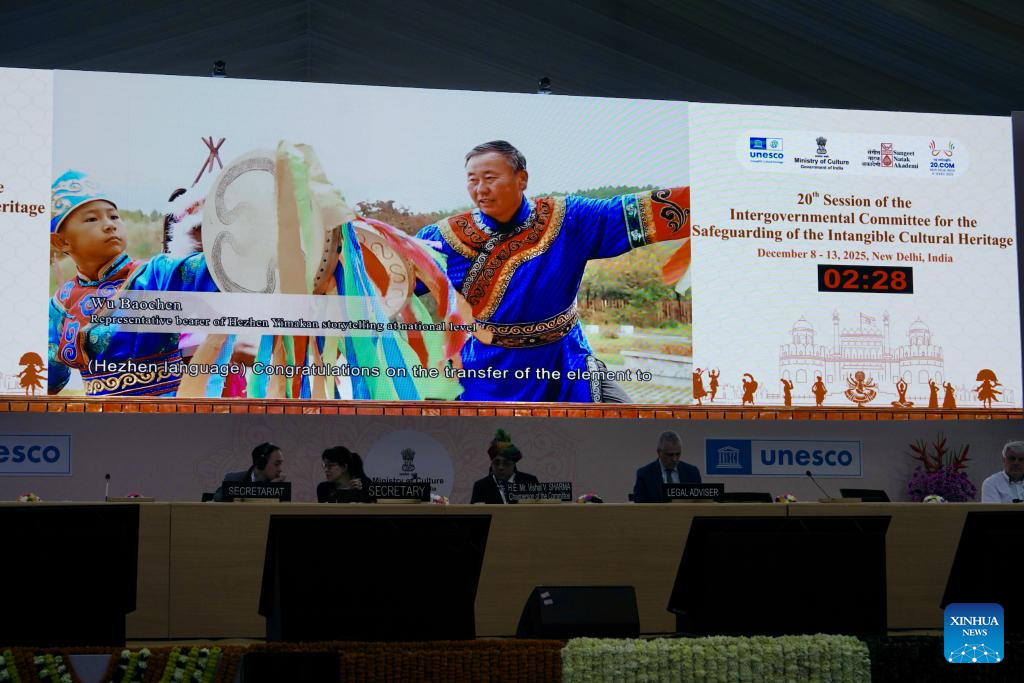
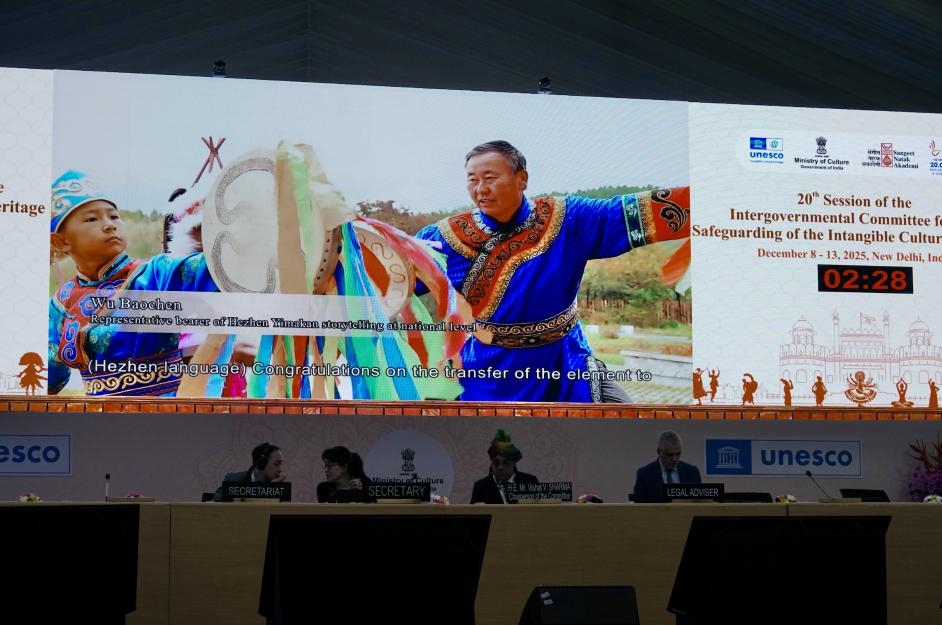
A video on the protection achievements of China's "Hezhen Yimakan storytelling" is played during the 20th regular session of the Intergovernmental Committee for the Safeguarding of the Intangible Cultural Heritage in New Delhi, India, Dec. 11, 2025. The Intergovernmental Committee for the Safeguarding of the Intangible Cultural Heritage at its 20th regular session decided to transfer China's "Hezhen Yimakan storytelling" from the List of Intangible Cultural Heritage in Need of Urgent Safeguarding to the Representative List of the Intangible Cultural Heritage of Humanity. At the same time, based on the effectiveness of the protection of this heritage project, the committee decided to include the safeguarding program for Hezhen Yimakan storytelling in the Register of Good Safeguarding Practices. (Xinhua/Wu Yue)
"This is the first time a Chinese project has achieved such dual success at UNESCO," an official of the Ministry of Culture and Tourism told Xinhua.
"It is a remarkable achievement China has made in intangible cultural heritage protection, and will help advance the country's fine traditional culture and strengthen cultural confidence among its people," the official added.
Performed without instrumental accompaniment, Yimakan storytelling makes use of different melodies to represent different characters and plots. It conveys the Hezhen people's rituals and norms through the group's mother tongue, and serves functions such as documenting the past, educating younger generations and providing community entertainment.
"The Hezhen people have only a spoken language but no written script, so the endurance of their ethnic history and memories relies entirely on oral transmission," said Wu Baochen, a national-level practitioner of Yimakan.
To protect this precious oral art, the government searched for the remaining Yimakan practitioners in Hezhen villages, collected over 1,000 hours of audiovisual materials, and compiled a text of hundreds of thousands of characters covering the lyrics and history of Yimakan, establishing a digital archive.
Efforts have also been made to bring Hezhen Yimakan storytelling to communities, scenic areas and schools, enabling more people to embrace the wonders of the ancient art.
To date, seven centers for the study and practice of Yimakan have been established in Heilongjiang, with the number of Yimakan practitioners at all levels growing to over 100. Online courses of about 150 hours in length have been offered to local communities, and related cultural activities are held during the celebrations of multiple festivals.
At a cultural inheritance base in Heilongjiang's Tongjiang City, visitors can enjoy classic excerpts of Yimakan through earphones and interact with a digital avatar of national-level practitioner Wu. There, they can also scan QR codes on Hezhen fish-skin paintings to learn the stories behind them and hear the Yimakan storytelling related to the artworks.
Both Yimakan storytelling and the Hezhen language have been added to the curriculum in Tongjiang's elementary schools, sparking increased interest among younger generations in their own culture. And over 10 literary or artistic works on Yimakan have been created in the city.
"The effective safeguarding of Hezhen Yimakan storytelling has provided important lessons for other ethnic minorities in China," said Wu Xuan, deputy director of the Center for the Safeguarding of the Intangible Cultural Heritage of Heilongjiang Province.
As a unified multi-ethnic country, China attaches great importance to the safeguarding of traditional ethnic cultures, having inscribed projects from all 56 of its ethnic groups on its national representative list of intangible cultural heritage.
Including Hezhen Yimakan storytelling, there are currently 45 Chinese projects on UNESCO's lists and registers for intangible cultural heritage, ranking first globally.
Chang Xiaohua, an expert on intangible cultural heritage preservation, said that the success of Hezhen cultural preservation highlights China's commitment to intangible cultural heritage protection.
"It serves as a window for the international community to understand China, and will help enhance the global reach and appeal of Chinese culture," Chang added.

