Xinhua | December 4, 2025


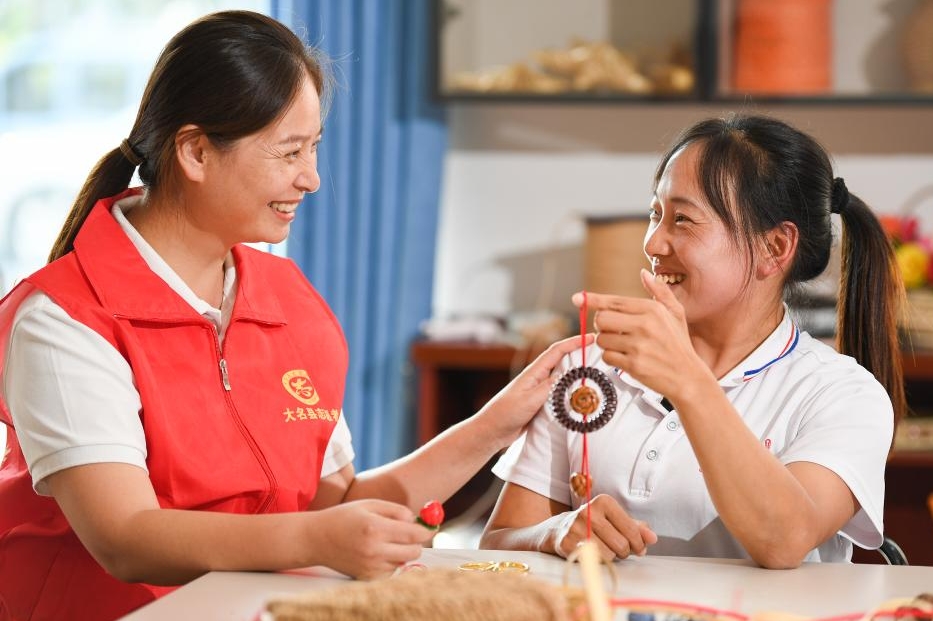

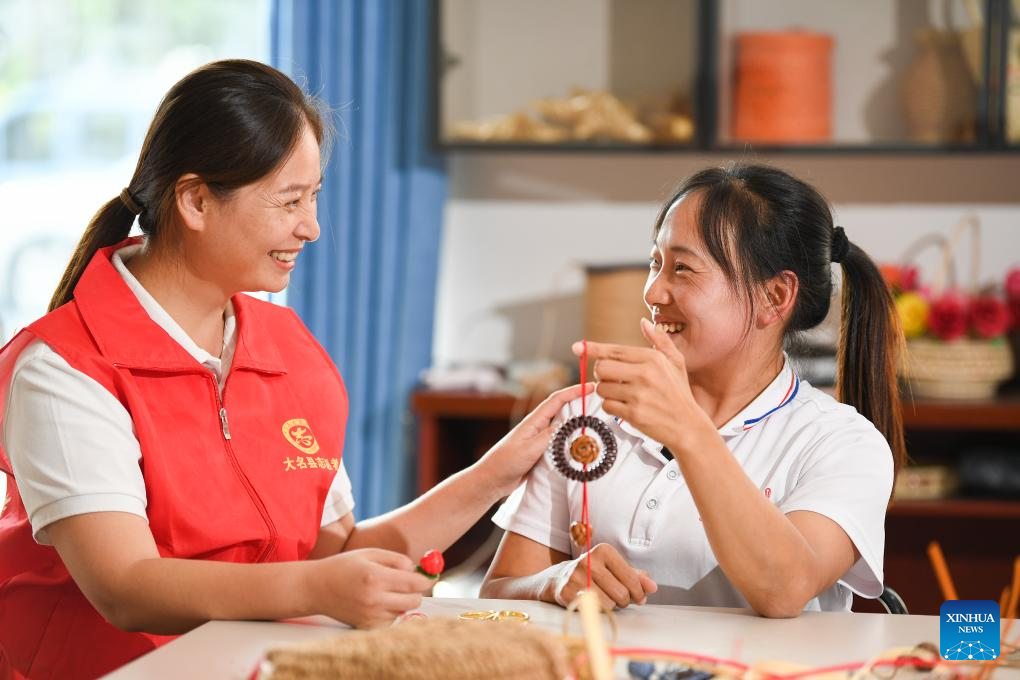
This photo taken on Sept. 20, 2025 shows Gu Sui (L), founder of Yushan Center, a local institution providing free straw plaiting training for people with disabilities, chatting with Li Peipei, a craftswoman working at the center, in Daming County, Handan City, north China's Hebei Province. (Photo by Dong Yuan/Xinhua)
Seated in a wheelchair, 39-year-old Li Peipei deftly twisted a strand of golden corn husk between her fingers, watching as a delicate earring materialized from the humble fibers.
Restricted in mobility due to infantile paralysis, Li has become a master practitioner of straw plaiting, an ancient craft involving the weaving of plant fibers like wheat straw and corn husks into both practical items and artistic creations. For this native of Daming County in north China's Hebei Province, the craft carries profound cultural significance. A tradition long cherished in her hometown, it was officially recognized as a national intangible cultural heritage in 2008.
Reflecting on her journey with the time-honored craft, Li's voice brimmed with emotion. "It has completely transformed my life," she said.
She was not exaggerating.
Confined by her disability, Li left school early and spent over a decade in isolation at home. "Every time I saw children playing outside, my heart ached," she recalled. "I'd lie in bed at night, tears streaming down my face, cursing life for its injustice."
The turning point came five years ago when Li enrolled in Yushan Center, a local institution providing free straw plaiting training for people with disabilities.
Li still vividly remembers her first encounter with the center's exhibits, ranging from stylish handbags to exquisite vases -- all woven from plant fibers. "At that moment, I thought only divine hands could create such beauty," she said.
But it was the encouragement of Gu Sui, the center's founder, that ignited Li's confidence to embark on this journey. "She told me I was no different from anyone else and that I could carve out my own future through persistent learning," Li said. "No one had ever spoken those words to me before."
Li enrolled in the center's free training program, which also provided accommodation and job opportunities. "Besides mastering straw plaiting techniques, we studied traditional Chinese classics to broaden our intellectual horizons and deepen our appreciation for cultural heritage preservation," she said.
After completing the systematic training, Li transitioned into a full-time artisan role at the center, earning approximately 4,000 yuan (around 565.3 U.S. dollars) monthly. "This job has given me financial independence and a sense of self-worth I never thought possible," she revealed.
Li is among the thousands whose lives have been transformed by this initiative. Since its inception in 2019, Yushan Center has trained nearly 3,000 individuals with disabilities and created over 200 employment opportunities, empowering them to break free from social isolation and unlock their full potential.
According to Gu, the idea of merging disability support with cultural heritage preservation had stemmed from her own experience. Having cared for a disabled family member for years, she intimately understood the challenges they faced -- particularly the pervasive issue of diminished self-esteem.
As a master straw plaiting craftswoman herself, Gu recognized an innovative solution. "This traditional craft demands patience, precision and creativity, rather than physical prowess," she explained. "It provides a new pathway for people in need to reclaim their dignity and discover their worth."
Gu's efforts have yielded tangible results. As the center expanded its operations and attracted growing numbers of trainees in recent years, its products have gained international acclaim, capitalizing on surging global demand for eco-conscious and culturally significant handicrafts.
"We've secured buyers not only domestically but also in countries including Britain, India, Russia and the United Arab Emirates," Gu said, adding that enthusiastic feedback has become a powerful motivator for everyone at the center.
The center's achievements mirror a nationwide initiative to bridge inclusive employment with cultural heritage preservation. In 2020, China issued a policy directive encouraging persons with disabilities to participate in pilot programs safeguarding intangible cultural heritage, providing institutional support for such transformative models.
Notably, in 2022 China launched an initiative to establish and support "beauty workshops" -- specialized handicraft enterprises and institutions that offer flexible, home-based or locally accessible employment opportunities for women with disabilities. Many of these workshops are intricately linked to intangible cultural heritage preservation efforts.
Earlier this year, Yushan Center was formally recognized as a model beauty workshop for its transformative role in empowering individuals like Li to embrace new possibilities. "I feel profoundly honored to contribute to safeguarding our ancestral heritage," Li told Xinhua.
Now serving as an instructor at the center, Li has embraced the mission of training newcomers in a craft that has not only transformed her life but also reignited hope in others.
"The girl who once lost her spark has become a guiding light for others," Li said.

