China.org.cn | October 10, 2025


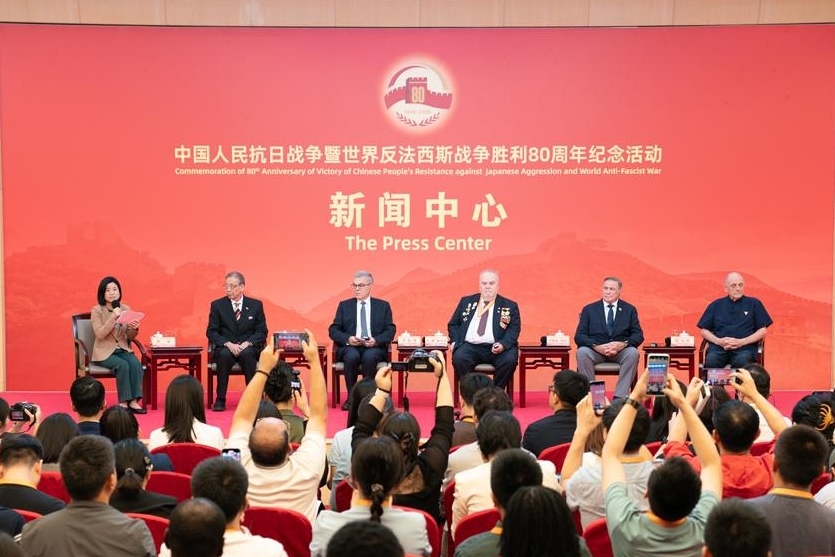

Speakers:
Mr. Kobayashi Yokichi, son of Kobayashi Kiyoshi, a Japanese veteran of the Eighth Route Army
Mr. Jean-Louis Bussière, son of Dr. Jean Jérome Augustin Bussière, a French physician
Mr. Nikolai Vladimirovich Chuikov, the grandson of Marshal V.I. Chuikov of the Soviet Union
Mr. Jeffrey Greene, president of the Sino-American Aviation Heritage Foundation
Mr. Michael Crook, the son of the British friends David Crook and Isabel Crook
Chairperson:
Ms. Zhou Li, head of the Press Center for the Events Commemorating the 80th Anniversary of the Victory in the Chinese People's War of Resistance Against Japanese Aggression and the World Anti-Fascist War
Date:
Sept. 2, 2025
Zhou Li:
Ladies and gentlemen, good morning. Welcome to the third group interview of the Press Center for the Events Commemorating the 80th Anniversary of the Victory in the Chinese People’s War of Resistance Against Japanese Aggression and the World Anti-Fascist War.
Eighty years ago, the Chinese people, together with peoples around the world, fought a grueling and heroic struggle to completely defeat fascism and achieve hard-won peace. We will never forget the invaluable assistance and support provided by peace- and justice-loving countries and peoples around the world during China's War of Resistance Against Japanese Aggression. Today, we pay our highest respects to the international friends who contributed to China's victory in the war, and we are honored to welcome five distinguished international guests to the press center to meet with journalists.
They are: Mr. Kobayashi Yokichi, son of Kobayashi Kiyoshi, a Japanese veteran of the Eighth Route Army; Mr. Jean-Louis Bussière, son of Dr. Jean Jérome Augustin Bussière, a French physician; Mr. Nikolai Vladimirovich Chuikov, grandson of Marshal V.I. Chuikov of the Soviet Union; Mr. Jeffrey Greene, president of the Sino-American Aviation Heritage Foundation; and Mr. Michael Crook, son of British friends David Crook and Isabel Crook.
Next, we will invite the five guests to briefly introduce themselves, after which we will proceed to the Q&A session. This group interview combines both consecutive and simultaneous interpretation, with foreign-language remarks by the guests and questions from journalists interpreted into Chinese. Now, I will give the floor to Mr. Kobayashi for his introduction.
Kobayashi Yokichi:
Hello everyone, my name is Kobayashi Yokichi. Today, I will introduce myself and answer questions in Chinese. I look forward to your kind attention.
My name is Kobayashi Yokichi. I am the eldest son of Kobayashi Kiyoshi, a Japanese veteran of the Eighth Route Army, and I serve as vice president and executive director of the Japanese Association of Comrades-in-arms of China's Eighth Route Army and New Fourth Army. In Japan, the Japanese Association of Comrades-in-arms of China's Eighth Route Army and New Fourth Army is also known as the "Coconut Society." The Coconut Society was founded in 1970 by Mitsushige Maeda, a former member of the Japanese Anti-War Alliance in China, and others. Due to the political environment in Japan at the time, the name of the association could not contain the words "Eighth Route Army" or "New Fourth Army." Therefore, it was ingeniously named the "Coconut Society," as the Japanese pronunciation of "coconut" corresponds to the numbers eight and four. Mitsushige Maeda, recognized as the "first Japanese Eighth Route Army soldier," along with his comrades, used the Coconut Society as a platform to hold gatherings, deliver speeches and write articles to educate the Japanese people, illustrating through their personal experiences the brutality of the Japanese imperialist war of aggression. The mission of our association is to carry forward the legacy of the older generation, inherit their cause, oppose war, uphold and cherish peace, and remain committed to Sino-Japanese friendship. Thank you.
Zhou Li:
Thank you, Mr. Kobayashi. Now, let us invite Mr. Bussière to give his introduction.
Jean-Louis Bussière:
Hello everyone, my name is Jean-Louis Bussière. My father was Dr. Jean Jérome Augustin Bussière. I am a cardiologist by profession and now retired. Like my father, I also studied at a military medical academy, and was assigned to Ivory Coast as a military doctor. After returning to France, I entered the hospital system and specialized in cardiology. Over the years, I worked in military hospitals, private clinics and rehabilitation centers in France. Before my retirement, I served as an international medical consultant at a multinational European medical rehabilitation company. Thank you.
Zhou Li:
Thank you, Mr. Bussière. Now let's give the floor to Mr. Chuikov for his introduction.
Nikolai Vladimirovich Chuikov:
Hello everyone, my name is Nikolai Vladimirovich Chuikov. I am the eldest grandson of Marshal V.I. Chuikov of the former Soviet Union. My association with China comes from my ancestors. As we know, my grandfather came to China three times in total and later served as a military attaché to the Chinese government. This was all between 1940 and 1942.
After the founding of the People's Republic of China, my grandfather became one of the initiators of the Russia-China Friendship Society. I am now a reserve officer, chairman of the veterans committee, a member of the Central Board of the Russia-China Friendship Society, and head of the Public Commission for International Relations of the Russian Union of Veterans. Thank you.
Zhou Li:
Thank you, Mr. Chuikov. Now, let's give the floor to Mr. Greene for his introduction.
Jeffrey Greene:
Good morning, everyone. I am Jeffrey Greene, president of the Sino-American Aviation Heritage Foundation. 30 years ago I co-founded this foundation with Flying Tigers veterans, to better pass on the story of the Flying Tigers to the next generation, so they can understand the important significance of the Flying Tigers spirit. Over the past 30 years, we have sponsored more than 500 Flying Tigers veterans to come to China, leaving their footprints in in 12 provinces and more than 30 cities. Every time the Flying Tigers veterans come to China, it is a great honor for me because I can see how much the Chinese people respect the Flying Tigers veterans. This time coming to China, I also feel greatly honored to share some very important historical stories with all of you here. Thank you.
Zhou Li:
Thank you, Mr. Greene. Finally, let's give the floor to Mr. Michael Crook for his introduction.
Michael Crook:
Good morning, everyone. I am Michael Crook. My father, David Crook, was British, and my mother, Isabel Crook, was Canadian. I was born and raised in China and I will continue my speech in Chinese.
During the World Anti-Fascist War my father went to Spain in 1936 to join the International Brigades. He came to China in 1938, returned to the UK in 1942 to join the Royal Air Force and returned to China after the war. My mother was born in China, went to Canada to study, and returned to China in 1938 to participate in rural development and the industrial cooperative movement, and form farmers' cooperatives. In 1942, they met in China, later fell in love, and my mother went to the UK with my father to join the army. After the war, they returned to China, and I was born in Beijing.
I just mentioned the industrial cooperative movement. The International Committee for the Promotion of Chinese Industrial Cooperatives (ICCIC) was an organization established in Hong Kong in 1939, with Soong Ching-ling as the honorary chairperson. During the Chinese People’s War of Resistance Against Japanese Aggression, the ICCIC did a lot in the supportive roles, forming production cooperatives, running hospitals, schools, etc. The ICCIC resumed activities after the reform and opening up. Our main work now is rural assistance and international people-to-people exchanges. Thank you.
Zhou Li:
Thank you, Mr. Crook. Thank you for your introductions. Now the floor is open for questions. Please identify the media outlet you represent before asking your questions. Now you may raise your questions.

